Tariq Ali on Pakistan’s most influential left-wing press, the intellectuals behind it, the new country they envisioned, and its 1959 seizure by the military regime.
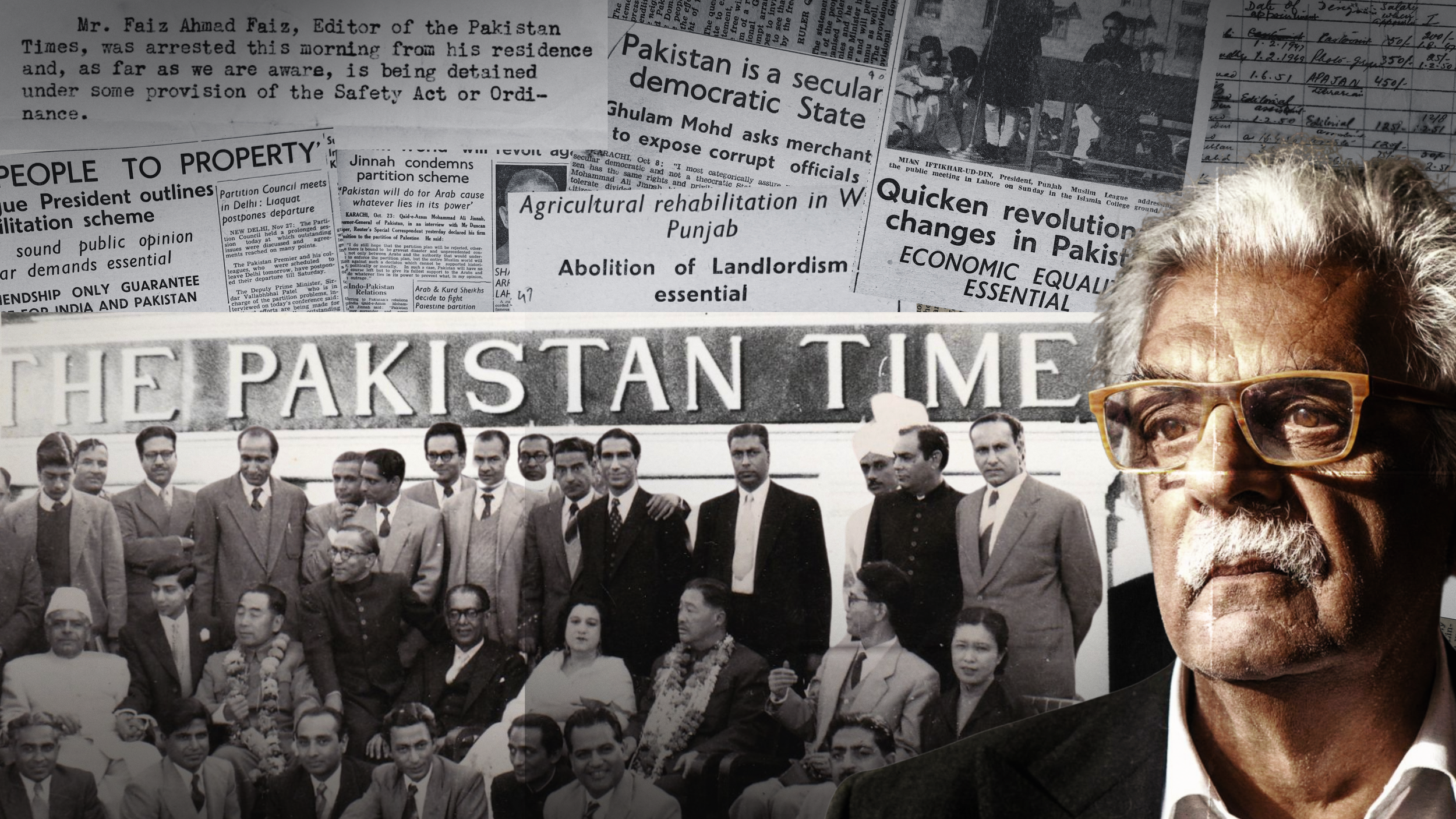
Illustration: Jamhoor
The Progressive Papers Ltd. (PPL) was founded in 1946 by Mian Iftikharuddin, a left-wing politician associated with the Muslim League and erstwhile member of the Indian National Congress, under the patronage of Muhammad Ali Jinnah. Responsible for publishing the daily Pakistan Times and Imroz alongside the weekly Lail-o-Nihaar, the PPL became a home for socialist intellectuals and independent journalists in Pakistan’s early years. Its papers were notable for offering critical coverage of oft-underreported issues concerning labor, land reforms, and preventative detention policies while also situating Pakistan’s domestic preoccupations within the larger context of Cold War conflicts. The papers remained staunch in their opposition to Pakistan’s alignment with the US, maintaining a consistently anti-imperialist line in open defiance of state policy.
The PPL’s journalistic ranks, however, were not ideologically homogeneous. Its largely male cast of journalists included many who were not avowedly on the Left, and who had been employed as much for their prowess as prolific writers and thinkers as for any political commitment. Faiz Ahmad Faiz, Mazhar Ali Khan, Chiragh Hasan Hasrat, Ahmad Nadeem Qasmi, I. A. Rahman, F. E. Chaudhary, Anwar Ali, and Alys Faiz were among the individuals associated with the project who went on to cement their names in Pakistan's journalistic and literary worlds.
The Pakistan Times was first printed out of the Civil & Military Gazette’s building on Lahore’s Mall Road in January 1947, before the PPL settled into its main office on Rattan Chand Road. Imroz, launched in March 1948, began at the Attar Chand Kapoor Press on Abbot Road, next to Nishat Cinema. That was reputedly the second-largest press in undivided India, and Imroz joined its sister paper on Rattan Chand Road in 1950. It was the first Urdu daily printed on a rotary press, and it soon ran editions from Multan and Karachi, with the Multan edition reaching readers as far south as Sukkur. By the Pakistan Times’ tenth anniversary in March 1957, its print order stood at 50,000, the highest in the country. As the papers grew in influence and popularity, the PPL offered a challenge to more centrist and regime-aligned sections of the press. In 1959, however, the Ayub Raj nationalized the organization. Mazhar Ali Khan, who had succeeded Faiz Ahmad Faiz as chief editor of the Pakistan Times, resigned in protest. The papers subsequently became part of the regime’s National Press Trust. What had been a central node for critical journalism and left-wing intellectual production had been reduced to an instrument of military rule.
We sat down with veteran intellectual, author, and organizer Tariq Ali, whose father Mazhar Ali Khan was central to the PPL’s editorial history. Having grown up around the papers during their heyday, Ali offers us a personal account of the people, political commitments, and the intellectual currents that animated the PPL’s offices. In this conversation, he traces the ideological origins of the project, the political influence of its journalism, and the relationships between its editors, writers, and the political movements that characterized Pakistan’s formative years.
Sixty-six years after the takeover, Pakistan’s press again operates under a hybrid order in which the line between civilian government and military command has all but dissolved. The 2025 amendments to the Prevention of Electronic Crimes Act have also criminalized the dissemination on social media and elsewhere of “anti-state” sentiment, an ever-expanding and nebulously defined category, making it punishable by imprisonment. As in 1959, the state’s intensified crackdown on dissent at home has gone hand in hand with a courtship of Washington abroad. The PPL may be history, but the dynamics of media dissent and its suppression certainly are not.
Asmer Asrar Safi (AAS): The Progressive Papers Ltd. (PPL) was founded in 1946, at a moment when the political and intellectual contours of Pakistan were still being contested. Its emergence brought together a range of Muslim League politicians and progressive intellectuals from the Left, making it a particularly interesting site through which to examine the relationship between socialism, anti-imperialism, and the Pakistan Movement.
Could you take us back to the political and intellectual currents that gave rise to this project?
Tariq Ali (TA): Well, obviously, these papers wouldn’t have existed without Pakistan. I think a starting point should be the debate on Pakistan within the Left.
There was a debate inside the Communist Party of India (CPI), and they eventually published a little pamphlet called Pakistan and National Unity, explaining their position. This largely followed Jinnah’s definition of Pakistan, but it went even further in some ways, arguing that Muslims constituted a nationality, if I remember correctly.
Once the CPI had come out in favour of Pakistan, it became impossible for the Muslim League to ignore them. Jinnah was personally very pleased that this had happened because he knew that many people around him were duds: former Unionists and plodders from the Unionist Party. He wanted some real people. There were intellectuals, Muslim intellectuals from the United Provinces—Uttar Pradesh, Lucknow, and elsewhere—who joined the Muslim League, as did people from other parts of India. But the League was looking for intellectuals who could rise above even what it demanded, and it found them in the Communist Party.
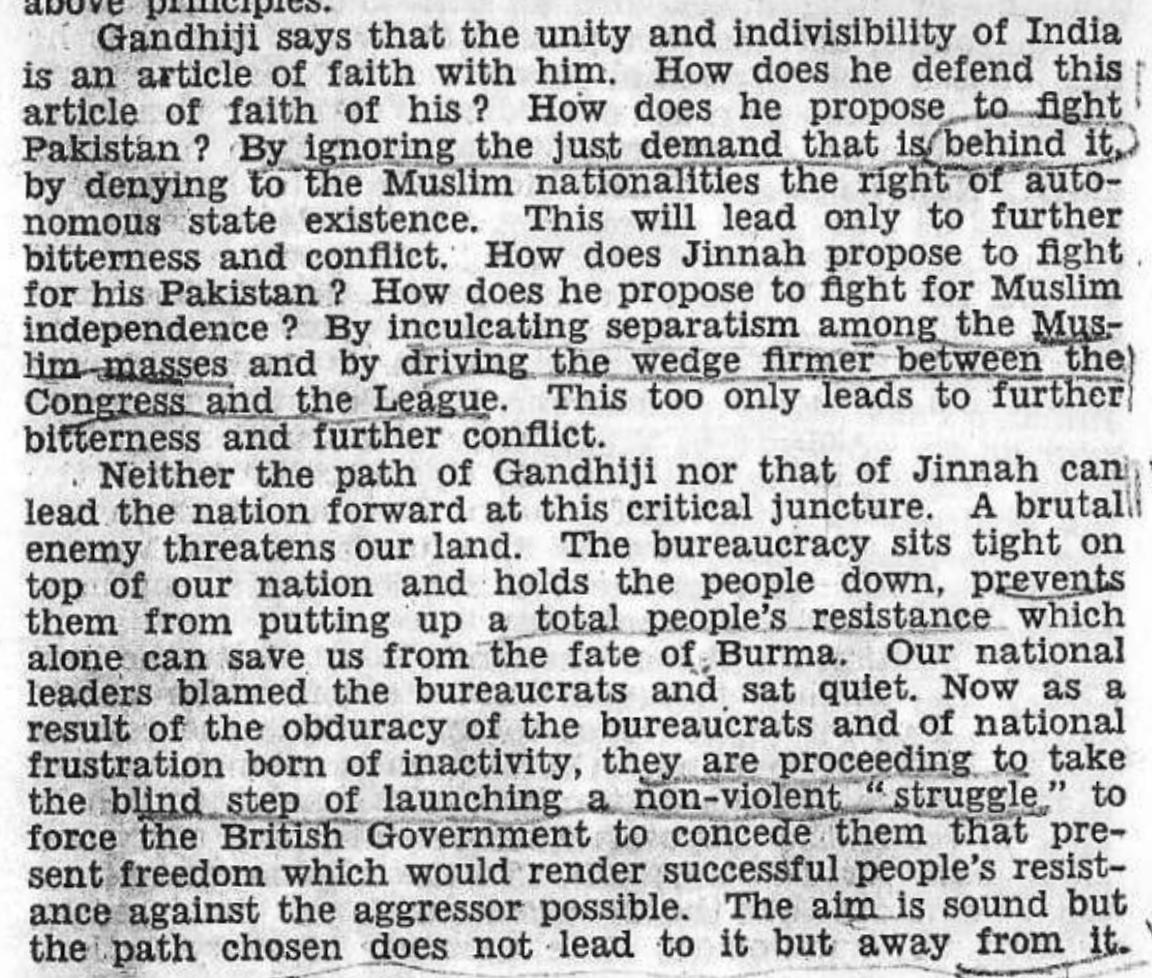
From “Pakistan and National Unity” (1942) by Gangadhar Adhikari. Source: Marxists.org.
Their starting point was the Progressive Writers’ Association, which provided the necessary bridge between the Communist Party and the non-communist, but progressive world. It was a front organization, certainly, but it was a bit more than that. Some people who disliked its close affiliation with the CPI didn’t join it, although they should have. Saadat Hasan Manto, our greatest short-story writer, didn’t join the Progressive Writers’ Association for quite principled reasons.
The other thing worth remembering is that the Muslim League and the Communist Party were the two principal organizations that decided to back the British during the Second World War. The British were therefore well disposed towards them. The League and the CPI were both able to operate relatively openly during the war, while Congress and other nationalists were being imprisoned. This helped the CPI grow and gave its intellectuals access to political circles they had previously been excluded from.
“There was a debate inside the Communist Party of India (CPI), and they eventually published a little pamphlet called Pakistan and National Unity, explaining their position.”
This was the atmosphere in which it became clear that Pakistan was going to be formed, come hell or high water. At the last stage, Jinnah was desperate to have something. Afterwards, he complained that Pakistan had been given a “truncated and moth-eaten” territory. In my opinion, the whole process was badly mishandled by the British and the Muslim League, not to mention Congress, which was extremely ungenerous and refused to make serious concessions.
In this atmosphere, the Communist Party leadership in India decided that all its Muslim communists in the areas that were to become Pakistan should, for this particular period, work inside or very close to the Muslim League. My father refused. He said, “No, we’ve been fighting these people all our lives. There’s no way we’re going in there!” But they had to. The party’s decision was that they had to collaborate.
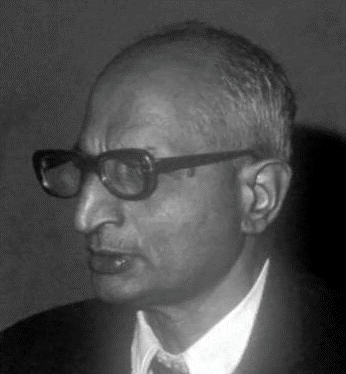
Danial Alma Latifi (1917-2000). Image: St. John’s College, University of Oxford.
That is how Danial Latifi came to be asked to write the Muslim League’s manifesto for the 1946 elections, the most radical manifesto the party ever produced. Latifi was a very witty communist lawyer. The manifesto was approved by Jinnah, who said, “I like this.” And so it became the Muslim League manifesto. Of course, most of the Leaguers in what became Pakistan were landlords. This created a contradiction because the manifesto called, I think, for massive land reforms. From the beginning, there was a major contradiction within the Muslim League. For the landlord Leaguers, the question was how far they could make concessions. They were willing to make a few, but not too many, and ultimately they didn’t make many.
Nevertheless, the communists were not regarded as traitors in what became Pakistan. They were accepted, and this paved the way for the founding of Progressive Papers Limited, which concretized the alliance, however temporary—and it was temporary—between Muslim League leaders and the Left.
The Left was represented by Mian Iftikharuddin, a very talented and gifted politician who had become radicalized while studying at Balliol College, Oxford. He had certainly read the Communist Manifesto, as well as bits and pieces of Marx more generally. The Soviet Union was also winning the war, and its prestige was extremely high at the time. All of this helped shape Mian Iftikharuddin’s politics. He was never formally a member of the CPI, but he was, in some ways, one of its better-known fellow travelers.
“That is how Danial Latifi came to be asked to write the Muslim League’s manifesto for the 1946 elections, the most radical manifesto the party ever produced. Latifi was a very witty communist lawyer. ”
The first informal meeting included Mian [Iftikharuddin] Sahib and Faiz Ahmad Faiz. I have a feeling that Sibte Hasan and Sajjad Zaheer, from the Progressive Writers’ Association, were also consulted, although Sajjad Zaheer had not yet moved to Pakistan. This was the first meeting at which they decided, or at least discussed, setting up a newspaper chain. It was Mian Sahib’s idea. A new country would need newspapers. The only newspaper of any significance apart from the pre-independence papers was Dawn, which, if my memory serves me correctly, had been a Muslim League weekly in Delhi. It was brought to Karachi, and the Haroon family helped turn it into a daily newspaper. But there was very little else. Its circulation was largely concentrated in Karachi. Although it circulated more widely later, it wasn’t a popular paper in the broader sense. It was too closely identified with one political formation: the Muslim League.
The idea of creating Progressive Papers Limited was therefore a brilliant one.
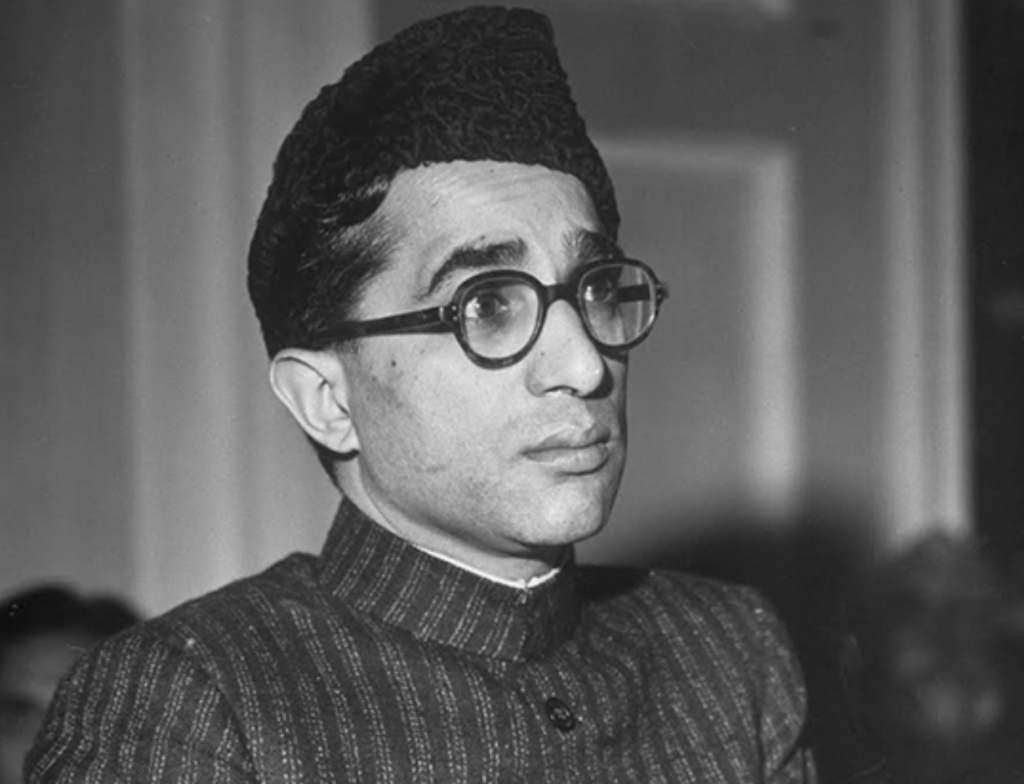
Mian Iftikharuddin. Image: Revolutionary Papers.
My father, Mazhar Ali Khan, and Mian Iftikharuddin were very close friends. They had worked together as left-wing members of Congress at one stage. Mian Sahib was keen to involve my father in the papers from the beginning. At the time, my father had decided that his main task in life was to establish peasant organizations near our family estates, educate the peasants, and build militant peasant organizations. He had gone to Wah, in Rawalpindi district, and begun his work, much to the annoyance of other members of the family. The CPI Central Committee discussed the matter because my father said he would follow the party’s instructions. Although he could have entered Parliament through his family, the party advised him against taking a seat on that basis.
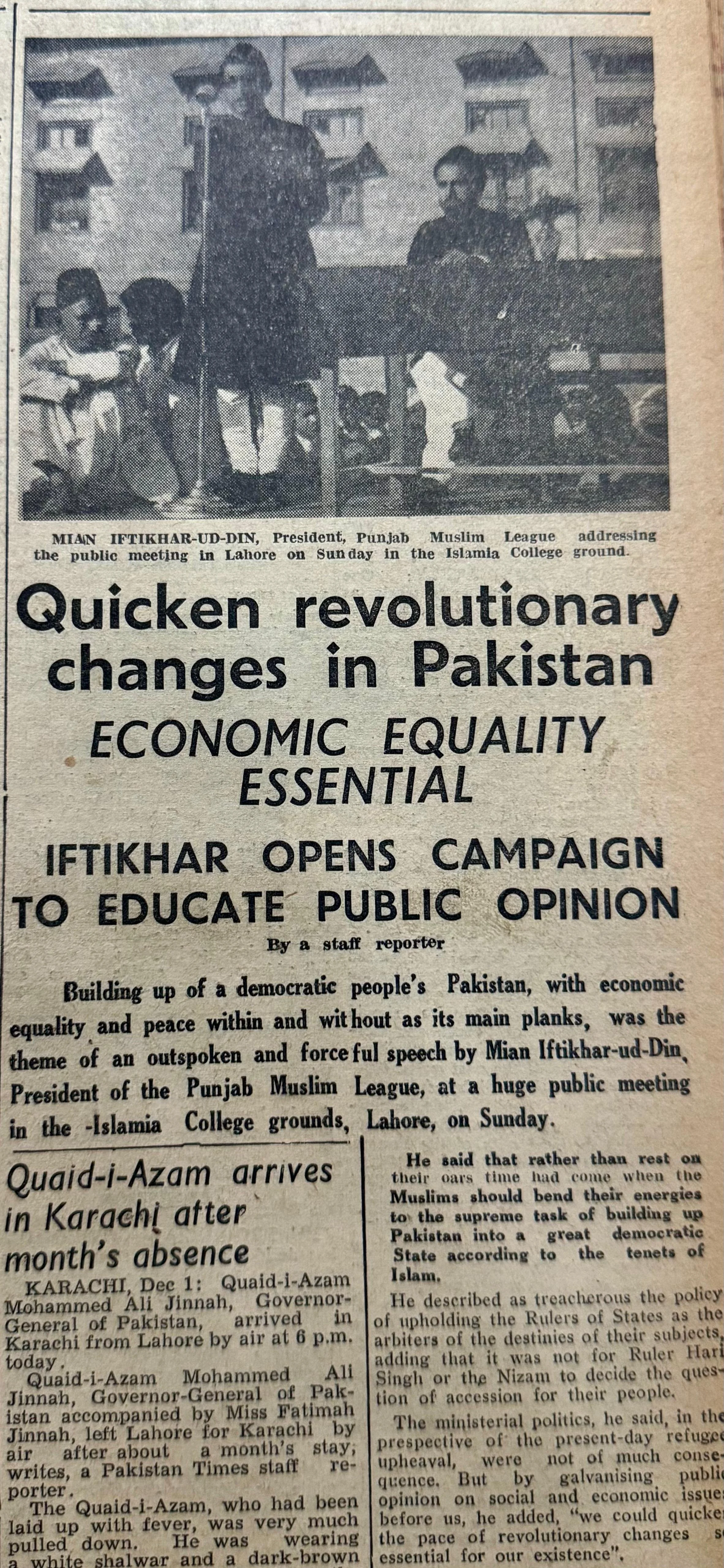
Pakistan Times report on a speech delivered by Mian Iftikharuddin at Islamia College, Lahore, in December 1947. Source: Government College University Library, Lahore.
At this point, Mian Iftikharuddin sent him a telegram saying that he was coming to Wah and that my father should put everything aside for a week because they needed to talk. He came and stayed with us, speaking with my father every day. My father said, “Look, Mian Sahib, political organization is essential. It has been very weak in this part of the country. Now, with Hindu and Sikh communists leaving in droves, the party is going to be very weak in any case. I think I should concentrate on this.” Mian Sahib replied, “Look, this is really your forte: writing and investigating. Do it for the newspaper.” He eventually persuaded my father to become deputy editor under Faiz.
My father subsequently became a central part of the whole operation. In fact, it was he who came up with the name “Progressive Papers Limited.” He felt that they had to signal, even if not through the pages themselves, who they were.
The point I’m making is that this group of progressives had already decided to establish the papers before they went to see Jinnah. There’s a notion that the idea came from Jinnah, but that’s nonsense. They went to see Jinnah, who thought it was a good idea. He was quite open-minded in that respect. But he said that they should also work with some of his people. So the leading landlords were brought in as shareholders, like Mumtaz Daultana and Shaukat Hayat—my maternal uncle. But Mian Sahib insisted that, since he had set the whole thing up, he should have a controlling stake. I think he held 50 per cent. With those shares, there was no doubt about who would control and dominate the paper.
One of the Muslim League leaders, possibly Jinnah himself although I’m not sure, also told the people setting up the papers that they were very clever but had never run a newspaper before. To help them, they had arranged for Brigadier Desmond Young, a British officer, to work with Progressive Papers Limited for a time. This is something that isn’t usually mentioned or publicized very much, but it should be. My father, Mian Iftikharuddin, and Faiz said, in effect, “So what? Let him sit in the office. If he gives us useful technical advice, we’ll accept it. Otherwise, we’ll keep him happy, make sure he gets his drinks on time, and so on.” Young eventually gave up, saying that the editors were set in their ways and producing a good newspaper, so there wasn’t much he could do.
That is how the whole thing came into being.
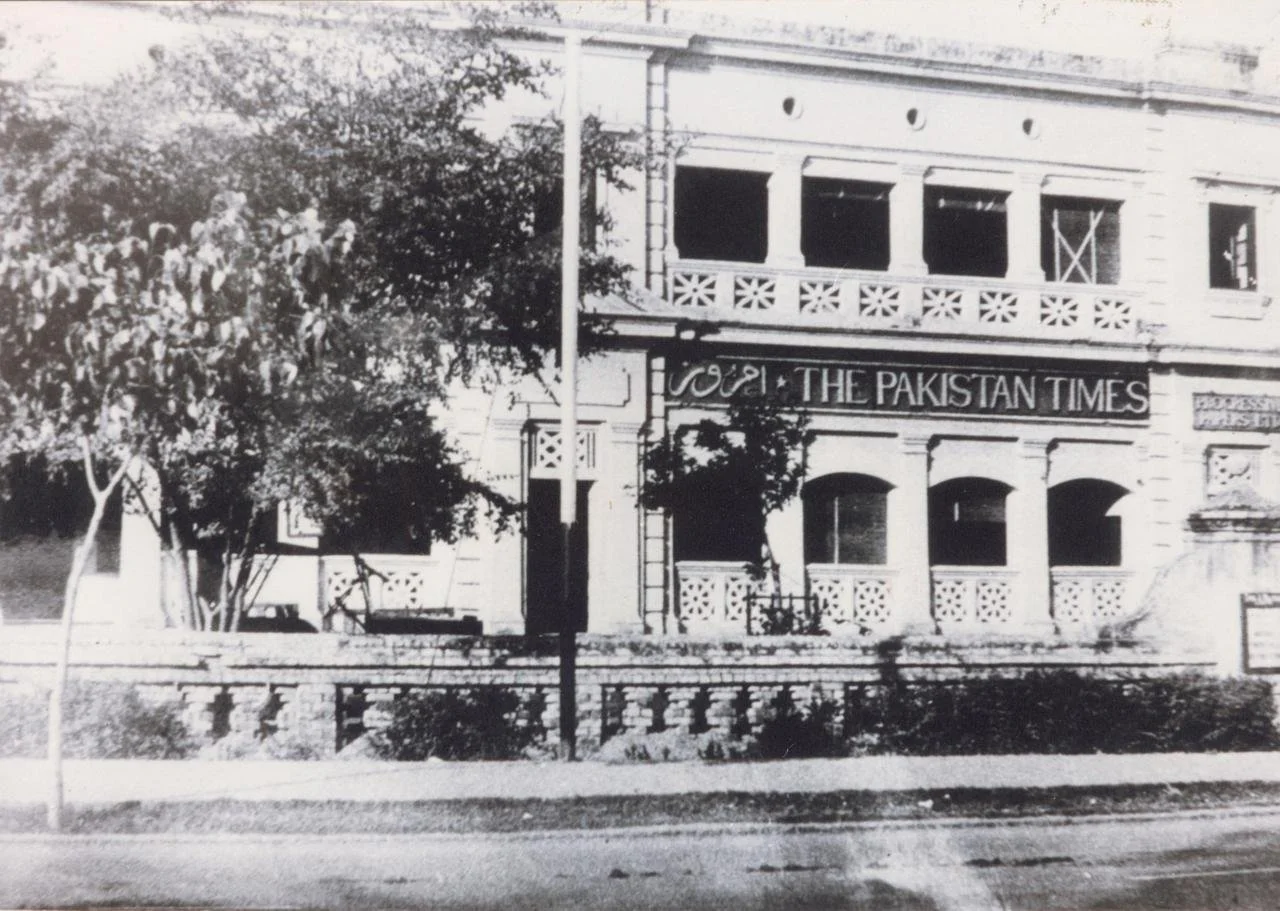
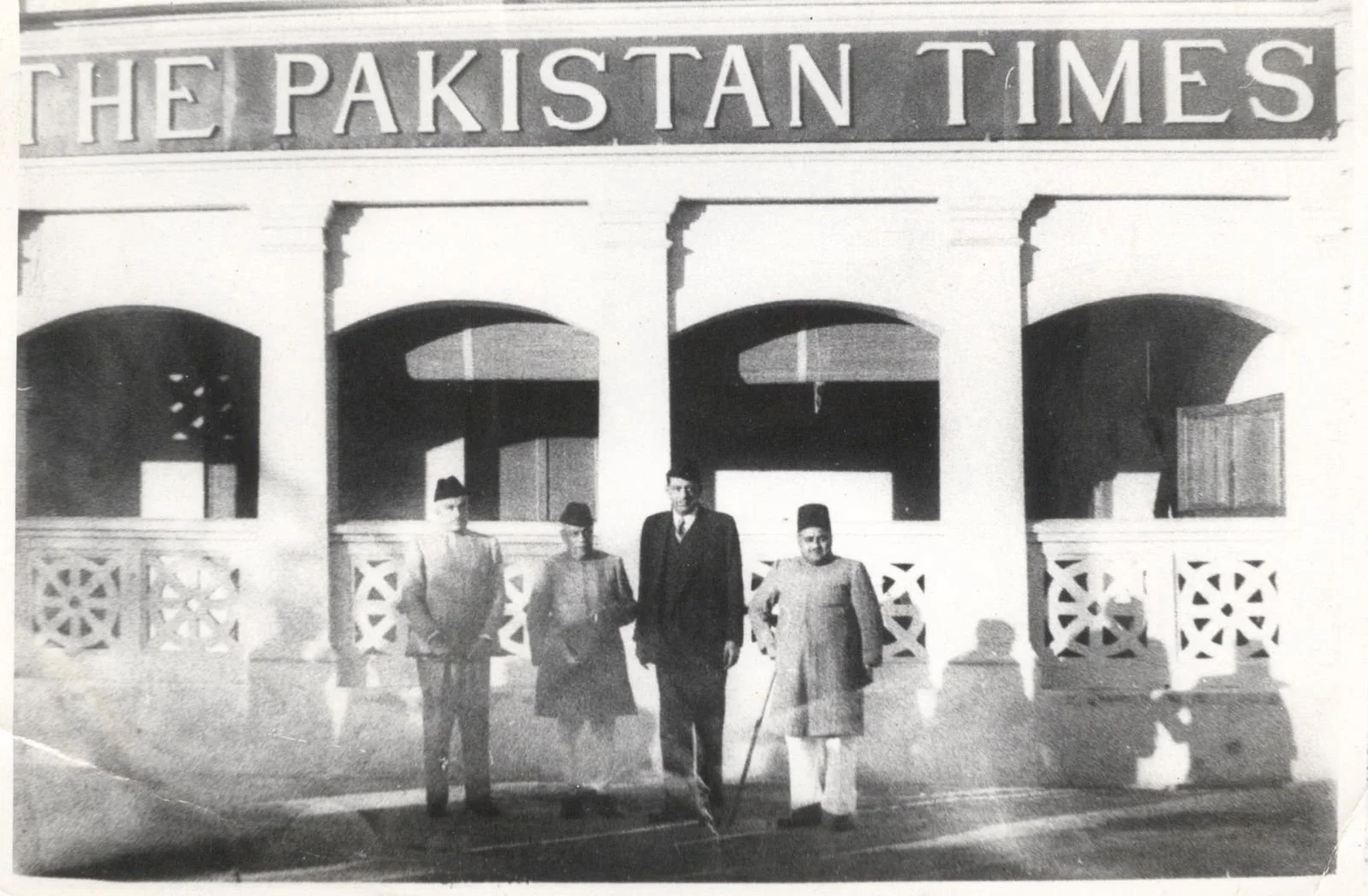
Offices of the Pakistan Times and Imroz at Rattan Chand Road, Lahore. Images: Mazhar Ali Khan family archive.
Mishael Hyat Ayub (MHA): You’ve spoken about the need for a newspaper in Pakistan’s early years. In your book, Pakistan: Military Rule or People’s Power, you draw extensively on the Pakistan Times to reconstruct the political conflicts unfolding during this period. What does reading the Pakistan Times allow us to see that we might not be able to recover from other sources? More broadly, whose voices was the paper trying to represent? What kind of Pakistan did it imagine the new state could become, particularly amid the conflicts shaping it, from Kashmir and refugee rehabilitation to the instability of early governments?
TA: I think that if you study the Pakistan Times closely, some things become very obvious. Politically, the newspaper wasn’t explicitly socialist, but it was definitely in favour of massive reforms to the country’s structures, especially in the countryside. It reported peasant evictions in a way that no other newspaper did. Its sister paper, Imroz, which was established a year later, in 1948, covered these issues particularly well too. For many readers, it was the first time they had gained an idea of how peasants lived and what their lives involved. The papers also reported working-class struggles and actions in factories.
They also covered political debates taking place both within and outside the Muslim League. Overall, I would describe their perspective as one of social-democratic rationalism. They weren’t religious papers, but they were strongly committed to ensuring that democracy and the democratic institutions established after 1947 functioned properly. They reported on parliamentary debates, for instance. Other newspapers did this too, but the Pakistan Times gave these debates meaning by explaining the context in which they took place.
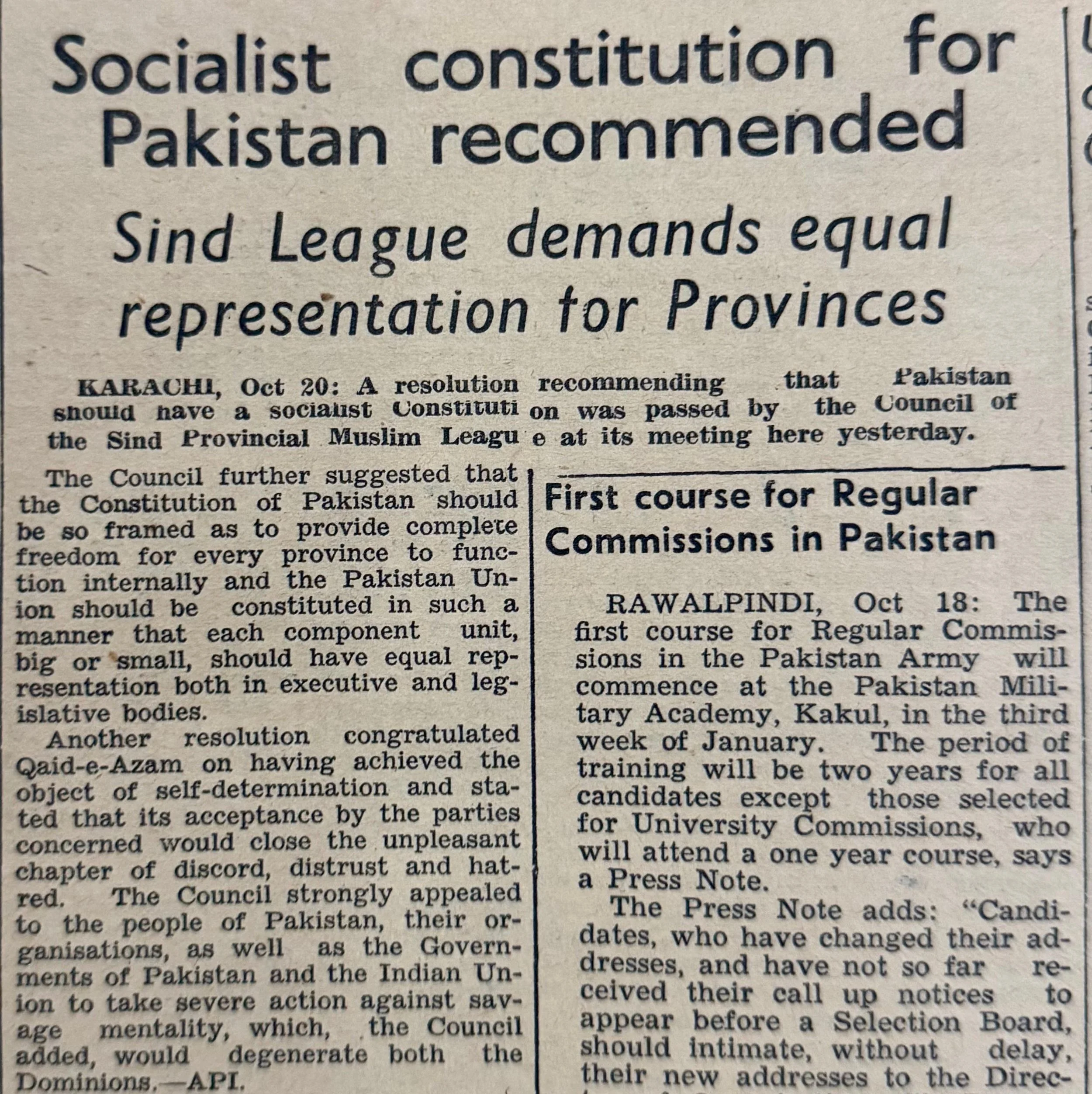
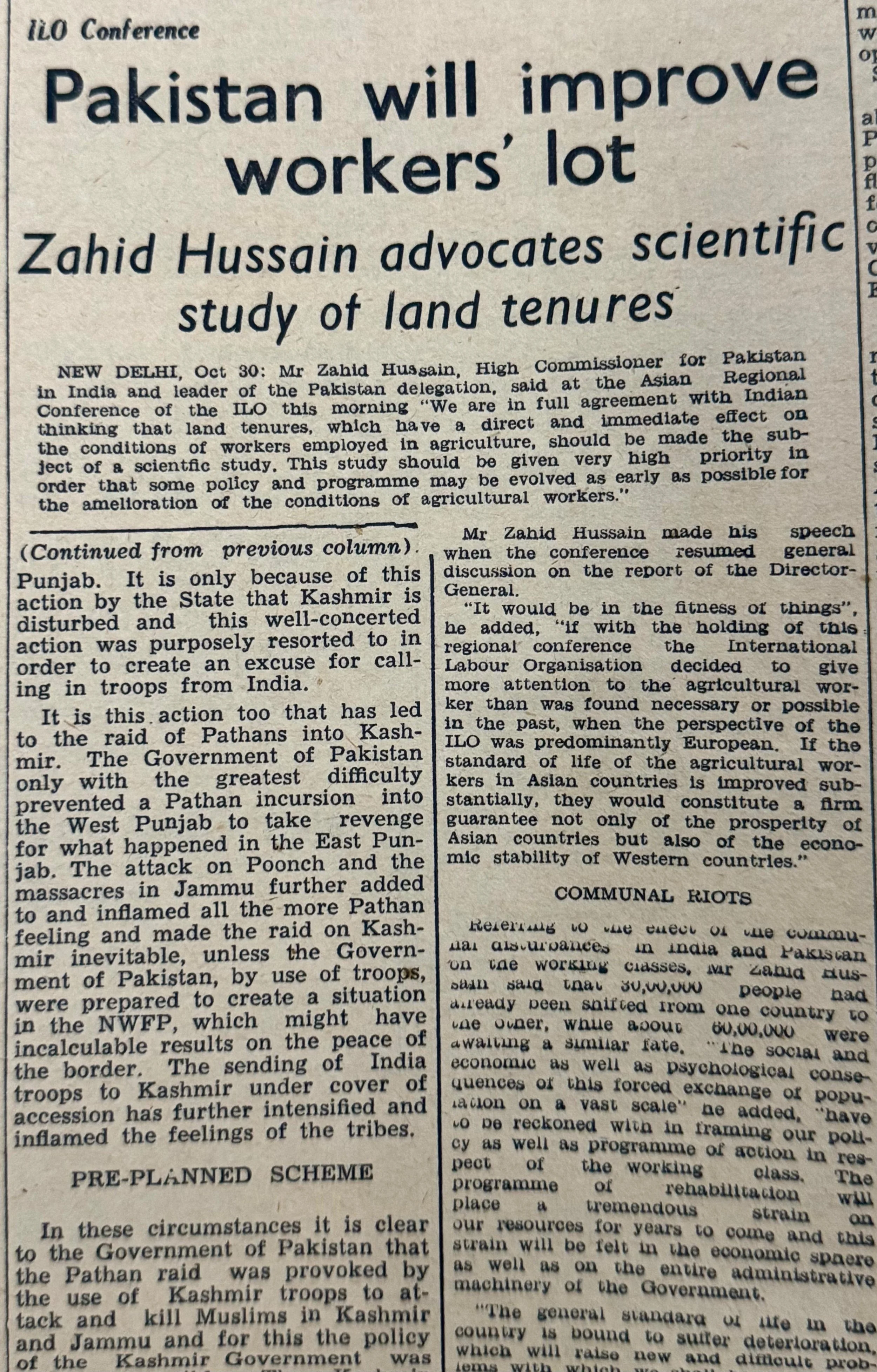
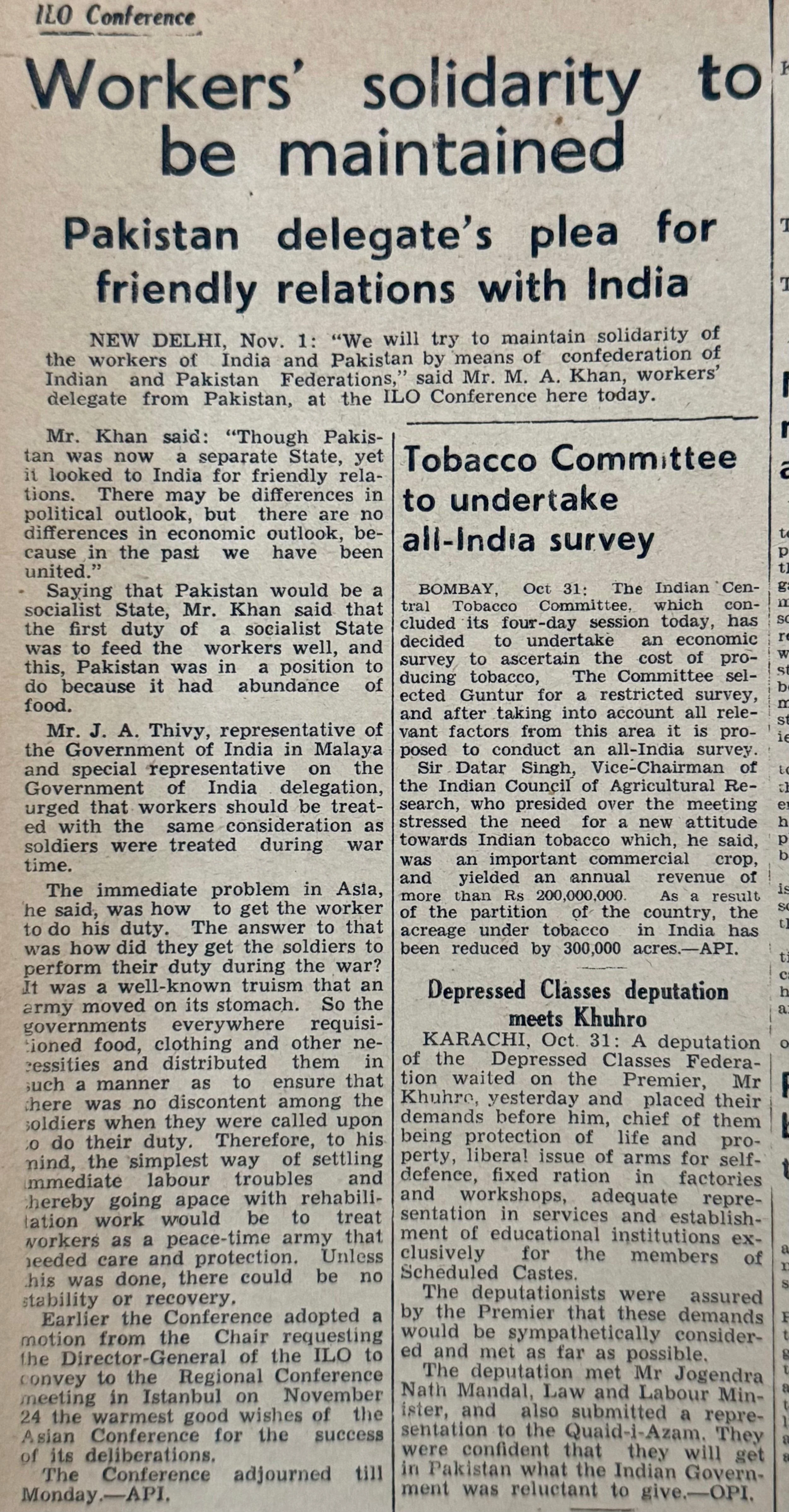
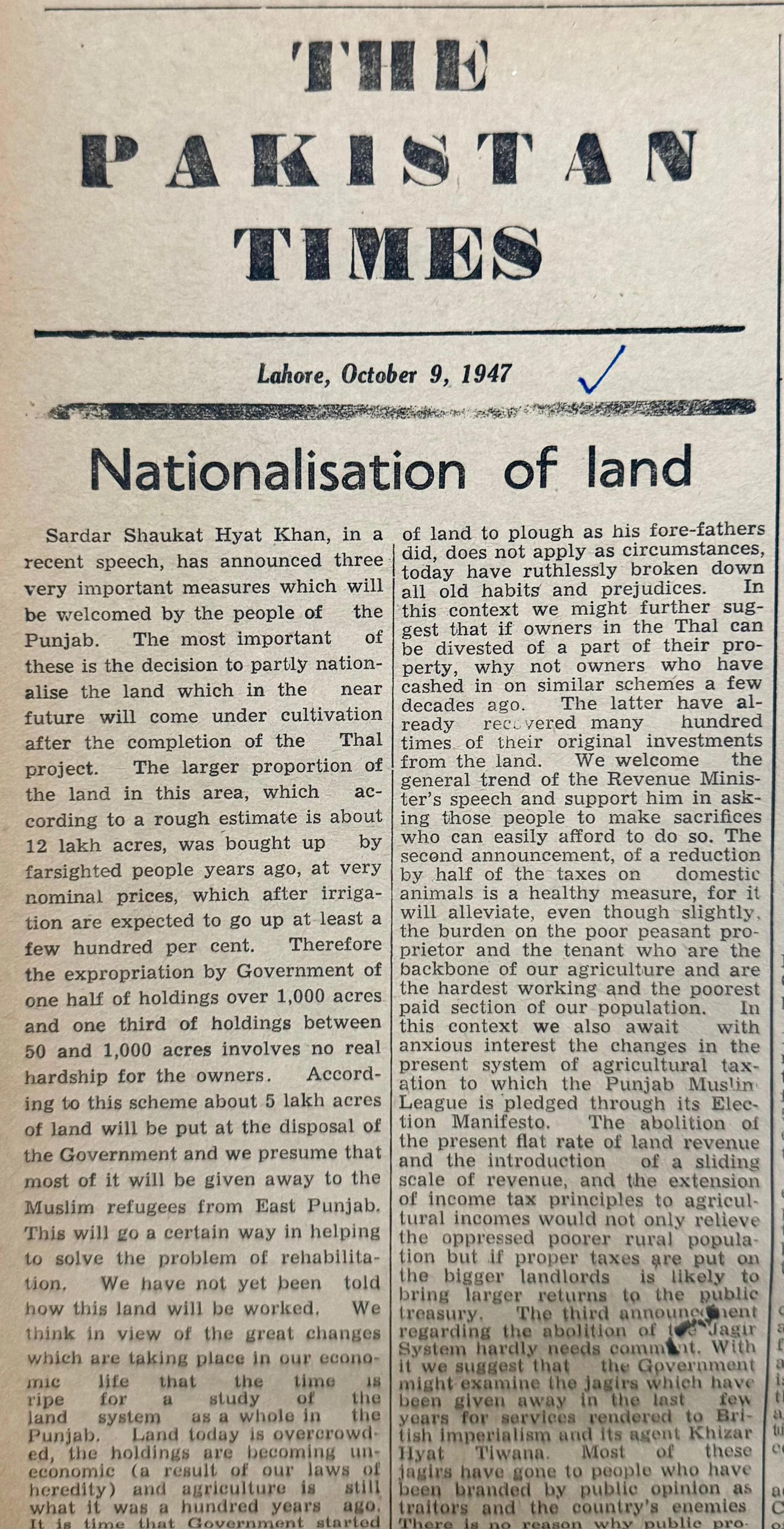
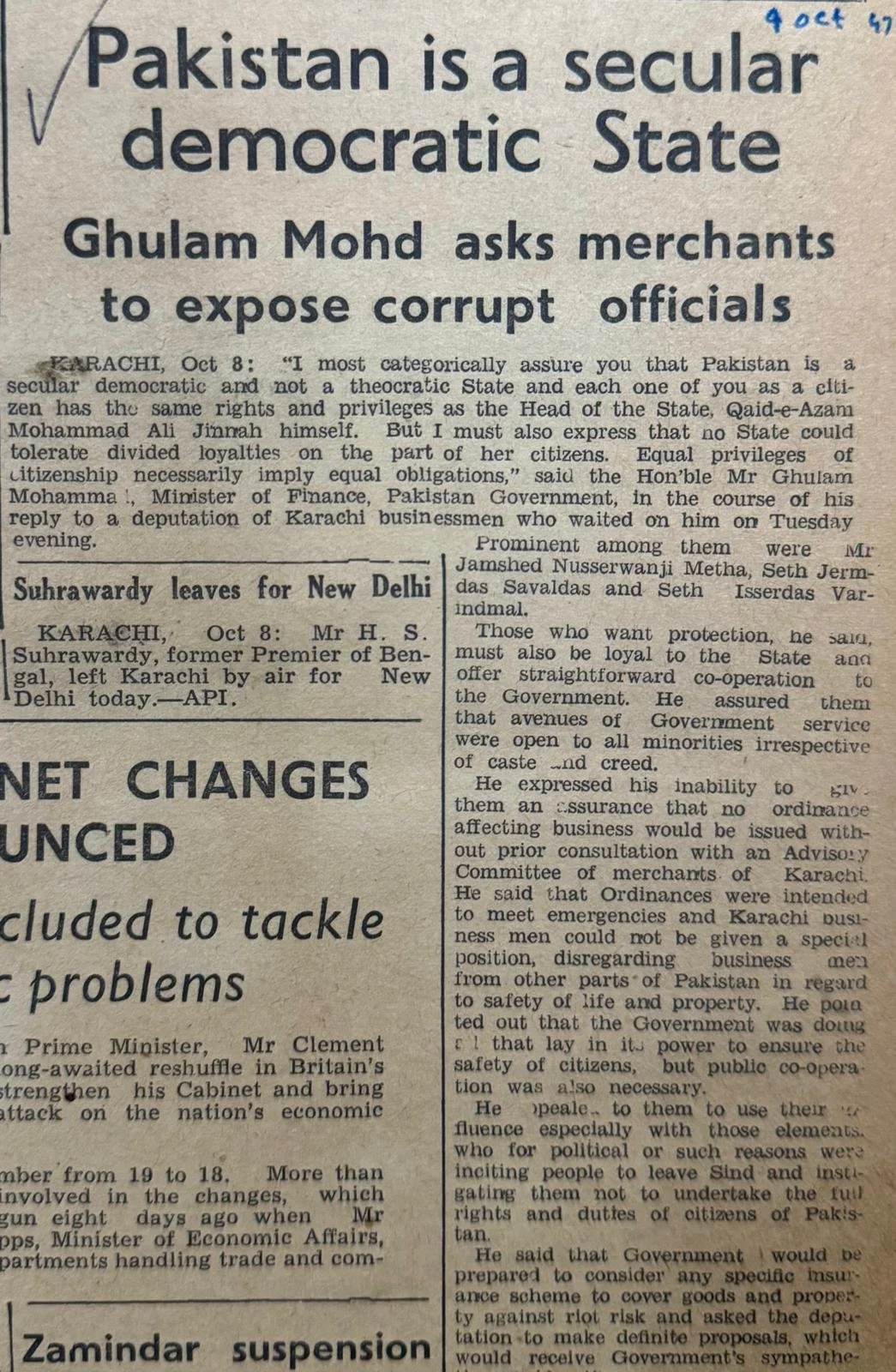
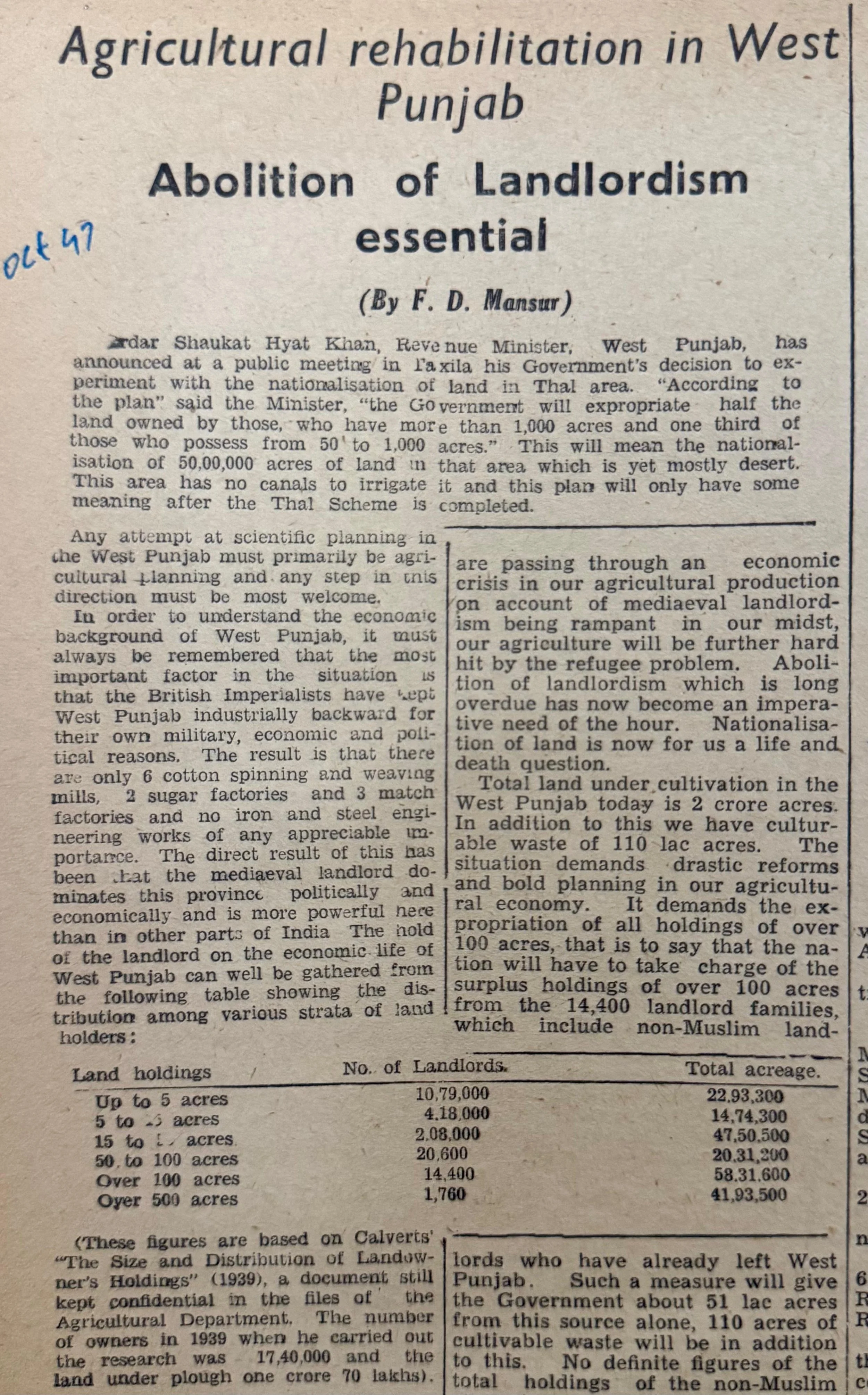
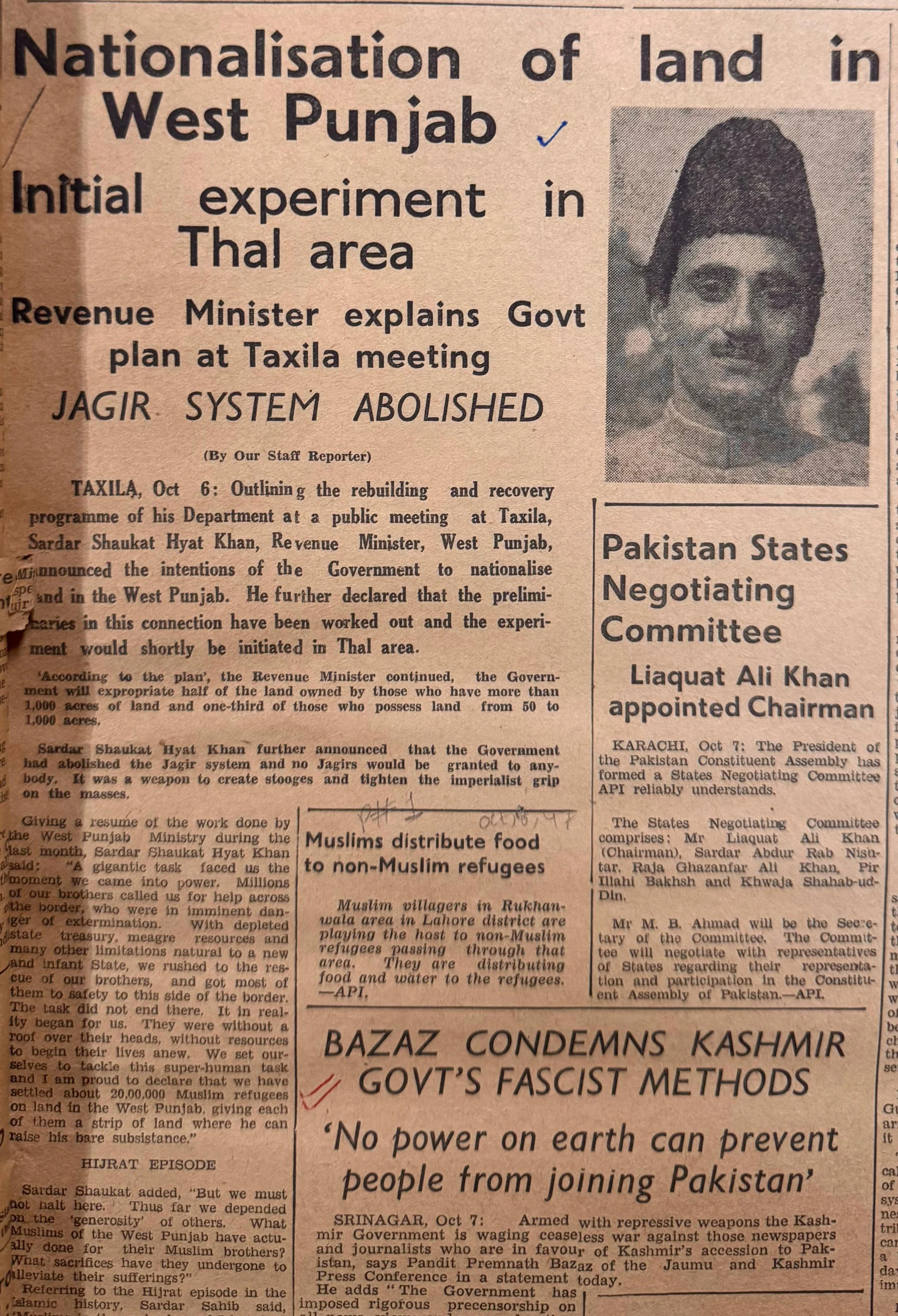
Clippings from the Pakistan Times (1946-1948). Source: Government College University Library, Lahore.
From the beginning, the papers strongly opposed fake news, which some other newspapers published to encourage their own side. That was their importance, and it’s why I used them extensively in my book. I was surprised by how useful the paper’s archives proved to be. While I was writing the book, the late Nizamuddin, the librarian at the Pakistan Times who had established its library, sent me every clipping I requested. I would tell him which subject I was working on, and the clippings would arrive in parcels in London, where I was writing. It was incredibly useful. Nobody else was [reporting and analyzing events] on the same scale and detail.
“I would describe their perspective as one of social-democratic rationalism. They weren’t religious papers, but they were strongly committed to ensuring that democracy and the democratic institutions established after 1947 functioned properly. ”
On Kashmir, the paper’s position was clear from the beginning. Faiz was a close personal friend of Sheikh Abdullah, the Kashmiri Muslim leader, and obtained information that wasn’t being supplied to other newspapers. Nehru had pledged a referendum and the right of Kashmiris to national self-determination, but he kept delaying it. The Pakistan Times’ editorials argued more or less that the way Indians had taken Kashmir was blatantly unfair and that the people should be allowed to choose their future.
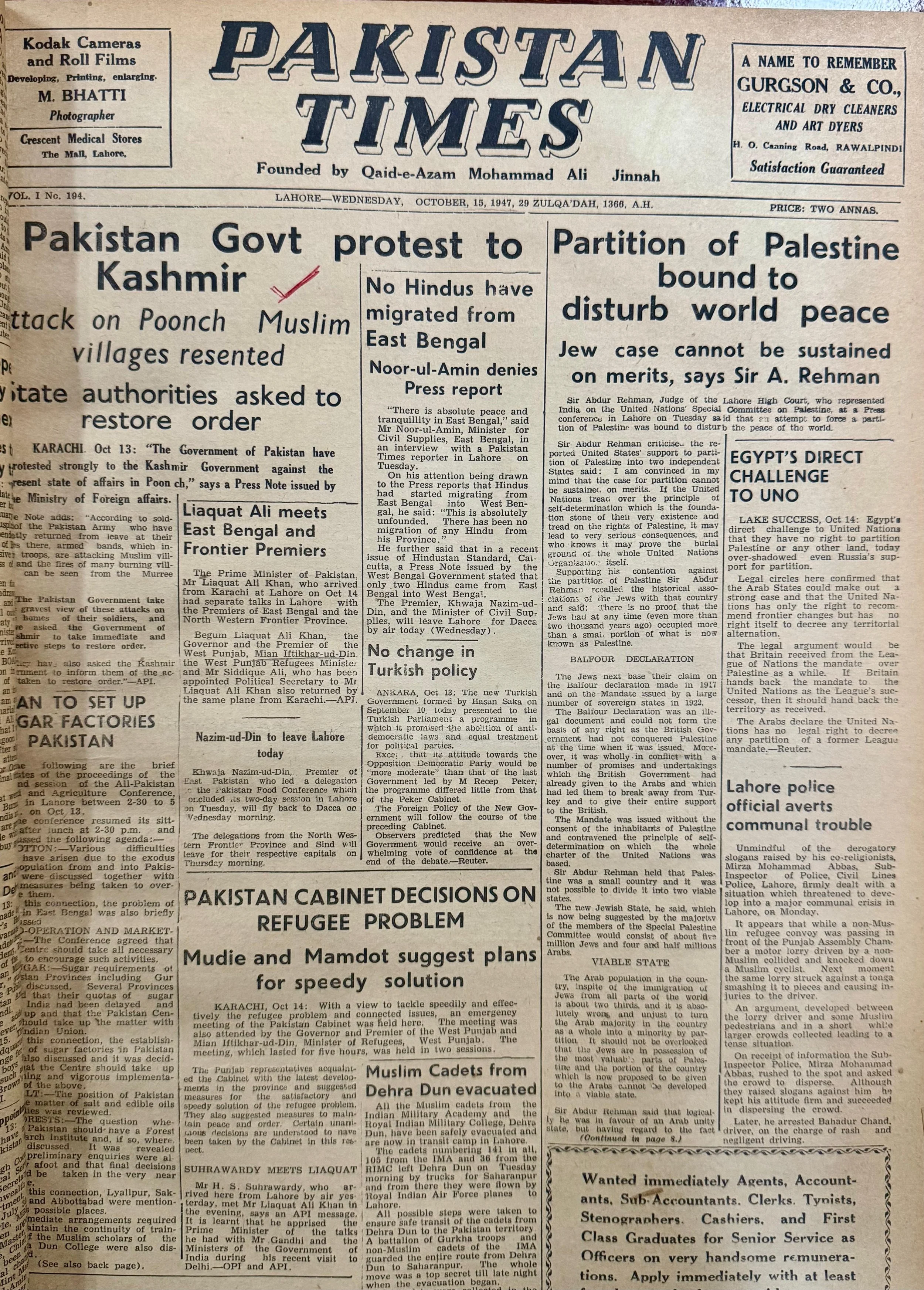
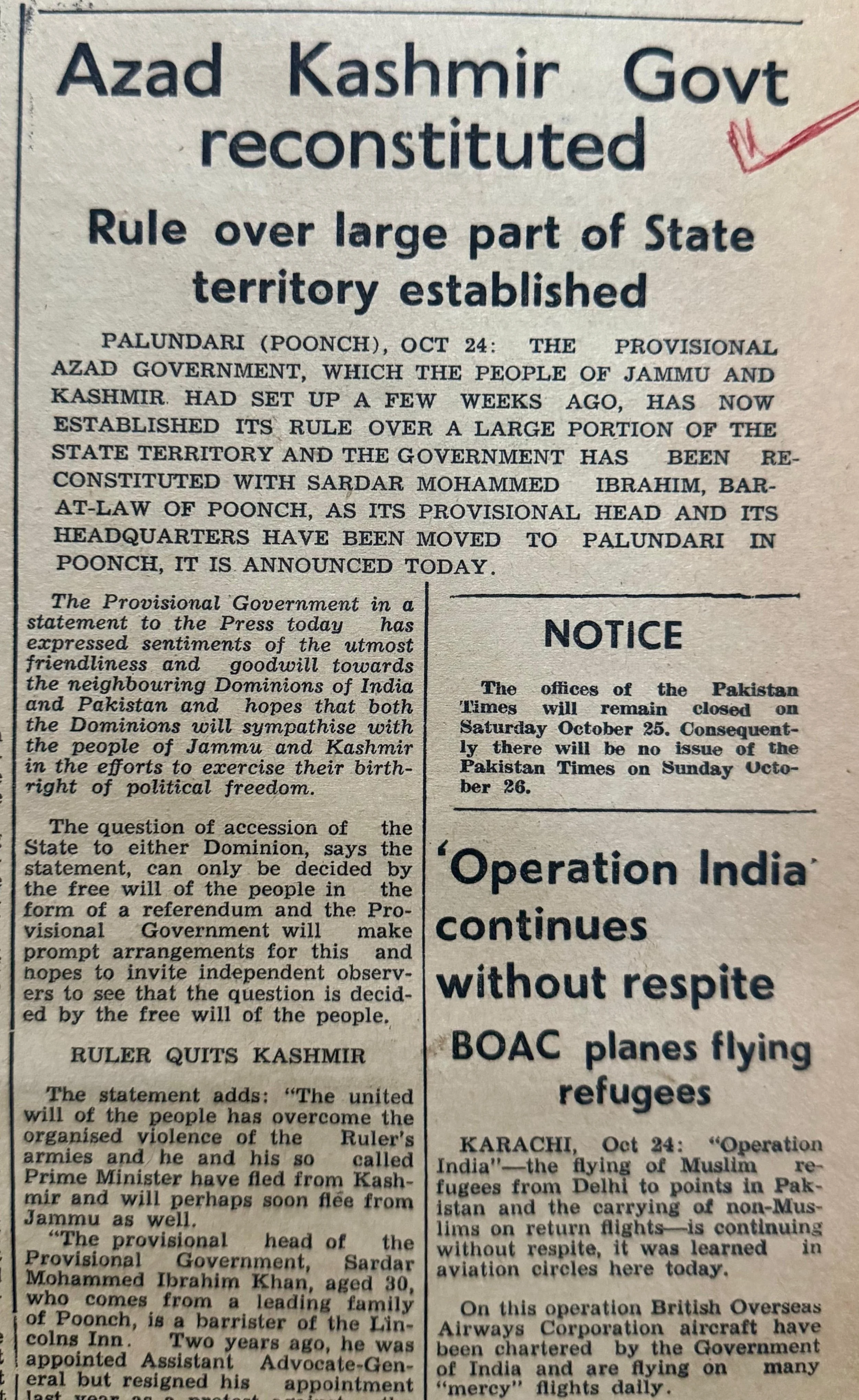
Clippings from the Pakistan Times (1947). Source: Government College University Library, Lahore.
Pakistan’s early foreign policy was another area where the Papers were at loggerheads with every [Pakistani] government. The Pakistan Times was opposed to Pakistan joining the security pacts. They were opposed to Pakistan's membership of the Baghdad Pact, which was set up by the United States during the Cold War as part of their war strategy.
Initially, there was little debate about foreign policy in the government. The Muslim League leaders largely accepted British advice. In one of my books, I provide evidence of a Muslim League leader travelling around and meeting Americans and British officials to ask which direction Pakistan should take. There was very little independent-mindedness within the Muslim League. An overwhelming majority of its leaders had become so accustomed to working with the British that, to be frank, they didn’t know how to think independently.
The thought that Pakistan could have pursued an independent foreign policy or adopted non-alignment, as India was moving to do, was rejected by some for rather foolish reasons. They didn’t want to copy India. It was childish things like that. By and large, Pakistan’s leaders decided to join the post-war pro-American bloc of countries.
On the other hand, the papers were hostile to the security pacts because they correctly understood them as a crude attempt to gobble up Pakistan and control its foreign policy, which was certainly the case. One big incident on this front is when the British, French, and Israelis invaded Egypt in 1956 in an attempt to topple Nasser because he nationalized the Suez Canal. Pakistan’s government of the day, led by the Bengali politician Huseyn Shaheed Suhrawardy, supported Britain and Israel. It didn’t support Nasser.
“In some ways, this was the Progressive Papers’ finest hour. Through their newspapers, they helped mobilize opposition to the government’s policy, and people took to the streets in defiance of it.”
In some ways, this was the Progressive Papers’ finest hour. Through their newspapers, they helped mobilize opposition to the government’s policy, and people took to the streets in defiance of it. I remember the demonstration very vividly because I was there, at a very young age. There were hundreds of thousands of people on the streets of Lahore. All the universities closed down, and students came out on strike. The pressure forced the government to move back a bit from the position it had taken. The Progressive Papers’ role was incredibly popular, although other newspapers attacked it for supporting Nasser.
This was a high point: the papers were at loggerheads with the government over foreign policy, and their position intensified American anger. The US wanted Pakistan to remain in its camp, not to have a newspaper permanently criticizing its influence.
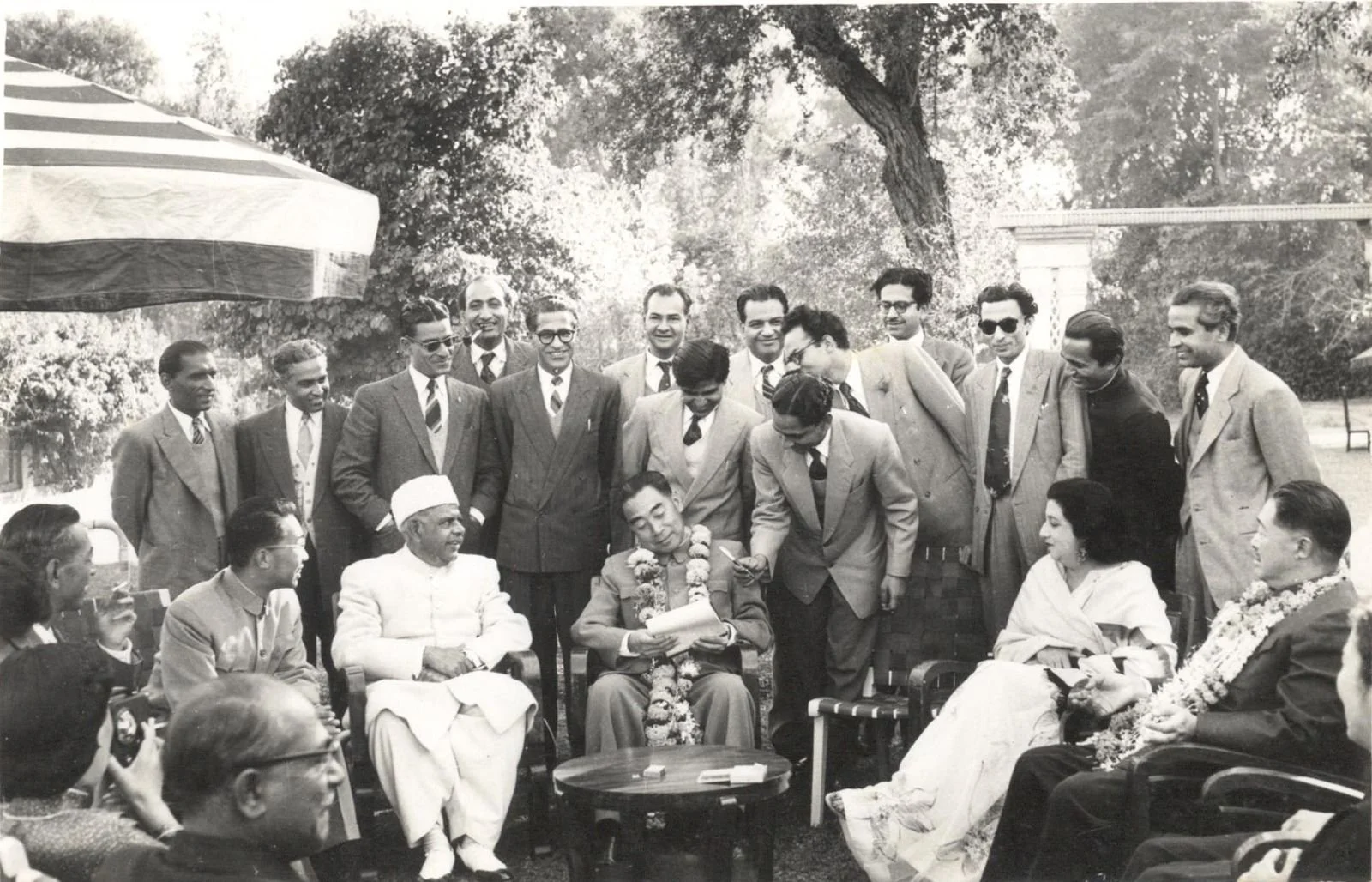
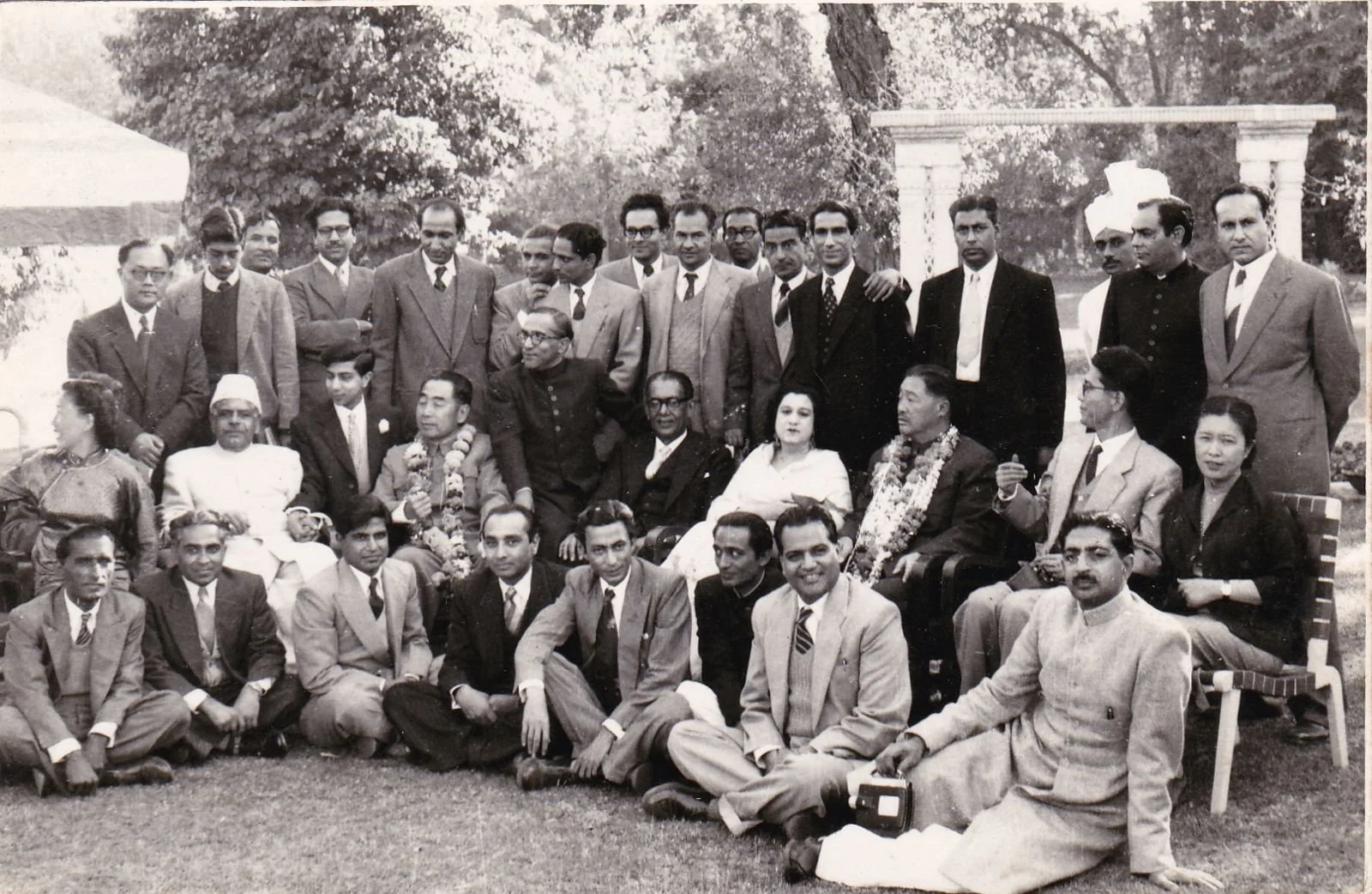
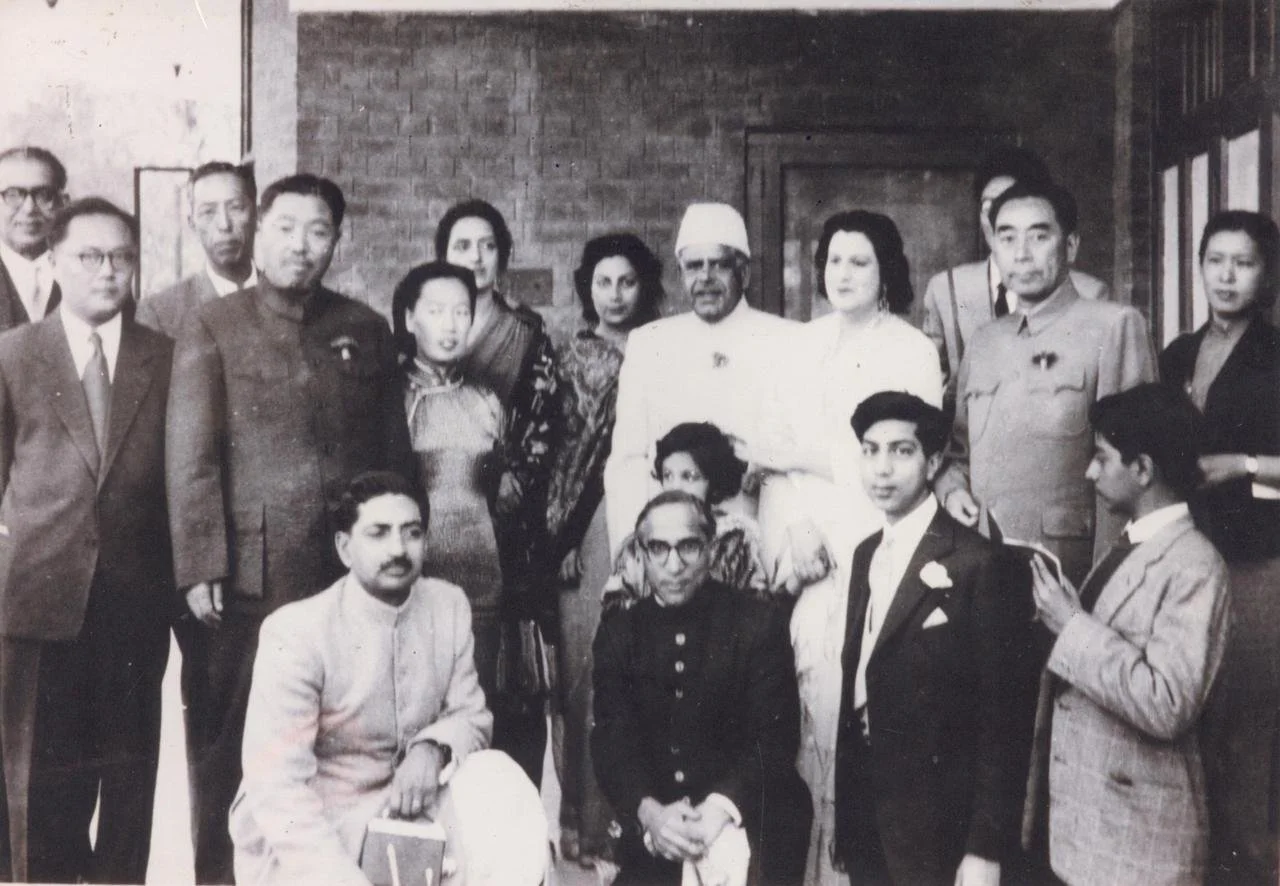
Reception for Zhou Enlai at Mian Iftikharuddin’s residence at 21 Aikman Road, Lahore, during his 1956 visit to Pakistan. The Chinese delegation included He Long, Qiao Guanhua and Gong Peng. Source: Mazhar Ali Khan family archives.
MHA: All this internationalism and anti-imperialism existed within an increasingly repressive domestic political environment, from the 1951 Rawalpindi Conspiracy Case to the imprisonment of people involved in Progressive Papers Limited—Faiz, among others—and the subsequent banning of the Communist Party of Pakistan in 1954, which profoundly altered the terrain in which the Left could operate.
How do you think the papers navigated all this? What was the relationship between their anti-imperialist editorial positions and the repression of the organized Left within Pakistan?
TA: The anti-imperialist position was popular because it also appealed to a certain nationalism. It wasn’t particularly strong, but it did exist in the country on some levels. And the conspiracy cannot be understood outside that context.
The decision of the Muslim League government to collaborate permanently with the British and later the Americans is what created the crisis inside the army.
Major General Akbar Khan, [a ringleader of the conspiracy] who was second-in-command in the army, wasn’t a nobody. He had been angered by the failure to do anything on Kashmir, because the British had vetoed any direct involvement by the Pakistan army—whereas the Indians were allowed to fly in and take Srinagar airport with support from the British. Gandhi, despite his pacifism, was very strongly in favour of that move. In Pakistan, the army wasn’t allowed to do the same.
This created a great deal of anger inside the army towards the British. What General Akbar was planning was a radical coup that would break relations with the British—not literally, perhaps, but would move Pakistan into a completely different position. It would have been a pre-Nasser coup, because Nasser hadn’t yet emerged in that way. These developments were taking place inside the Pakistan army from late 1947 onwards.
“The anti-imperialist position was popular because it also appealed to a certain nationalism.”
Of course, there was also the involvement of the Communist Party. You must understand that what was left of the Communist Party in Pakistan after Partition was tiny. In the Frontier, the main political force was Abdul Ghaffar Khan’s Khudai Khidmatgar movement. The communists worked with it rather than fighting it, but were unable to build a strong independent organization there. The Communist Party of India (CPI) had been strong in Punjab, but with the departure of the Sikhs after Partition, there were very few Muslims involved as such and the communists were unable to sustain a party. That was why the CPI decided to send Sajjad Zaheer, Sibte Hasan, Imtiaz Ali Khan, and others from India to try to build the party in Pakistan.
The problem was that they were very good intellectuals, but they had no real independent base in Punjab. They had a tiny base in Karachi, where large numbers of Muslim refugees had arrived from India after 1947. In some ways, Karachi became the strongest base of the communist movement in Pakistan. But it wasn’t a large party, and it never developed into one. Some party members used to complain that all their best cadres had been taken by Progressive Papers Limited and given salaries at Imroz and the Pakistan Times. They would mock the journalists, saying, “We have to work from the ground up, while you people have already got jobs,” and so on. There was an element of truth in that.
But the reason these people had been recruited was that some of them were very good journalists and functioned as such. Imroz, in particular, had a very fine stable of Urdu writers and journalists, including progressives and some communists. That was one reason the paper had a knack for winning popular support. Before the takeover, it was published, I think, in Lahore, Karachi, and Multan.
When I met Sajjad Zaheer in London for the first time after the Rawalpindi Conspiracy Case in the 1960s, we sat and chatted for several hours. I asked him to explain his involvement in the conspiracy case, and his first sentence had me in fits of laughter. He said, “Well, Tariq, this is how it happened, we were at a cocktail party in Lahore.” [Laughs]
He continued: “Akbar came. I was there, and Faiz was there too—or perhaps it was Sibte, not Faiz. But I was there. General Akbar Khan suddenly came up to me and said, ‘Listen, we need you communists because we are making arrangements to overthrow this government. We need your help drafting the manifesto and so on. Write it, and work with us.’”
I asked him, “Did you have no hesitations at all?”
He said, “Bhai, we weren’t that strong anyway. We thought, if something comes of it, so be it.”
I said, “The Left, whatever was left of it in Pakistan, you helped destroy, and then you went back to India.”
He said, “Yes, it was a big mistake.” He said they had become a bit overexcited.
The communists also helped prepare a list of people to be executed if they seized power. It included senior state and government figures; Qurban Ali Khan, the Inspector General of Police, was certainly on it.
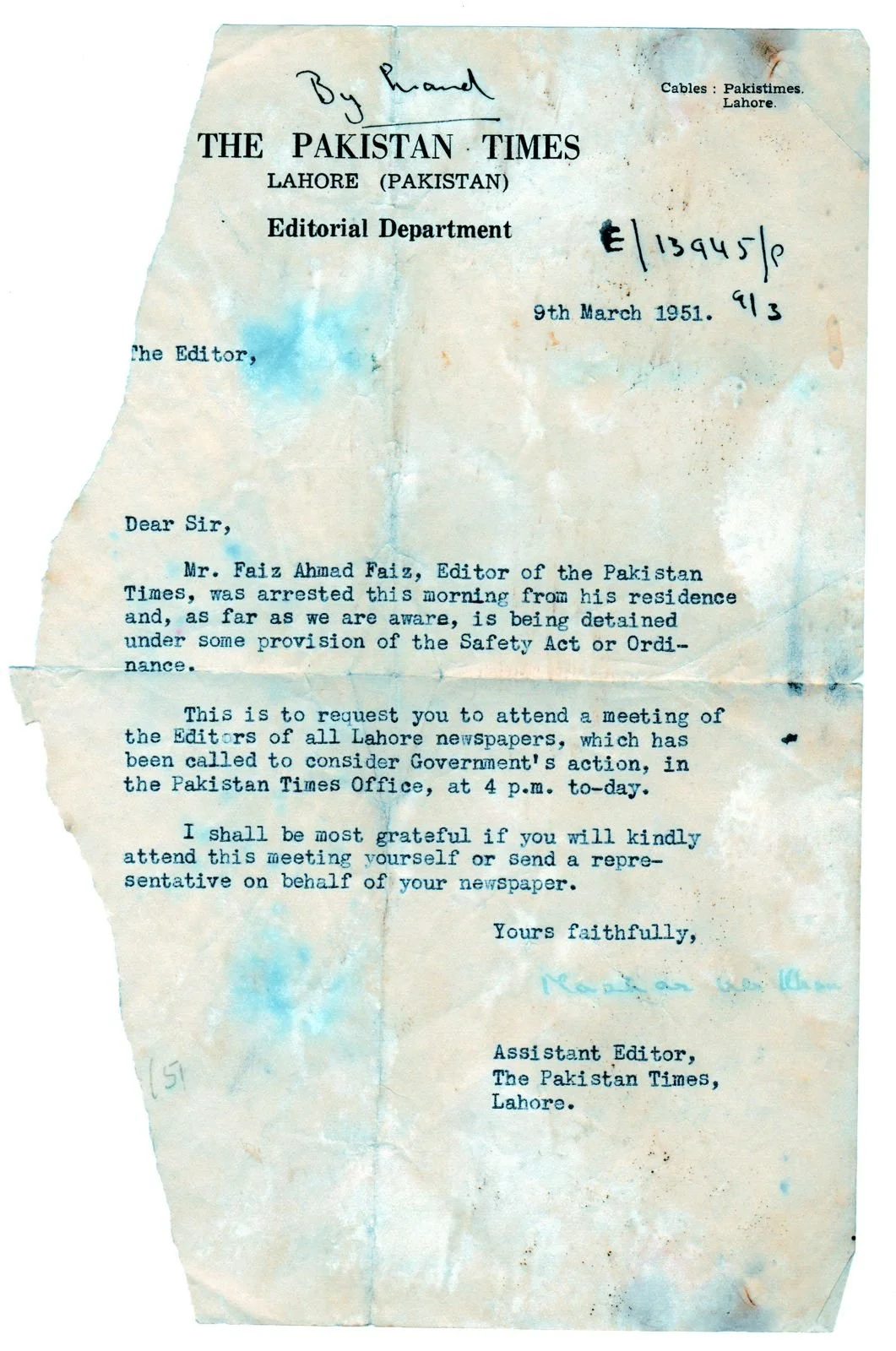
Letter from Mazhar Ali Khan to the editors of various Lahore newspapers following Faiz Ahmad Faiz’s arrest on 9 March 1951. Source: Mazhar Ali Khan family archives.
But it was never a serious conspiracy. They were infiltrated from the very beginning by senior army officers, brigadiers and others, who pretended to go along with the conspiracy while reporting everything back to military intelligence. The advice from military intelligence was to hang on and let it continue. There was also no way the conspirators were on the verge of seizing power. They had very few contacts in East Pakistan, which is something few people discuss. If the Communist Party had been seriously involved, you would expect to see some participation from East Pakistan, where the communists were a real political force, even if not an especially large one.
Now, Mishael asked how the Progressive Papers navigated their way through this. Mercifully, my father wasn’t told about the conspiracy. He wasn’t involved at all. Ahmed Nadeem Qasmi and others at Imroz weren’t involved either, and neither was Mian Iftikharuddin. The line they adopted was that if Faiz had been involved—if, they didn’t say that he was—he certainly hadn’t passed the information on to them.
“There was also no way the conspirators were on the verge of seizing power. They had very few contacts in East Pakistan, which is something few people discuss.”
My parents were very grateful that they hadn’t been taken into the conspirators’ confidence. In fact, this was the only time my mother, because all of its leaders had been arrested, was appointed general secretary of the underground Communist Party. She worked in that capacity, but the party was soon banned, and the whole thing came to an end.
That is precisely why I say that what remained in Pakistan [after the conspiracy and the banning of the Communist Party of Pakistan in 1954] was Progressive Papers Limited. It became the voice of the progressive left, whether communist or non-communist. Anyone who was progressive appreciated the papers. In later years, I would meet people who told me, “We were in the army,” or “We were in the civil service, but we were educated by those newspapers. That’s why our caliber was slightly better,” they would joke.
The papers survived the conspiracy. Faiz, I think, was kept on the payroll while he was in prison.
AAS: I want to briefly return to Mian Iftikharuddin, especially given his break from the Muslim League in 1948, and how his own political trajectory evolved from that point onwards. There was the Azad Pakistan Party and the National Awami Party–both of which he helped establish. Could you speak to his political evolution and how it intersected with the history of the papers, particularly as the Left itself was, in many ways, forced to evolve during the 1950s?
TA: After Faiz’s arrest, my father was appointed principal editor in charge of both the Pakistan Times and Imroz. He was the person responsible for what they did.
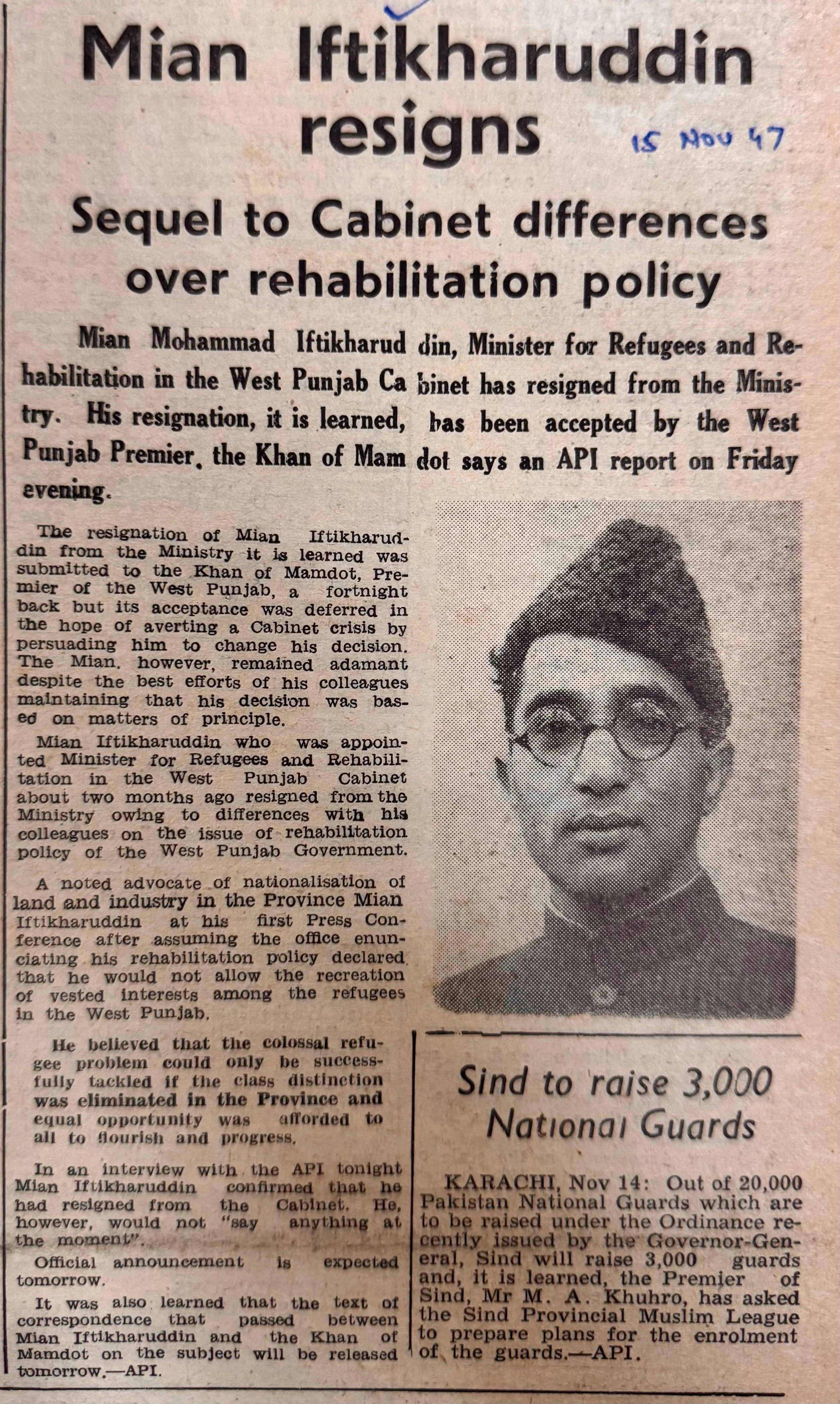
Pakistan Times report on Mian Iftikharuddin’s resignation as Minister for Rehabilitation of Refugees in November 1947. Source: Government College University Library, Lahore.
Mian Sahib himself left the Muslim League in 1948, which was, of course, an event tied to the instructions given by Moscow to all its parties to try to seize power. This was the period of the Ranadive thesis within the Indian Communist Party, which was a sudden shift away from working with Congress towards armed rebellions, one or two of which weren’t entirely unsuccessful. In Pakistan, however, there was nothing of the sort. All it meant was a break with the Muslim League and the setting up of a front party, the Azad Pakistan Party.
All the banned communists, and people who would be banned in the future, joined the Azad Pakistan Party. Originally, it also had a few Muslim Leaguers who came over on the basis that the Azad Pakistan people said, “Well, we support the 1946 manifesto of the Muslim League. We’re not going beyond that.” But then they realized that this was actually a nest of communists and more committed people.
Mian Sahib kept the party going, but the Progressive Papers didn’t give it too much publicity. He was always grumbling and complaining. He once even said to me, “Your father never gave us more publicity than we deserved. And he said the papers couldn’t be used for that purpose.” Which they weren’t. They were careful not to be linked to the organization.
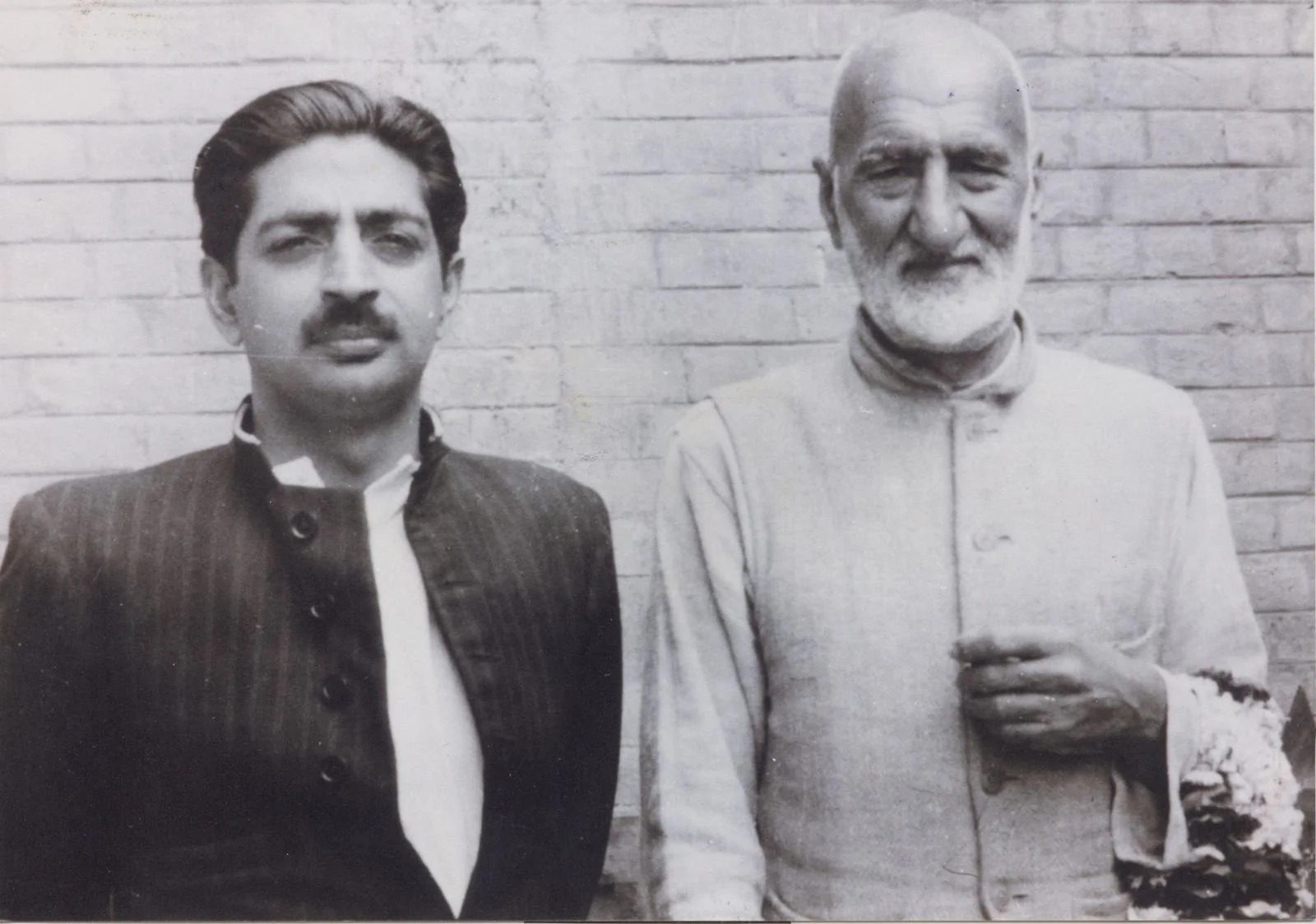
Mazhar Ali Khan with Khan Abdul Ghaffar Khan. Image: Mazhar Ali Khan family archives.
Later on, when people began creating an opposition movement in Pakistan, those in the Azad Pakistan Party, who were mainly centered in Lahore and Karachi, decided to link up with Ghaffar Khan’s movement in Pakhtunkhwa. The Muslim League governments never got over the fact that, in one of the largest Muslim-majority provinces, they had systematically lost elections to Ghaffar Khan, who believed in a composite nationalism rather than just a Muslim nationalism. That irritated them, and they punished him. They locked him up for periods of time; he would go to Jalalabad in Afghanistan and not return to Pakistan, and so on. But his Khudai Khidmatgars moved leftwards as they saw what they were confronted with. The National Awami Party was born out of the amalgamation of the Khudai Khidmatgars, the Azad Pakistan Party, and other smaller groups and individuals from the Left.
However, the generation that brought down the dictatorship in 1969 was a generation that had been educated by the Progressive Papers Limited. There’s no doubt about that.
MHA: The Pakistan Times and Imroz brought together writers, journalists and intellectuals, including people who did not share the Left’s politics. They also developed a distinctive visual culture, with F. E. Choudhury’s photographs and Anwar Ali’s cartoons. What made their editorial culture distinctive, and how did PPL balance progressive commitments with journalistic independence and professional standards?
TA: The PPL emerged partly because of the weaknesses of the Left in Pakistan. They were very tiny after 1947. And Iftikharuddin’s brilliant initiative was to make sure that the Left didn’t totally disappear.
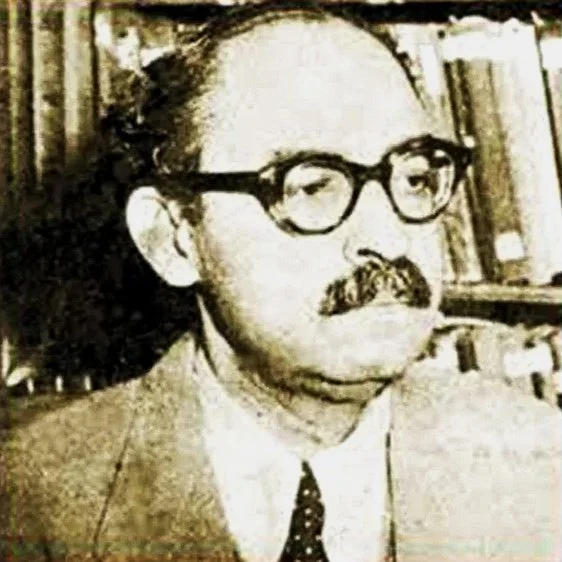
Chiragh Hasan Hasrat. Image: The Friday Times.
Faiz and my father were very particular about the quality of the research and writing. This is why the first editor of Imroz was not on the Left at all. Chiragh Hasan Hasrat was one of the great Urdu journalists of his time, very witty and an incredible Urdu writer. And Faiz actually suggested that the Urdu paper’s quality had to be particularly high because there was competition in the field. Nawa-i-Waqt in particular also had good columnists, but from the right-wing. Hasrat was given a free hand over Imroz. He finally left because he quarreled with everyone, but without any animus. But he left behind a very strong team of writers and journalists whom he had helped to train. Hameed Akhtar was one of them, and he was a leftist.
I’m stressing this to emphasize that the aim was, in a strange way, to make sure that the newspapers were journalistically of a very high quality. It was a curious hybrid. People like my father argued that, otherwise, it would be very difficult to defend even progressive views. The newspapers had to become indispensable, so that people knew that if you wanted to read real news and get real coverage in the English press, it was Pakistan Times, and in the Urdu language, well, Imroz, alongside its competitors. Later on, when the newspapers were taken over in 1959, I think Time magazine or Newsweek said that Pakistan Times was the best-edited paper in Asia. Everyone who led PPL—Chiragh Hasan Hasrat, Iftikharuddin, Faiz, my father and, later, Ahmed Nadeem Qasmi—made sure the standards of journalism did not fall.
“I’m stressing this to emphasize that the aim was, in a strange way, to make sure that the newspapers were journalistically of a very high quality. It was a curious hybrid. People like my father argued that, otherwise, it would be very difficult to defend even progressive views.”
And there was the fact-checking. There were people at Pakistan Times—Nizamuddin, the librarian, was one of them, but there were others—who would cast an eye over a story. If anything didn’t look right, they checked the facts. They rang the reporter up in Lyallpur, saying, “Where did you get this news from? Who told you?” Things like that, which were very unusual for the press in Pakistan at that time and created new standards for reporting altogether.
Choudhury Sahib, the photographer, was a genius in his own way. He photographed people who were normally ignored in this totally bourgeois, elite-dominated world. Workers would see their photographs after a May Day demonstration. Women forming women’s organizations would see their meetings covered.
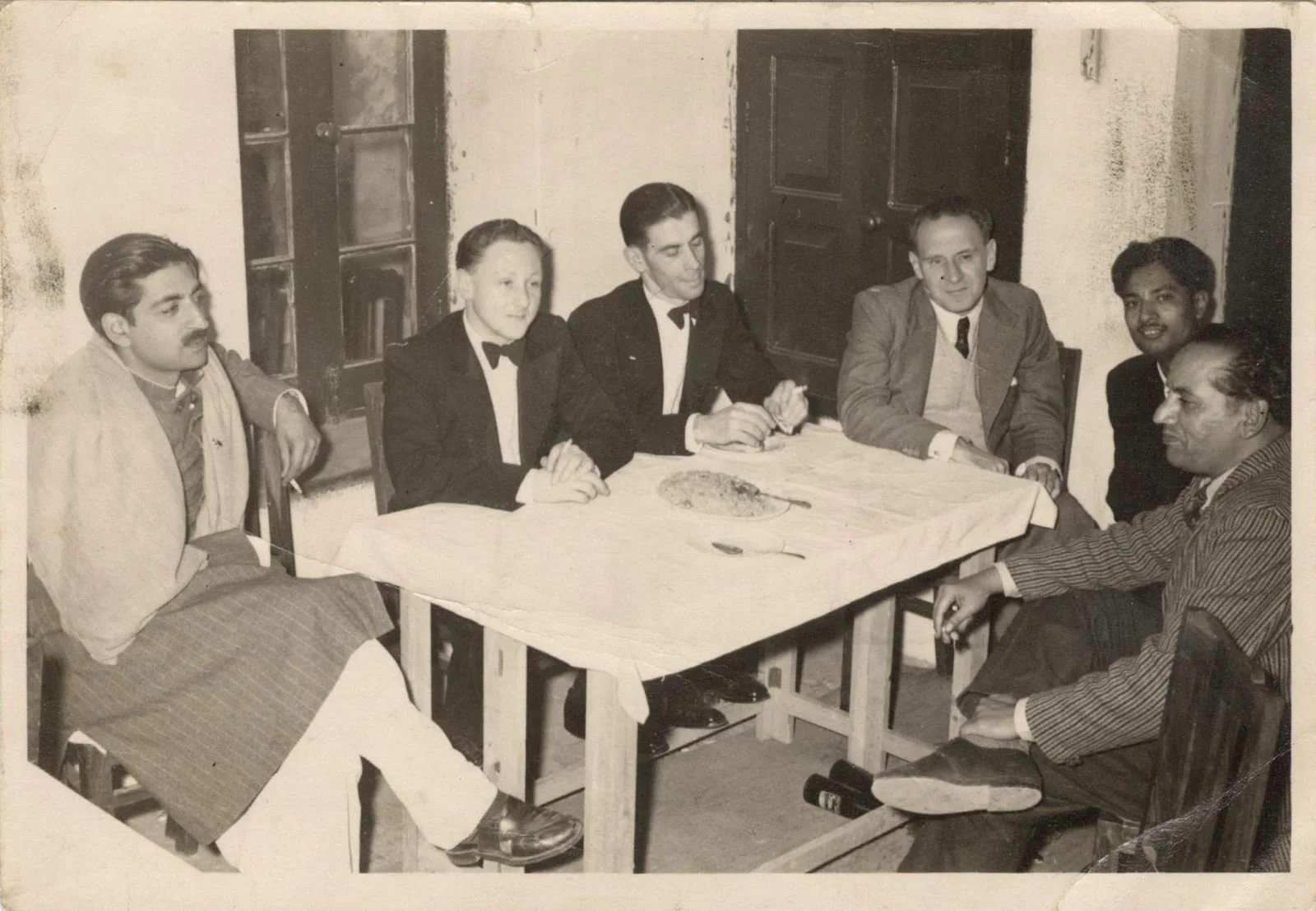
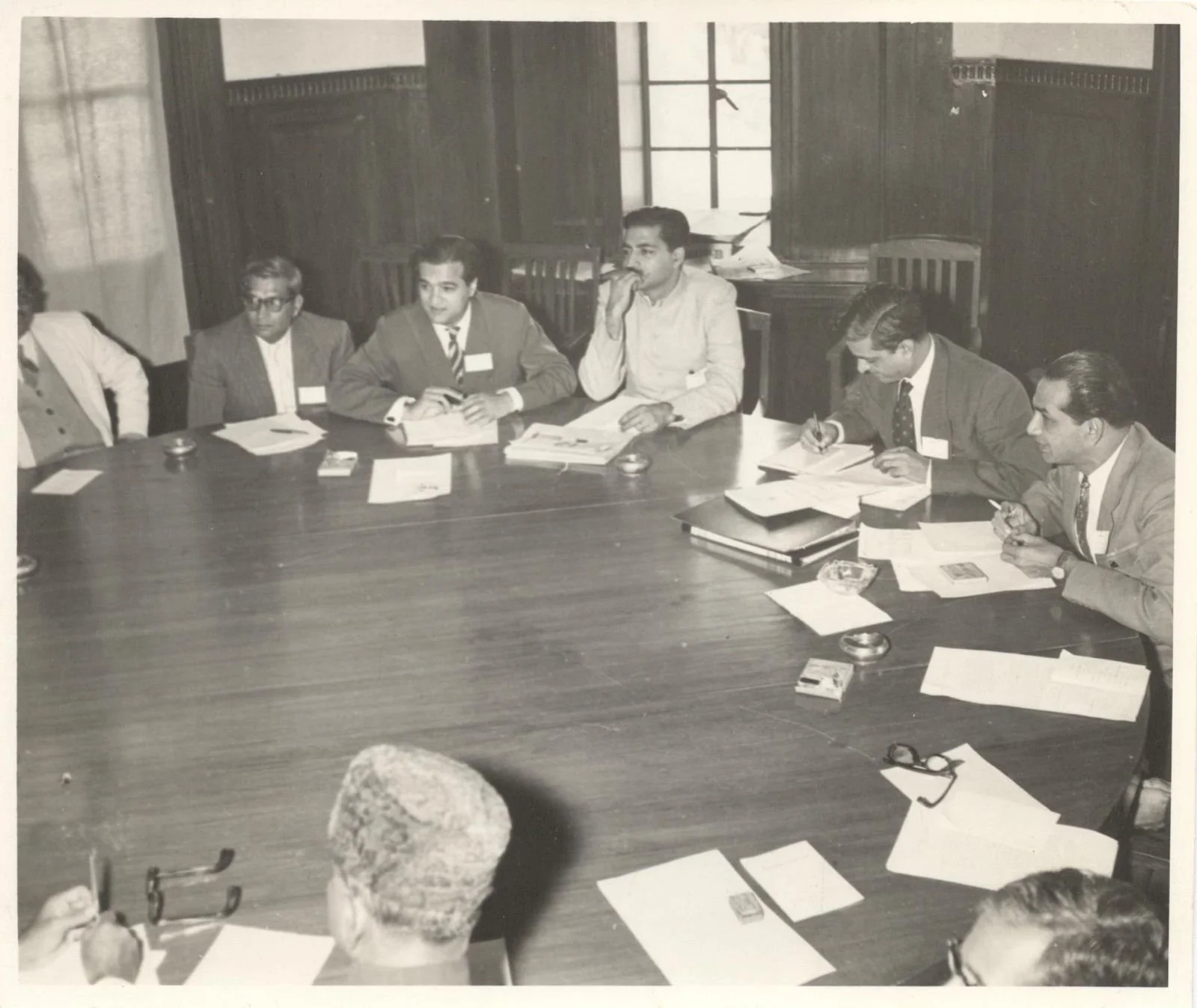
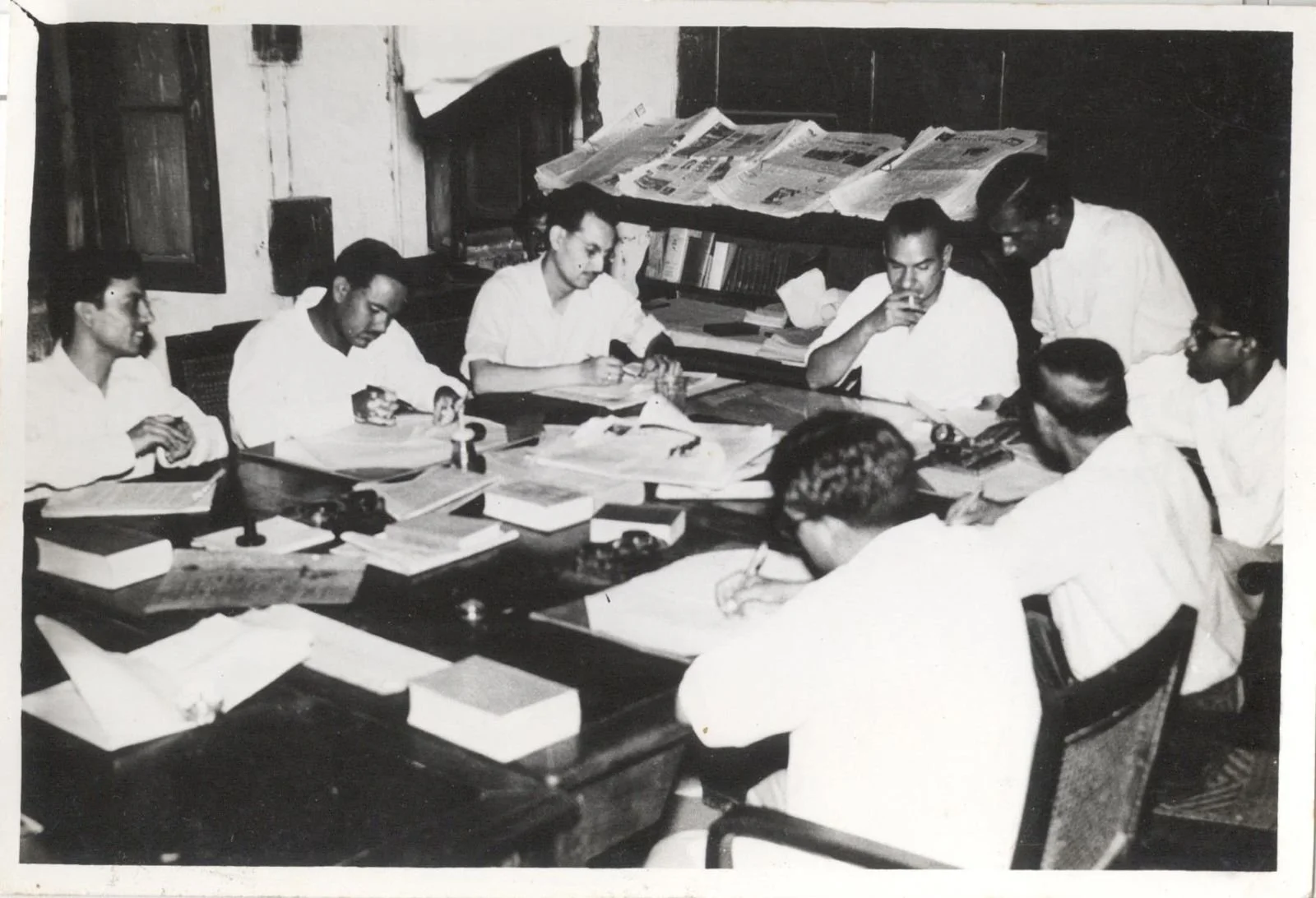
From the offices of the Progressive Papers Ltd. Images: Mazhar Ali Khan family archives.
This visual side extended to cartoons. Anwar developed this character called Nanna in 1953, who served as the daily voice of the readers. He was the one people would look to and say, “What does Nanna say today?” And, as with these things, not every one of them was brilliant. They were uneven. But they were an interesting innovation.
[In terms of working relations], it was a very friendly, comradely atmosphere–not at all “I am the boss and you are working for me.” People used to go and talk to Iftikharuddin when they saw him, and he encouraged that. And Iftikharuddin, in particular, laughed a lot when people made jokes about him, if they were funny. He never minded that. One famous example was that he would cast a quick eye over Imroz every day, though he never read it. One day, he walked into Chiragh Hasan Hasrat’s office and said, “Today you’ve really outdone yourself—there’s a beautiful editorial in Imroz.” Hasrat thanked him, then joked to the other journalists that Iftikharuddin’s chauffeur, Khizer, must have read the paper.
Faiz was, of course, a guy in his own right, with his own identity, but he never used that in any way. None of this “I’m a great poet” business. People respected him for what he was, and he behaved like any other person. And that also had a way of educating people.
The papers also brought together journalists who did not necessarily share the Left’s politics. The chief reporter, Iftikhar Ahmed, was not on the Left, but was an excellent journalist who respected the papers because they allowed him to tell the truth. He left when the papers were taken over and later became a lawyer, working with Mahmud Ali Kasuri and others.
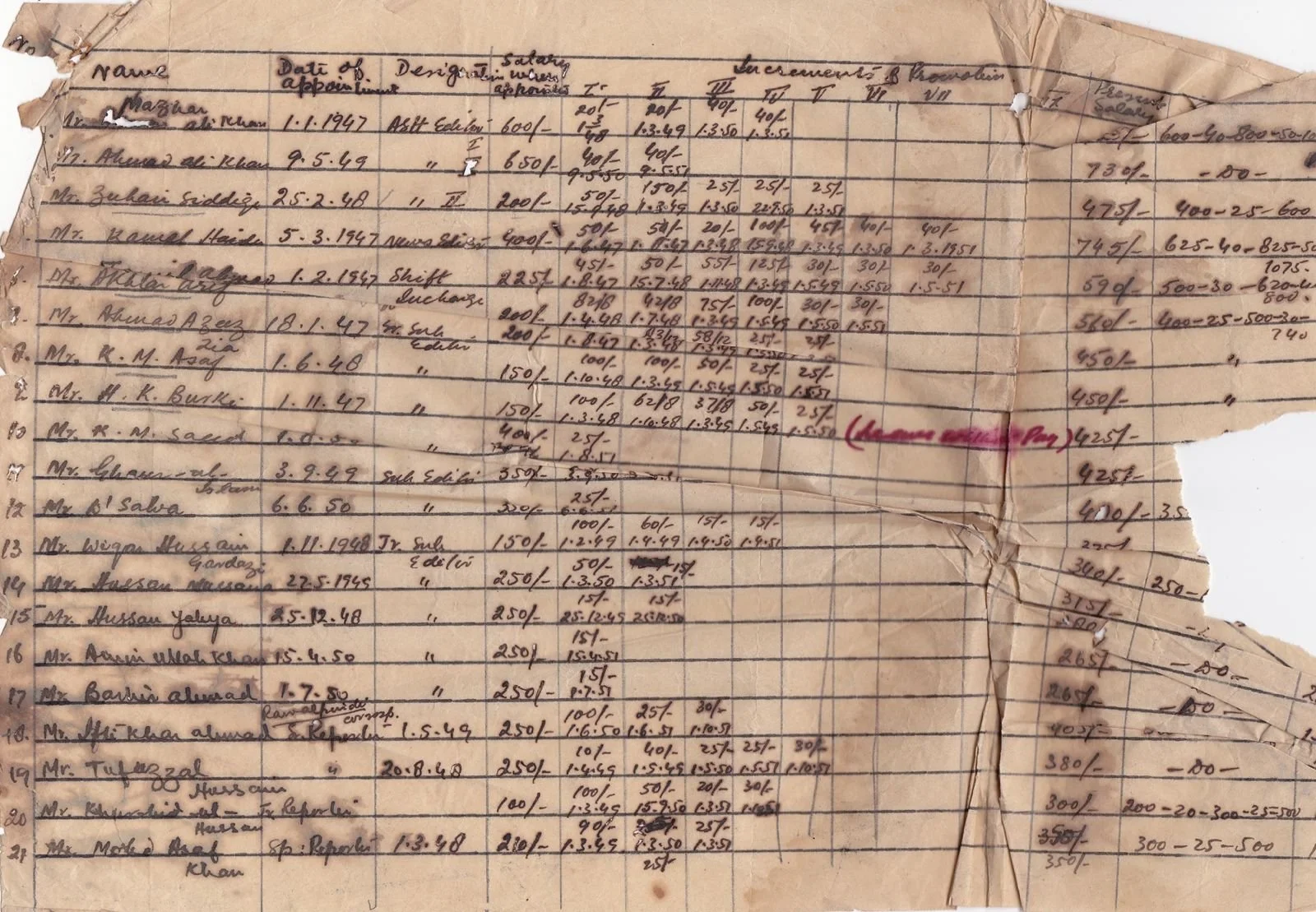
Staff salary and increment register for the Progressive Papers Ltd. Image: Mazhar Ali Khan family archives.
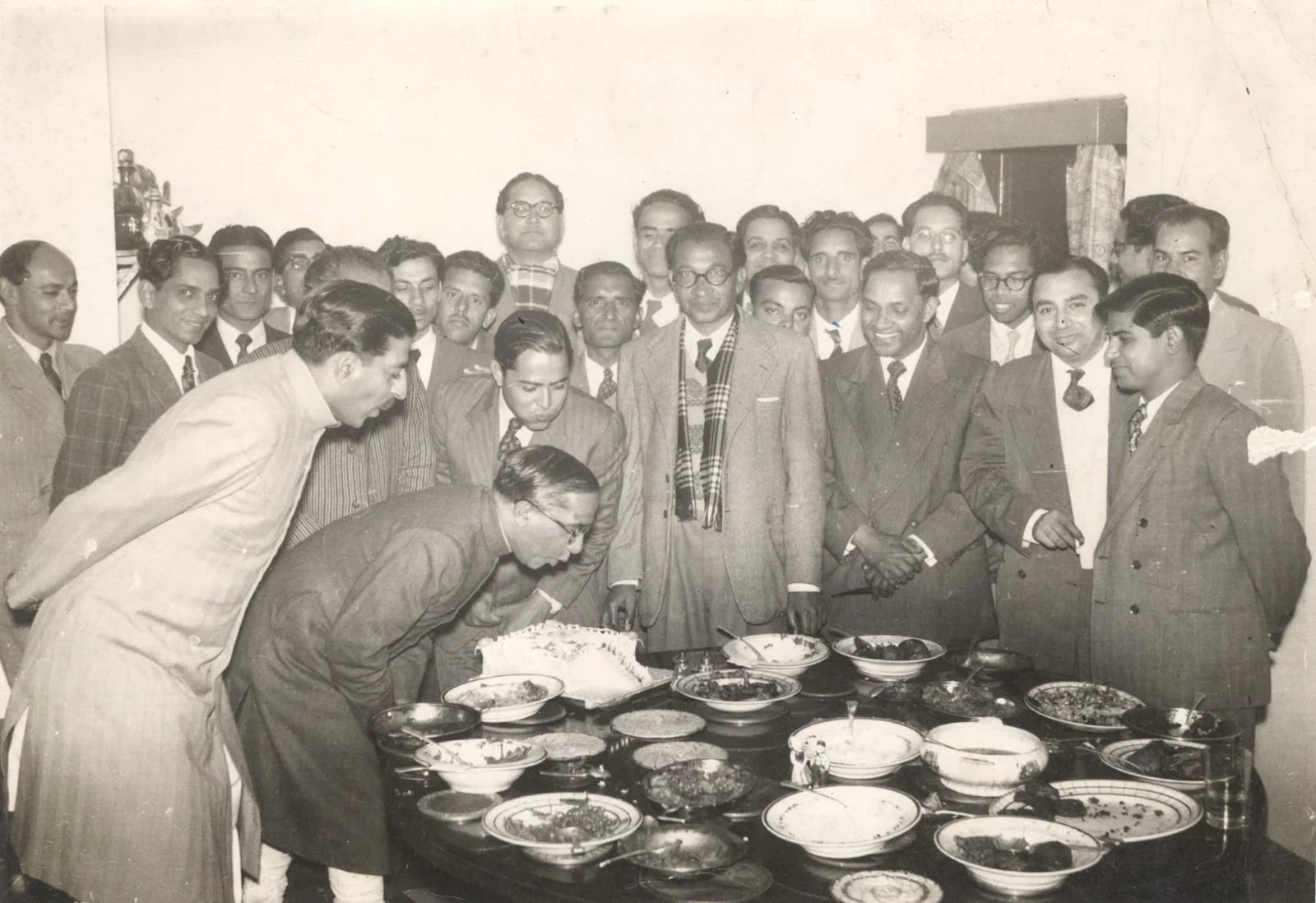
Pakistan Times anniversary celebrations at Mazhar Ali Khan’s residence. Image: Mazhar Ali Khan family archives.
I. A. Rehman, the film correspondent, kept the culture pages going, while K. M. Asif, the chief sports editor, was highly respected for his sports writing and could not be bought, despite attempts to do so. Syed Amjad Hussain was another leading reporter, and Kamal Haider, the news editor, was far removed from the Left but generally sympathetic to the papers’ aims.
And that’s how they made it into the outfit that it was and became: by not simply recruiting people from the Left, because… I remember my father joking that, apart from all their other problems, they tend to be very lazy!
AAS: You’ve already alluded to the nationalization of the papers. Could you give us a brief account of how that played out and what it reflected about the regime’s priorities at that moment?
TA: What happened was this: the newspapers had undoubtedly become very powerful. So, when martial law was declared in October 1958, there was a sense of crisis among the high command. I was at dinner at Mian Iftikharuddin’s house because his younger son, Suhail, and I were friends. Over dinner, my father and Mian Sahib discussed what martial law could mean for the papers, and they were both quite sanguine. They said, “If they impose censorship, just send all our stuff to the censors. If they censor it, we’ll just leave the paper blank, and the blankness will make it clear to our readers that we couldn’t publish what we wanted to. Let’s keep cool heads and not do anything foolish. The papers should be preserved at all costs.”
That was the general mood. At first, while all the other newspapers published editorials praising the military takeover, Pakistan Times ran an editorial written by my father on soil erosion. It dealt with the actual problem of soil erosion in Pakistan, but the message was very clear: our political soil was being eroded as well, without saying a single word about it.
Someone from the paper would then ring up whoever was in charge of censorship and say, “The paper is ready.” They would reply, “We don’t want to censor you. You write.” Out of caution, the editorials and opinion pieces were sent to the censor, and sometimes they raised objections, but by and large they let things through because the papers had become very careful.
At the same time, two things were happening. At the first cabinet meeting of the martial law government, where Bhutto was a junior minister, Bhutto later told me, “Tariq, it’s quite astonishing. The first thing Ayub Khan said to the whole cabinet was, ‘I want you to understand one thing. There is only one embassy in Pakistan, and that’s the American embassy.’” The message was very clear.
My aunt Bilquis, my father’s sister, was married to the interior minister, General Sheikh. A few weeks later, she came and told my father that it was a staunchly pro-American government and that he should have absolutely no illusions about that. That was all she said. He replied, “We don’t. Thanks for confirming it.” American pressure over Progressive Papers Limited intensified. The Americans hated the papers; they had never liked them.
One day in late March 1959, my father received a phone call. It was Bhutto, who was then Minister for Commerce. He said, “Mazhar, are you free this evening? Let’s meet up at Faletti’s Hotel for a gup shup.” It was a very casual invitation, probably because the phones were tapped.
My father turned up at Faletti’s, and Bhutto said, “Look, this is serious business. There’s a horrible plan being concocted to take over Progressive Papers Limited.”
My father said, “What? Are you sure?”
“Yeah. I’ve sat in cabinet meetings. Manzur Qadir is the one really pushing for it.”
One of the country’s greatest criminal lawyers was pressing for a crime to be committed.
They talked, and my father asked what Bhutto suggested. Bhutto said that the only way out, though even that might not work, was for Mian Iftikharuddin to ask for an interview with Ayub Khan and say what needed to be said. He should ask why the government was thinking of banning their papers and explain that they were doing nothing illegal. Everything they published was sent to the censors.
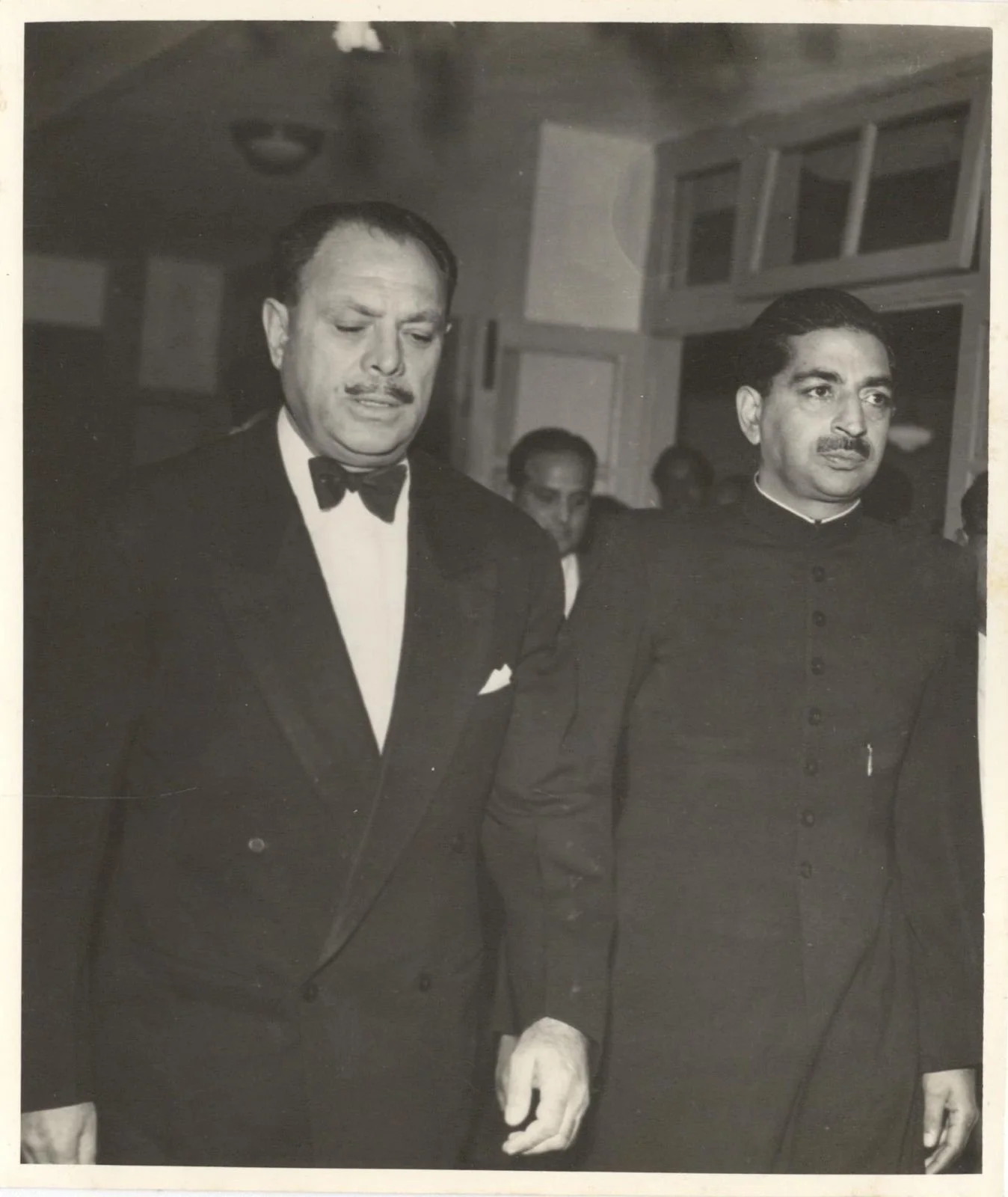
Mazhar Ali Khan meeting Ayub Khan in his capacity as President of the countrywide Council of Pakistan Newspaper Editors (CPNE), prior to the nationalization of Progressive Papers Ltd. Source: Mazhar Ali Khan family archives.
Bhutto told my father, “Mazhar, this might work, but it might not. I’m just warning you to be careful.”
“My father turned up at Faletti’s, and Bhutto said, “Look, this is serious business. There’s a horrible plan being concocted to take over Progressive Papers Limited.””
My father went straight from Faletti’s to 21 Aikman Road, where Mian Sahib lived, and took him aside. He told him what they were planning.
Mian Iftikharuddin, who could often be very clear-eyed, particularly because he knew this elite and what they were capable of, said that Bhutto was exaggerating. My father asked, “Why would he exaggerate? He’s taken his political career into his own hands by telling us. They could sack him; he could be finished. Why would he do that?”
Mian Sahib said there was always talk of doing these things. My father replied, “Iftikhar, he was very serious.” Bhutto had recommended that Mian Sahib go and see Ayub to find out whether a deal could be done to save the papers.
But Mian Sahib said, “No, who can touch us? We’re so powerful and strong.” Well, they were. But that was precisely why the government felt they had to be taken over. They couldn’t trust them.
In a way, it was quite creditable that he said, “Why should I go? We’ve done nothing wrong. What am I supposed to say?”
My father said, “You should say exactly that. We’ve heard that you’re planning to take over the newspapers, and we’ve come to appeal to you not to do it.” He wanted him to be upfront about it. But Mian Sahib didn’t go. Ayub might not have agreed to see him anyway, but no attempt was made.
Ironically, two cabinet ministers arrived at our front door on the eve of the takeover. One was Bhutto, whom my father knew well as a family friend. The other was my uncle, General Sheikh. They told my father that this was not an action against him as editor of the paper, but against Mian Iftikharuddin. The government had information that Mian Sahib was involved in the coal trade with China, which supposedly constituted a threat. Can you imagine? China, with which they have traded endlessly ever since! They used trade with China as one of the excuses for taking over the papers. It was an allegation that was later brought against him. They had come to ask my father to stay on as editor-in-chief and publisher-in-chief of Progressive Papers Limited, but the papers would be owned by the state.
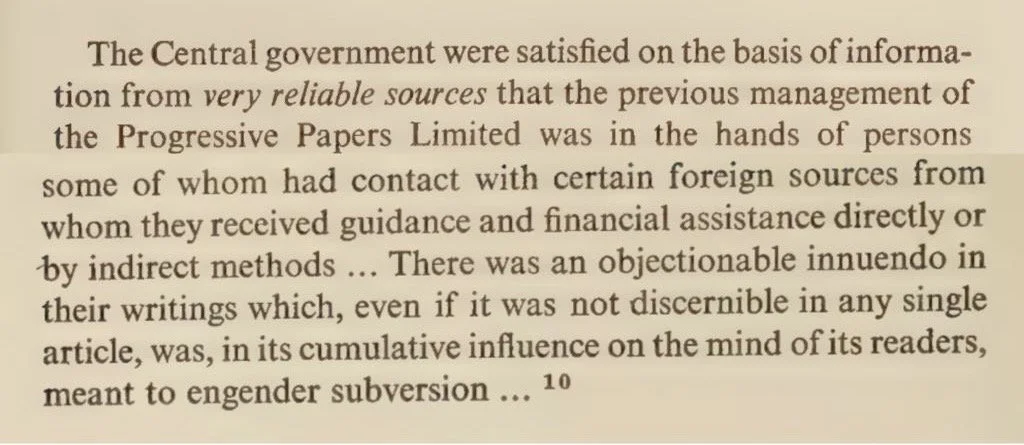
Excerpt from a press note issued by the government regarding the takeover of the Progressive Papers Ltd. Source: Pakistan: Military Rule or People’s Power (1970) by Tariq Ali.
My father just laughed in their faces. Bhutto replied that once the papers were owned by the government, they could invoke the Essential Services Act, which would forbid my father from disobeying orders, leaving his post, and so on.
My father replied, “Well, if you do that, we’ll be having conversations in prison, no doubt.”
They pleaded with him, quite seriously. But my father said there was no question of his staying on. “We built these papers to promote freedom and democracy in the country, and freedom of the press. And you want me to be in charge of government-owned newspapers? It’s unheard of.”
So they left.
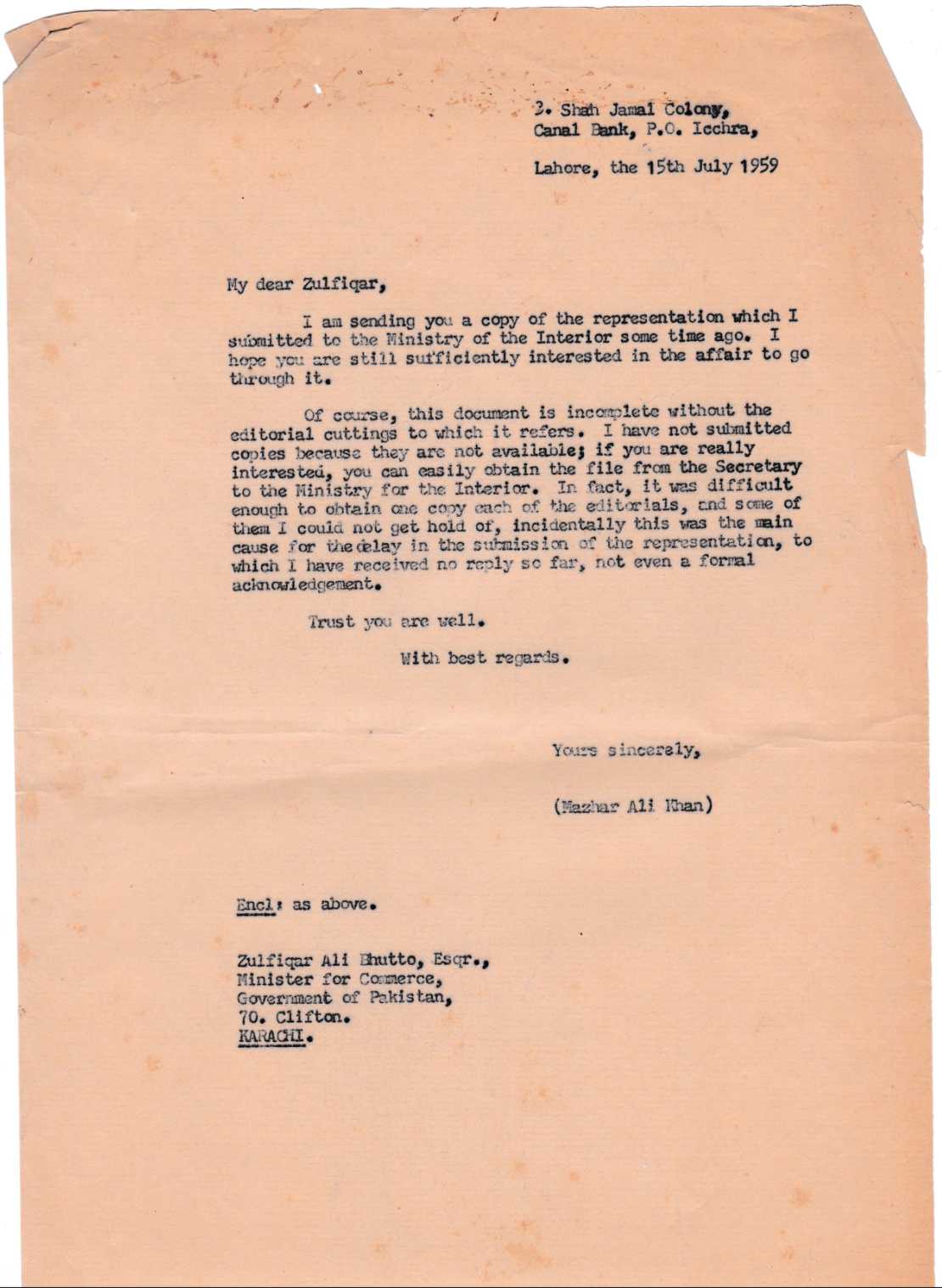
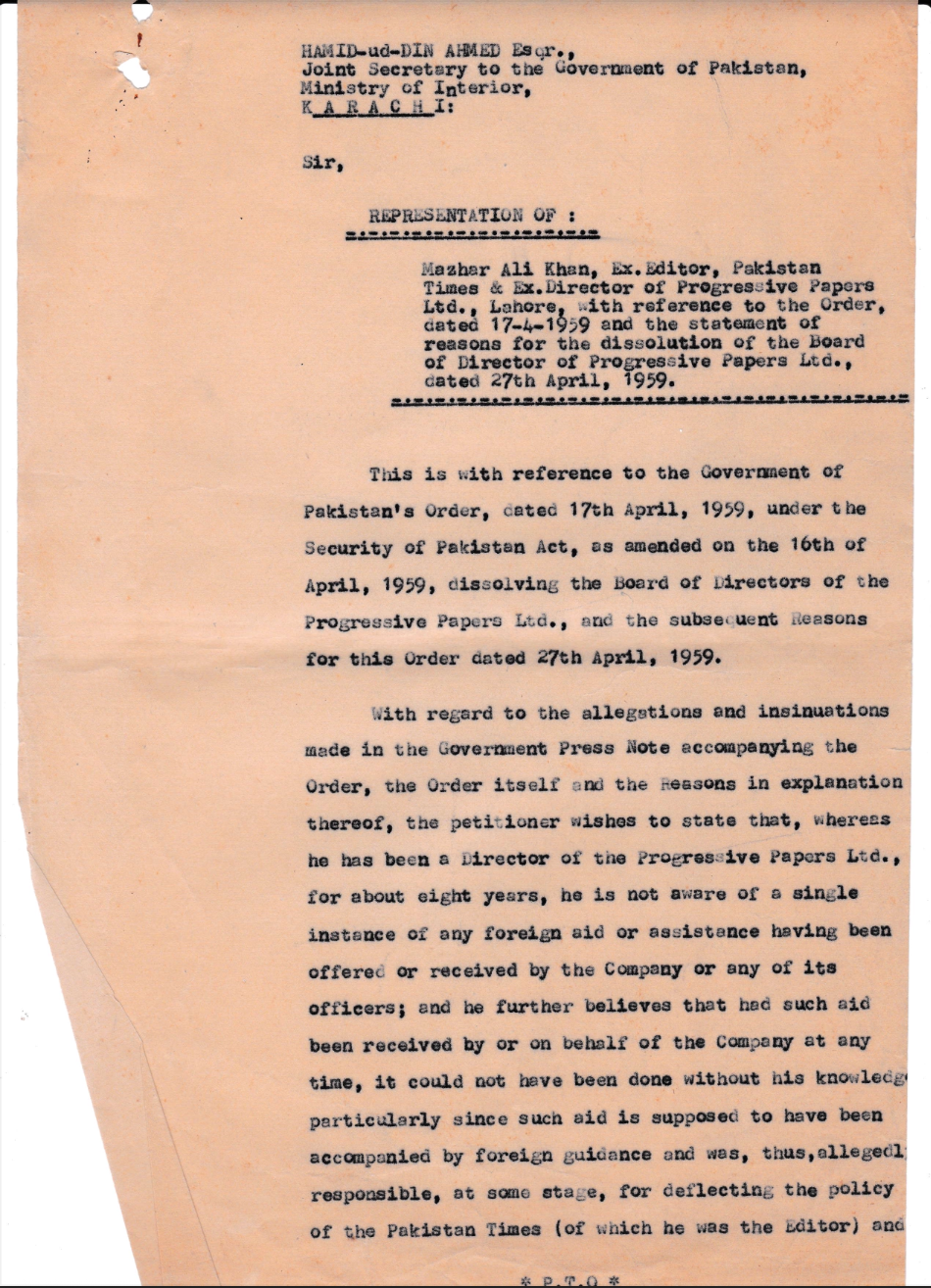
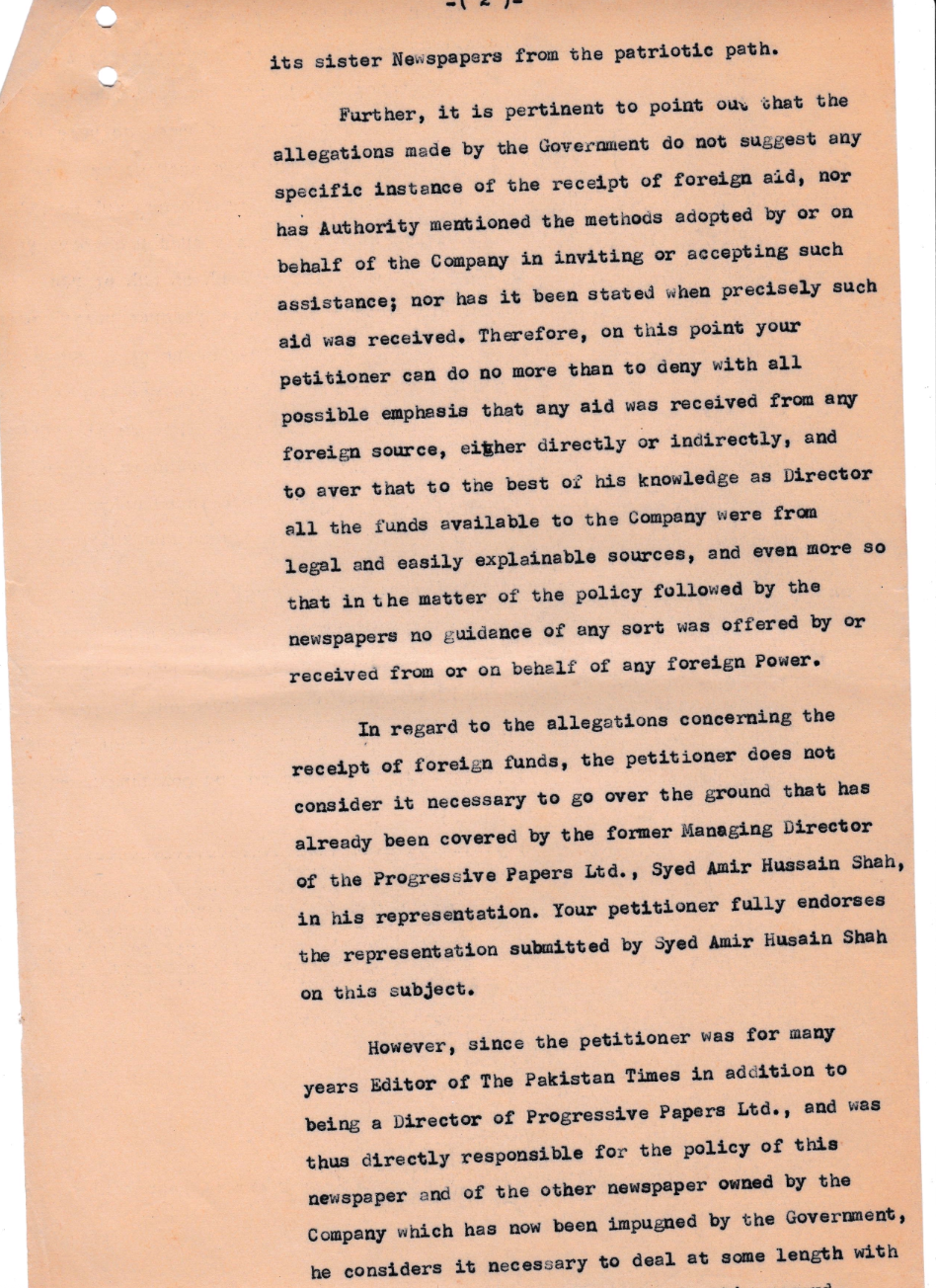
Excerpts from Mazhar Ali Khan’s testimony in defence of Progressive Papers Ltd. (PPL), sent to the then Minister for Commerce and later Prime Minister of Pakistan, Zulfikar Ali Bhutto. Source: Mazhar Ali Khan family archives.
My father went to the office and called a big staff meeting. They had already seen police jeeps surrounding Progressive Papers Limited, so everyone knew something was happening. He explained what had happened and told them about the offer he had turned down. He wanted his name removed from the imprint of the following day’s paper and his resignation announced. That was all.
“And that was it. The whole experiment collapsed. People missed these papers. They said so at the time and afterwards.”
He said to them, “I know the circumstances many of you are in, and I don’t want any heroic actions. Those of you who have families and children, especially, should feel free to stay in your jobs if you want to. We’re not advising you to do anything on that front. It’s entirely your own personal choice.” It was a very sad day.
And that was it. The whole experiment collapsed. People missed these papers. They said so at the time and afterwards.
The first editorial in the government-owned Pakistan Times was written by Qudratullah Shahab. It was called “The New Leaf.” It was a disgusting piece of writing. Altaf Gauhar, later Ayub’s information chief, was the one who commissioned Qudratullah Shahab to write it. Later, he said, “I am ashamed. It’s one of the things I’ve done that I’m most ashamed of.”
This should be noted: every major paper in the country supported the takeover of Progressive Papers Limited. Dawn and Nawa-i-Waqt were particularly prominent, but all the others joined in. So much for solidarity. It was also a signal to people that the government wasn’t going to tolerate any meaningful dissent. The country was stifled, and that fed the uprisings that were soon to emerge.
This interview has been edited for length and clarity
Asmer Asrar Safi is a writer and organizer from Lahore, Pakistan. He is currently pursuing a PhD in History at the University of Oxford as a Rhodes Scholar. His research focuses on the intellectual history of the Pakistani Left in the 1960s.
Mishael Hyat Ayub is a researcher and writer from Lahore, Pakistan, currently based in Singapore. Her work focuses on inequality, state power, and struggles over visibility and voice in South Asia. She studied anthropology at Yale-NUS College.