On NPA’s Quest to Restore Political Agency in Bangladesh
Readus Jawad and Oliur Sun, central committee members of the newly formed left political platform Network for People's Action (NPA), in conversation with Jamhoor about the future of left-wing politics in post-July Bangladesh.
Illustration: Jamhoor
Editorial Note: The interview was conducted on January 30, 2026 prior to the elections in Bangladesh on February 12, 2026.
The following transcript has been edited for clarity and brevity. It is not an exact match of the audio interview.
___________________________
Nafis Hasan: Thank you, Oliur and Jawad. My name is Nafis Hasan, and I'm a member of the editorial committee at Jamhoor, a left online media platform focusing on South Asia and its diasporas. Today we have Oliur Sun and Readus Jawad, two central committee members from the Network for People's Action, a new left-wing platform from Bangladesh in the post-July Revolution political landscape. Welcome, Oliur and Jawad.
Oliur Sun: Thank you, Nafis, and thanks to Jamhoor for hosting us today.
Nafis: So, I want to dive in to talk about what the Network for People's Action is - what is the NPA, where did the name come from? I saw some post online that said it was the name of a WhatsApp group. Like, how did that happen? Tell us a little bit more about your origin story and what your name signifies, and tell us a little bit more about what exactly is the NPA, and why did you choose to form a platform instead of a political party? And more importantly, why now? What is it about this political moment in Bangladesh that has inspired you and your comrades to form this platform?
Readus Jawad: Basically, even during Sheikha Hasina's tenure, there was a very palpable sense of political emptiness in Bangladesh, because at the end of the day, we have these two sort of bourgeois liberal parties, like BNP and Awami League. None of them actually represent the people, and Awami League day by day became a very despotic, a very fascist entity. There was always a plan in people's, or there's some sort of dream in people's spirit, that we will one day be able to do a different kind of politics, we will one day be able to do something that will be not only effective in Bangladesh, but the politics will be rooted in Bangladesh, the politics will be developed keeping the historicity and the ethnography of Bangladesh in mind. So that was basically the goal from the very beginning.
After that many people were trying to build something like that, something of a political organization, something of a coalition, even before the July uprising. So, after the July uprising , there was a breakthrough. People could organize freely, people could organize more openly, and they were not as persecuted as they would be under Hasina’s regime. So basically, that's where the idea first originated. I still remember that two days after Hasina's fall, I was talking to another member of NPA, and I was saying to that person, hey, brother, we have to form something, like there's a very large political vacuum in this country, so we have to do something. So that was basically the goal, and the story about the name is very true. The name was basically made as a WhatsApp group name, as a placeholder. It was called New Political Action. At the end of the day, we voted for the name Network for People's Action, because at the end of the day, what we want to do is connect people. We don't want to be the party where everybody has to join, or we don't want to be a platform that everyone has to subscribe to if they want to have a secular or liberal or leftist politics in Bangladesh. What we want to do is connect people's struggles in Bangladesh, because even after the July uprising, we saw the rise of fundamentalism, a rise of right-wing tendencies, fascistic tendencies in Bangladesh politics, but there was resistance to those politics, their rise. We want to connect those pockets of resistance, we want to connect people's struggle, and deliver at least a narrative, a tangible way, a solution-based way that people can actually hope for a better future; people can actually., feel connected to us even if he or she is not a part of our platform.
The process of forming this platform has been going on for about 10-12 months. The timing for our inauguration ceremony wasn’t some plan that we will emerge before the election, and we will be some kind of political force. That wasn't really our goal. We couldn't manage an auditorium last December, that's why we did it in January. We are a bunch of volunteers, we are funding our own political parties, we are giving our own money. We are collecting funds from our own people. Everybody involved is either in a job or in a business, or they work for themselves. So they are giving their time to build something that is still in its infancy. So, at the end of the day, we don't know yet what this network for political action will bring. But our goal is to connect people who firstly believe in the historicity of Bangladesh, who believe in the spirit of ‘71, ‘90, and 2024, and people who believe in the universal human dignity and civil and and political rights for everyone. And secondly, people who understand that power has been centralized in Bangladesh in the hands of a very small number of wealthy people, and if we want to dismantle the fascistic structure that has been put in place in Bangladesh, we have to dismantle that oligarchy that is now controlling Bangladesh.
Oliur Sun: I think also one of the other reasons why it was named network is actually because we also do not want to fall into the trap of narrow nationalism, which is gaining ground globally with sort of fascistic movements that are taking place everywhere. For example, usually what would happen is whenever you're trying to form a new political platform, whenever the N-word is used in an abbreviation, you would usually think of nationalism, right, or nation, or something like that. Another reason why I think this platform was formed was also because we wanted to revisit the relationship between the state and the citizens, which have been in a very precarious state over the last 15 years, or even going back to the genesis story of the country. And not just in the country, I think it goes back to the genesis of South Asia, like how South Asia has been formed, and different countries of South Asia have been formed, so that's also a history that we are actually looking at quite closely, and it's also one of our guiding narratives. We are very rooted in history in that sense; I mean, not to do some sort of historical determinism, but having a grounded sense of history, so we don't repeat history in a way that we don't want to.
And also, to offer an understanding of democracy beyond majoritarianism, which I think is almost the case everywhere. And there's a direct connection between majoritarianism and corporate capitalism, which absolutely go hand in hand. That's also something that we actually want to revisit, because, right after the July uprising, which was an uprising against authoritarian government. People use the word fascism, but I'm not quite sure if that is actually an appropriate wording to describe or denote a regime like that, because what we see, or what we are witnessing right now, is also a different kind of fascism. In fact, the one which is actually more close to, perhaps, the origin story of fascism itself in Italy. And if you really look at that, then you'd find the idea of religion and profit - money making is actually quite embedded in the fascistic kind of logic, or, in the myth-making of fascism, if you read from Mussolini and all of that.
So, that's also another understanding which I think we are quite aware of, and we actually want to offer a new kind of understanding of democracy itself as well, and I think globally liberal democracy is in peril - let's not be delusional about that at all. So I don't think just offering a different version of liberal democracy is going to be enough, but of course, it has to be contextualized as well. A country like Bangladesh and its relationship with the global capital always puts us in a very precarious state in terms of policy-making, in terms of being able to make economic decisions. It's very difficult when you have to take loans from IMF and World Bank, and if you don't take them, then you have domestic oligarchy, and then you have a global system of oligarchy, so you are actually crunched in between, you are crushed all the time from both sides. So, the only way to safeguard some sort of citizens' rights, dignity, or well-being, and not just citizens but other forms of lives as well, such as the environment, other sentient beings, trees, plants, insects, and all of that. How do you really safeguard or create a strategy of safeguarding when you are crushed between the global capital and the local set of oligarchies?
That's actually one of our offerings - it's very challenging, and we don't really have everything laid out because, of course, it's a struggle that you have to put up with and then you figure out as you struggle at the same time. There's no one solution which has worked anywhere in the world, honestly. Because even if you look at Europe, you have a model of social democracy, something which I think is one way of understanding or maybe one way of negotiating with the capital, right? You have some democratic rights for the citizens, where you try to fight the concentration of wealth, but you don't also want to challenge global capitalism, because then you have situations where Trump could just quite easily pick up a Venezuelan president. I mean, nothing would stop him from taking in a Bangladeshi prime minister, right? So, there were those discussions of regime change and all of that as well, but we obviously don't subscribe to that sort of understanding, especially in light of the July uprising, because it was a people's movement, ultimately.
We have to sort of articulate what our position is going to be in relation to the world, and also across larger South Asia, because in South Asia you have other versions of fascistic movements, especially what happens in India directly affects us. We are direct sufferers of whatever political establishment or movements spring up in India. So if you have a very unequal and discriminatory relationship with your neighbor, and the fact that we're a landlocked country, that's also another reality that we have to acknowledge. So, taking all of this in mind, we actually thought that it's better to have something which is led by people. And by people, we also have that sort of open orientation - it doesn't have to be limited within South Asia, or within Bangladesh, in fact. We are very much interested in building coalitions with people's movements from all around the world, people who are struggling against fascism, struggling against oligarchy, they're all our comrades, and we are trying to also build relationships with them, trying to find strategies which will not just help us, but also help our comrades all over the world. So I think that's an understanding of where we come from.
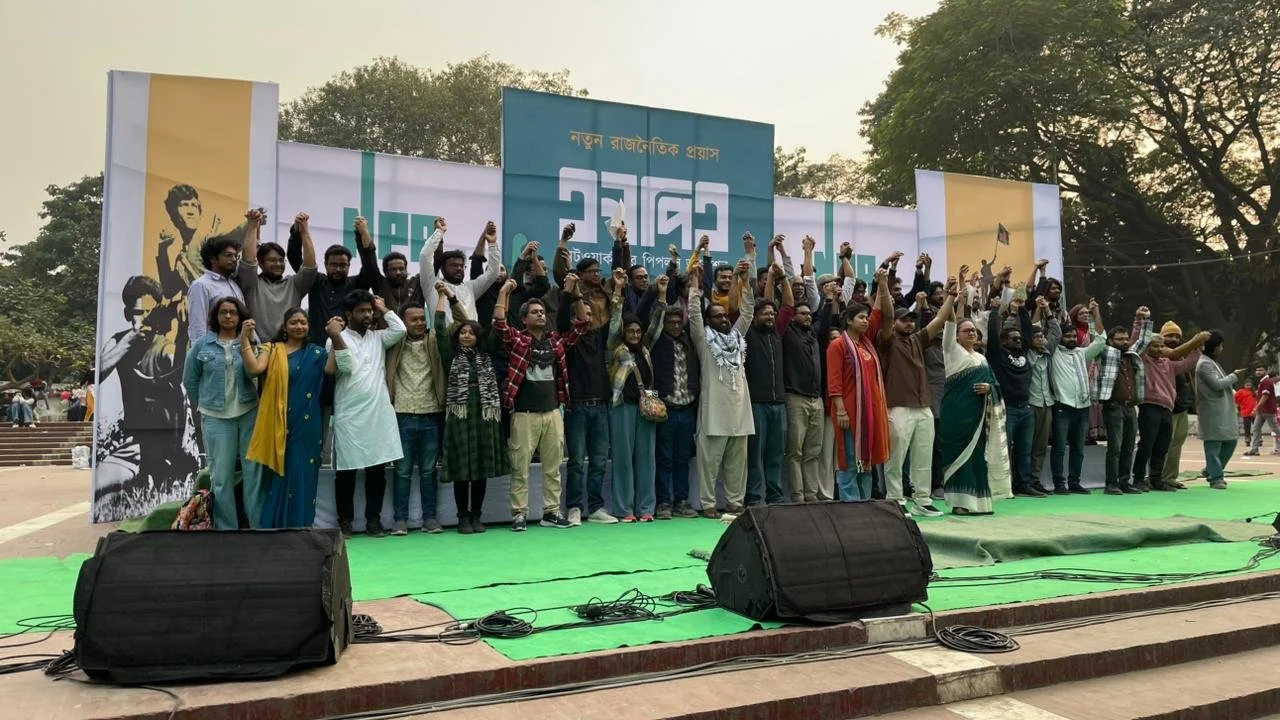
Network for People’s Action (NPA) launch rally in Dhaka on January 16, 2026. Source: NPA Facebook page
Nafis: Wow, yeah, I mean, it raises so many questions. This is all very, very interesting, and I want to dig into some of the things both you and Jawad have mentioned, and are very pertinent to current politics in Bangladesh, and one of them is what you mentioned about being grounded in history, or the historicity of Bangladesh, right? Because one thing we have noticed in the post-July landscape is that there's a lot of co-optation of what history is, and what it's not; it's a reaction to how Awami League and Sheikh Hasan's regime had created this singular historical narrative that without Bangabondhu, there would be no Bangladesh, right? Without Awami League, there would be no Bangladesh. The only history that matters is the history of Awami League in the creation of Bangladesh, right? One of the biggest backlash to that was the burning of Bangabondhu’s house in Dhanmondi 32, right? Obviously there is public sentiment that drove it, which ultimately resulted in what we see as mob-ocracy. But there's also something that Naeem Mohammed had written about - even if you really hate Awami League, that house still remained a critical piece of Bangladesh's history, because it was a turning point. in reversing Bangabandhu’s regime to full-on military takeover five years later in 1980. So when we talk about being grounded in history, what does that mean to NPA, or to you two? I mean, obviously there's no official position yet, but, what is the direction that you see yourself in, and how do you understand history? Given your left-wing orientation, we'd like to hear a little bit about where the materialist analysis of history is embedded in your understanding.
Oliur Sun: Okay, alright. So first of all, I think in response to that, what we have to understand is it was a very organized kind of a reaction. It was not something that's spontaneous because there were a lot of instigators; when you do some kind of activism, there's always instigation, so that's one way of understanding this. But what we have seen globally, that's also a trend. You have some right-wing influencers online, preachers, speakers, and those kinds of people who are actually actively influencing some of the domestic violence which had taken place quite some time after the July uprising.
Nafis: Yeah, the Pinaki-Elias crowd.
Oliur Sun: Right? Of course, absolutely. Thank you for naming them. It was actually quite actively orchestrated. It was not something that's spontaneous, like oh, people are mad about Bangabondhu, right? So that could have happened on the 5th of August. Right? And it did not happen on the 5th of August. People did barge into the Prime Minister's house, the Prime Minister's palace, the Prime Minister's office, and several other buildings as well. They even burned down a couple of media institutions as well, television channels, which were always airing propaganda. You have those types of moments in any sort of revolutionary uprising kind of situation.
But this was not something that we understand as a spontaneous reaction. And again it's part of our critical history, because whoever Sheikh Mujibur Rahman was, he was a leader during the liberation war, and that's something that you cannot erase. It's a historical fact. And, of course, any person can turn dictatorial. Any leader can turn authoritarian. And that is another historical reality that you have to come to terms with. But one does not undo the other. So that's something that we have to understand that a person who was at least the face of the struggle would really deserve a place in history of Bangladesh's emergence. So that's something that I think we are absolutely clear about. And at the same time, that doesn't have to turn into some kind of cultism, so that's also something that I think we are very much against. And I think this is something that most modern nations actually struggle with, because this is an embedded design in the idea of a modern state. You need some kind of a cult that will sustain this state. And I think this is a model that we have inherited quite well from the British Crown. So I think that is actually a design, and it's the problem with the design, and not necessarily with the person itself. Of course, even during Sheikh Mujib's regime, a lot of leftists were killed; there were extrajudicial murders. Siraj Sikder was, or is perceived as one of the first instances of extrajudicial killings during the Sheikh Mujib regime, so let's also take that as a historical fact, so that's there.
But, interestingly, there were a lot of left-leaning political parties, and even celebrated left figures aligned with Sheikh Mujib at that time. So that's also another historical reality, and there is a historical departure of Sheikh Mujib from left-wing Mujibism, and this is also another interesting idea, because Awami League actually had maintained some sort of a center-left or somewhat left image globally. The sort of global image of Awami league that they are this liberal progressive political force, which has helped shape Bangladesh and Bangladesh’s political narrative and what it stands for, its values and all of that. And then at the same time, the domestic experience of Awami League is something that's very different. And from the birth of Awami League, especially post-independence, I'm talking post-1971 right after Bangladesh was born, Sheikh Mujib was someone who had a different role. And then after he came to power, which I think we are also witnessing right now, people who were faces of a revolution quite often turn reactionary, or give in to the establishment, or are not able to manage the post-uprising situation well. And that is something that we have also experienced; the faces of our uprising - people feel betrayed by them. That's also one of the contexts in which NPA steps in.
The disillusionment and the betrayal of people's trust - although we have also seen a very nationalistic drive in terms of understanding of history, you want to challenge Awami League’s co-option of history, but what do you challenge it with? If you challenge it with another reactionary, narrow, nationalistic imagination, then that's no better and that is exactly what has gone wrong. Because you are trying to portray a different kind of vision, something which I think will compare with the Akhand Bharat kind of narrative. So you have this Akhand Bangla, something like that - I mean, there is a map, a revival of the old maps, like I've seen people sharing maps. This gives you this revivalist imagination, which I think is quite popular amongst right-wingers, especially in South Asia. If we compare that with Hindutva, you'd see that kind of weaponizing of decolonization or post-colonial narratives, and narrative making, and then offering a version like that.
We have seen this sort of revivalist moments as well - celebrations or festivals in a pre-colonial way, like back during the Sultanate, the way Eid was celebrated, we're gonna celebrate Eid this time like that, so these sort of revivalist tendencies are also very much present, which I think we are very critical and aware of. Because we are not doing some sort of historical revivalism as well, right? We know that we are at a very new political juncture, at a very new time, and it requires a new kind of politics, so we're learning lessons from everywhere, and we're trying to figure out what strategies would actually work best to challenge this sort of fascistic, narrow nationalist sort of tendencies, but at the same time also trying to have an understanding of how to fight the kind of narratives are out there. For example, according to Franz Fanon, nationalism is also understood as a reaction toward anti-colonial struggle. So, we are also revisiting whether that's still the case, or whether that's something that's still going to work, because something that's rooted in left history or left-wing political history is also the idea of internationalism, right? So I think whether we can fight the global capital within our own nation only is also a question that we are quite driven by.
Nafis: Jawad, do you want to weigh in on the question of history and how you are rooted in it?
Readus Jawad: Yeah, I just wanted to add, like, two or three things. So, Sheikh Mujib's house got burned down on 5th of August, when Sheikh Hasina was deposed. But it wasn't demolished until 5th February, so after 6 months. They took bulldozers and tried to demolish the house. But the house has not yet been demolished, and it has become a ritual. If anything happens with Awami League, or anything happens against Awami League, people go there, tear off some bricks and some rods, so the problem that we have seen after 5th of August in 2024 is a symbolic collapse of society, or the symbolic collapse of the historical narrative. For 15 years, the historical narrative was that Sheikh Mujib was the undisputed leader of the liberation movement, Awami League was the undisputed party of liberation. No other people did anything. Sheikh Mujib declared independence on 25th March, on 16th December, and Bangladesh became independent, right?
This sort of narrative - what it did was replace people's struggle, people's lived struggle of everyday lives, with a sort of great leader narrative, and this has happened in Bangladesh time after time. This has happened before in 1947, for example, in what we called East Bengal back then. East Bengali peasants were one of the main proponents of the Pakistan movement since the Khilafat movement happened. But at the end of the day, when Pakistan happened, all credit went to Jinnah. So, this sort of capture of people struggle by one person or one influential party happened in our history many, many times, and this happened after July also. NCP tried to frame that only they and their allies were the only stakeholders of July, and not everybody had a say, or not everybody was part of July.
Influential political parties and leaders are trying to take ownership of people’s struggle, and we believe why this keeps happening is that the material basis of history has not changed in Bangladesh. Before 1947, it was a largely agrarian, peasant-based country. It's still a largely agrarian, peasant-based country. In 2020, when COVID-19 happened, a lot of people went back to the agricultural sector because industry was shut down. So, the country is still in the same material position, but there has been a new development, there has been a new class that basically is the actual proletariat, because even in a village community, a person who doesn't have anything, who doesn't have any of his own land, can still get by by borrowing from people or trying to survive in different ways. But when urban migrant workers emerged in Bangladesh as a class, they didn't have any sort of social or economic or any other state protection mechanisms. So these urban workers are very agitated, they are very disillusioned with all the development narratives, all the historical narratives, and at the end of the day, July was able to call on them. July was able to encircle them in a way that they felt something will happen from this that will change their lives, that will make their lives a little easier, but that didn't happen. So what we see is that a people’s struggle that has been going on before 1947 has been getting captured by the bourgeois and elite people over and over. So what our understanding, or what our intention is to make people their own spokesperson. We don't want to replace participation with representation. When people have to tell their own stories they have to form their own history, and that's what we have been trying to do ever since July. I personally have done programs to portray how the liberation war was a people’s struggle, how it wasn't just done by one party or a leader. We are in a process of reclaiming our own history, we have a process of reinterpreting the narratives and understanding who benefits from what narratives and how people can actually find their own place in the history of Bangladesh.
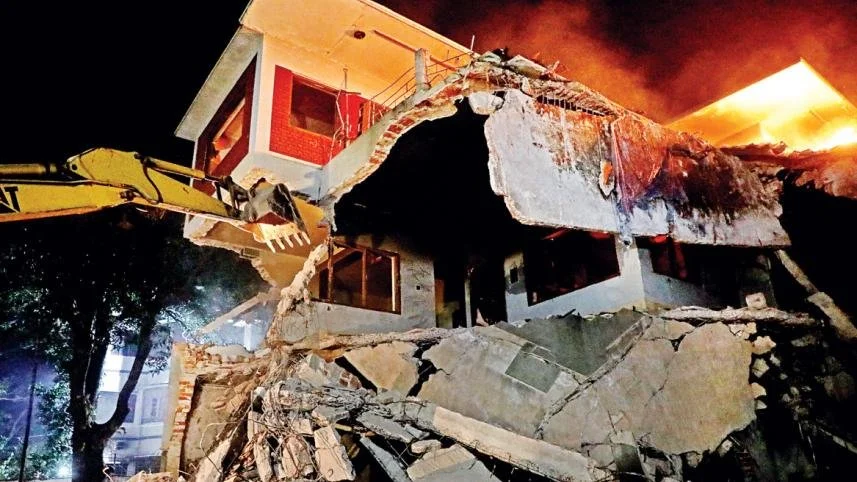
Bangabondhu Sheikh Mujib’s residence and museum in Dhanmondi Road 32, Dhaka, set on fire and destroyed using bulldozer after August 5. Source: The Daily Star
Nafis: That is very fascinating, and I want to shift gears a little bit and move the question towards what you said, Jawad - how your goal is to have people tell their own stories, and what Oliur you had said about how you want to envision a democracy that's beyond majoritarianism. Do you see these things as interlinked?
And if so, what do you think your approach is going to be? Like, how do you make it happen, and what does that look like in the coming years? How do we have a democracy that is beyond majoritarianism? There's so much heterogeneity, even in a country that's 97% Muslim and Bengali. There's still all these different voices, and not just identity-based voices, but also, classes. Like what, Jawad, you were saying, the urban migrant workers had no protection, and one of the biggest things we saw was during COVID, garment factory workers - they weren't sure if their factories were going to open. They walked all the way from their villages and then suddenly the factory worker owners are saying, no, we're closing and they have to walk back. And the state did nothing to help them. So tell me a little bit more about how you envision bringing that sort of democracy to people, which is beyond representation, beyond majoritarianism.
Readus Jawad: Well, I would say that, our organogram would give you a very basic idea of how we want to do this. Basically, we have two councils - one is the Central Council that has been published, and another is an executive council that will be published in the next press conference, probably next week. Both of these councils are democratic; there's no hierarchy, nobody takes the decision, everybody sits down, we have a meeting. We hear everybody's concerns, and then we move on to voting, and even after voting, we talk about the problems that our decisions might generate and how to mitigate them. So we are functioning like that and we intend to do the same in every other scenario. For example, we have already received thousands of applications from all over the country who want to connect with us. We are planning on meeting each and every one individually. We don't want to do it over Zoom, we don't want to do it over any sort of written interview or anything like that. We will go to their localities, we will go to their areas and we will connect with them, connect with their community, and hear their stories from themselves. We don't want to replace their voices with ours. If we have an issue that we have to address, we will bring the direct sufferers or the direct victims of that issue to.the forefront. We don't want to make or take people's narrative for ourselves and do politics with that. So that's one of our concerns. And secondly, what we want to accomplish at the end of the day is to enable people to talk about politics. And create an environment that will make them feel safe. For example, we took decisions in the Central Council even before the NPA was officially formed that I didn't agree with, or that Oliur probably didn't agree with. We made many of those decisions, but at the end of the day, we believe that if we don't respect each other's dignity, each other's understanding and perspectives, we will never be able to grow as a political party or any sort of political entity. So, we have this approach to direct democracy, if I should say, that we want to implement everywhere. We want to have these direct lines of communication with the people, with the masses, and we want to bring their ideas and their voices into the mainstream, where they have been perpetually marginalized.
Nafis: Oliur, did you want to add anything to that?
Oliur Sun: This is another challenge that I think people have not yet been able to sort out, that is, how do you NOT do identity politics and still have diversity in the room, or in your decision-making process, how do you make sure it's not just a bunch of men making or getting more ground than others. This can actually happen in many political settings, especially in party-making decisions, because, even in platforms, even in organizations, this is something that I have seen repeatedly happen over and over again, and this is actually a problem with left-wing parties in our country. So that's something that we have to be extremely aware of, and I think we are still in the process of developing a strategy. Jawad was mentioning about the Executive Council and the Central Council, but then we also have a General Assembly, and then at the same time, we are trying to currently reach out to people who are interested. We have already made contacts, we have already filled out forms, but then, you know, there's also a digital divide in the country, so there's actually a huge chunk of people who do not have access to internet, or not as active on social media, or would not be able to fill out a Google form, so you already have a class barrier right there.
That's also something that we have to take into account and set our strategies in a way so that we can go beyond that kind of digital divide. And this is something that we are actually trying to form, and there are a couple of decisions which are kindly being made in terms of how we reach out to people who are not in our room. For example, do we want to listen to a Hijra person, or do you want them to make part of our decision-making process? Do we have someone who is an informal worker? Let's say, for example, a domestic worker who doesn't really have any sort of protections whatsoever, not even a formal contract with their employer, so do we have someone like that when we are making or planning our economic strategies, when we are planning our programs. So it's very important for us, I think, to look in the room and see who is there and who is not, instead of someone who perhaps already has a social standing. Or, you know, someone people already know, and this is a problem with most of the parties, right? You do go after the celebrity cult - like, who is in your party, who is a well-known, popular kind of face? And then they end up gaining more credibility, or their voices are heard more or taken more seriously than others. This is a very serious challenge that we have to settle and we're still trying to build strategies to resolve that. We haven't figured it out at the moment, but we are trying to reach out to communities which are usually not represented.
This is a problem with any political party. Even if you look at any political party globally, most of them, in their decision-making bodies, will not have people from historically marginalized groups. And, they might have someone as their face of the party or someone as a member of the parliament, but in the decision-making body, you will not actually find them, and that is actually where the limits of this sort of identity politics come in, because they are always used as faces, never as decision makers. So this is actually something that I think we want to take up as a challenge - how do we have people from different groups which are historically marginalized, and put them in a room while we are trying to make decisions? And they should be in the decision-making body, so whatever they can agree on the commonalities would benefit or offer us a vision of material conditioning which actually is going to apply to everyone. So I think that sort of strategy making might help.
And this is something that I have not seen practiced anywhere, even in left-wing platforms, networks, even NGOs, you name it. Most of the platforms don't really have them in decision-making bodies. They will go and listen to them, but then you are going to be the voice for them. And you don't know them, and then we are judging that person based on their connection with the communities, right? I mean, I'm just speculating like, for example, you'd find a straight guy working with the trans community being their voice. Or maybe, a middle class privileged person translating what the working class needs are. That sort of issues are inherent especially when you are trying to make decisions for a community who are not there, or, you know, who are presented through someone else. That's a very big challenge. So that's something that we are actually trying to figure out because Bangladesh, although it's a very small land, we're actually dealing with a large number of people from different demographies, from different social class positions, even caste, I mean, we don't really talk about caste in Bangladesh that much, but that's also something that we have to take into account. You have Harijians who work as cleaners, and they are someone who is completely out of the political imagination. And then you obviously have the Rohingyas, which, we have sheltered them, but they are not even part of any consideration whatsoever until recently - there is an ongoing conversation like the Bangladeshi government has offered Rohingyas who are stuck in Saudi Arabia that they would be given Bangladeshi passports. That's also something that's not really part of the political mainstream discourse. What is part of the political mainstream is the idea of repatriation. But then nobody knows how that's going to happen, and Dr. Yunus is making promises that by next year, most Rohingyas will go back to their homeland, and that obviously did not happen because you are dealing with a very different political reality there. So how do you deal with these people when they don't even have an official refugee status?
“Even the left-wing parties have failed us in terms of delivering those ideals, because there’s always been this tension between cultural versus material welfare, and most of the left-wing parties are more interested in carrying on the banner of secularism rather than carrying on the banner of free healthcare”
And in a country like Bangladesh with its economy, we are told that you cannot afford to offer them some sort of refugee status, because then the question of rights comes in. And then how do you settle that? How do you make sure that they have the right to education, or the right to healthcare, and all those kinds of things. So that's also an ongoing issue that we have to come to terms with, something that we are actually thinking through. We are currently building strategies so that, at least in the decision-making process, decisions should be made in a way by who is not represented in the decision-making body, and they should have a say, even if they don't hold an official position. I think this is how at least certain decisions should be made, where you actually look in the room, and you realize that, you know, most of the people are not actually here. So we need people from historically marginalized communities to be in the room, so that we can agree upon something in common. And those sort of commonalities are exactly something that we are trying to look at, and that again includes material conditions like healthcare, access to public services and maybe even transportation, which is something that is not really part of our mainstream political discourse.
Even the left-wing parties have failed us in terms of delivering those ideals, because there's always been this tension between cultural versus material welfare, and most of the left-wing parties are more interested in carrying on the banner of secularism rather than carrying on the banner of free healthcare. So that is a very big challenge, and you see that most of the left-wing parties are in the primary phases of this secular liberal struggle, rather than some sort of material conditions, conditions which actually are going to benefit the people directly. And that's exactly the biggest challenge we are currently facing. If you can have free healthcare for everyone, then everybody benefits - people who cannot afford healthcare, people who have to go to public healthcare services for critical diseases or injuries which require critical attention. People are actually heavily reliant on the public healthcare services, and that's something that they're not currently getting, and the public health system is not being able to deliver the needs that they have right now.
So that's going to be part of our agendas as well, and we are trying to base ourselves in terms of how we can create strategies for material welfare, and not going back to some sort of Chinese cultural revolution. and again, that's also a part of our conversation, like, whether we subscribe to Chomsky as China being sham communism, or whether we want to take that as a model where people actually have been struggling with this as well. how do you come to terms with industrial capitalism?
Nafis: Oliur you brought up some really good points, and I'm really interested in dissecting this material versus cultural fights that we have had, because it seems to be a very big spot in contemporary left politics in Bangladesh. But I do want to go back to the question of identity politics and tokenism that you brought up, especially in the case that we have seen post-July. And it's not just in Bangladesh, right? Like, for example, for the longest time the right wing in the U.S. are xenophobic, they're anti-immigrant, or anti-black people, right? However, they do have representation from those communities, right? In the last election, we saw a rise in the number of votes in almost all immigrant and people of color communities for Trump, right? So, similarly in Bangladesh, what we're seeing is that, for the longest time, the belief was that Awami League was the party for the Hindus, Awami League was the party for the Adibashis, right?
But the case of Sarbamitra Chakma, which presents a very interesting case study in identity politics and how it can be weaponized, and I would love to hear your analysis of that situation. Sarbamitra Chakma ran on right-wing platforms, right, which was very different, because we saw that the same parties or the same groups who supported Sarbamitra Chakma were also connected to the people who beat up Adibashis on the streets of Dhaka, and who championed the full military occupation of CHT forever, right? Because they think, no, this is part of Bangladesh, there's a separatist movement going on, right? So how do we understand identity politics currently in Bangladesh's political landscape? And also, how do you figure out a way where you're not just using tokenism? One thing that has come out in the wake of Sarbamitra Chakma's case is that , there's no way to say Adhibashis are oppressed, because they will say, well, look at this guy, he is part of NCP, or, like, he was part of NCP, and he went pretty far. There's also representation of Adibashis in the members of parliament, etc, so why are you saying they are oppressed?
But we know they are oppressed because there's members of the Bawm community who have been incarcerated without any sort of charges against them for more than 500 days now, and the government is not saying anything about or justifying what exactly are the allegations against those folks. So, tell me a little bit more about, like, in the current political landscape, how do you see identity as a political object?
Oliur Sun: I mean, I'm talking about what people look like, their face color, their skin color, their biologies, for example. But this is a check that I have used, and this has worked more or less so far - checking for privilege, because Sarbamitra doesn't really represent the struggle of the Adibashis in any way whatsoever. He comes from a very well-off middle-class family and went to elite schools within Rangamati; has attended Notre Dame College in Dhaka, so he's not someone who is directly a victim of, let's say, a land grab by the military in the Chittagong Hill Tracts. He's not the kind of adhibashi who is struggling or fighting for their own land, not even someone who is struggling to at least make the CHT accord a reality. So that's something that we have to understand - he's not someone who shares the Adibashi struggle. Now, if you want to make him the face of Adibashis, you know, sure, go ahead. But he does not represent the struggle. So he's someone who doesn't really have a stake in the damage,for example, he doesn't feel for the Bawms; like, they have been incarcerated for … actually, it's going to be 700 days really soon.
And they were arrested during the Awami League regime, and the interim government did not even release them, so they're still in jail. Although, a lot of people were released from jail without any sort of formal legal processes, but then you have members of these communities who are just stuck in jail, basically, and nobody can even legally help them, so that's the kind of reality that we're dealing with. And then you have, you know, people like Sarbamiitra Chakma, who people take for face value, because, you know, here you have a face of the indigenous.
People who look different, so you go after the bodily other, right? That's the sort of, I think, identity and politics that we are actually dealing with, and this is something that also goes back to even the US. You have Melania Trump, she's white, she's the first lady, but cannot even speak English properly, and so how do you reckon with that reality? Does Melania really represent the immigrant struggle? She clearly does not. And in the very same way, Sarbamitra also doesn't represent the indigenous struggle. So, who is going to come to the forefront if you really do a privilege check; like, who is privileged in terms of what? Someone can be Indigenous, but then you have indigenous people who own multiple buildings in Dhaka City with extreme wealth.
And then you obviously have different groups as well. He belongs to the dominant majority of the indigenous group - Chakma, and then you have people from other communities, even Marma is also the second dominant group. So, you really have to understand the struggle of the indigenous communities to actually understand that he's not the representative of that community, or doesn't represent their struggle. Or the commoners within that landscape.
It's actually not too difficult, honestly; if you really look or check their privileges, I think then it becomes quite apparent. So, yes, the idea of identity is very much there, and this is something that Jamaat has used a lot, because they are the prime face of Islamist political positioning. They have a Hindu candidate running for election in Khulna and you really have to ask, like, is this person really representing a Hindu community whose house has been burned down by miscreants or Islamists? So if that's not really the case, then you can't take them as the face of, or as the representative of the community.
And I think that's something that's not too difficult to dissect or understand. We also should not take people as stupid, because people actually understand these kinds of things quite well. Because what we are dealing with is actually identities who are co-optable, right? And that's something that people are going to enjoy, right? Especially the right-wingers, especially the nationalists. Who is this ideal other? So the ideal other is the other who is going to work for us. Who is going to serve our political agenda, and not the other one. Not the one who protests, not the one who stands for their struggle, but the one who actually carries on our mantle, carries on our struggle, which is the sort of majoritarian agendas, the kind of negotiatory politics to which they're going to act as a bridge.
So it's basically a sort of sham representation. They don't really represent anybody, they represent privilege. Right there, that's what they represent, and they actually want to have the sort of privileged positions within the society to create a space for their own. And I think this is something that left-wing parties have also struggled with. Like you become a face, then how do you not fall for the celebrity cult? How do you avoid the idea of glamour, right? It's glamorous, and then you attract attention, you attract privilege. How do you really deal with that reality? And it's easier said than done. I’ve even seen seasoned activists falling for that sort of celebrity cult. Once you become a celebrity, you have a position in power, and also you get treated slightly differently in terms of positionality that you have acquired. So how do you really deal with your privilege? And how you do not get blinded by your privilege is also a very serious task that I think we all have to be extremely, extremely aware of.
Readus Jawad: Yeah, I'll just very briefly say two things. Firstly, about Sarbamitra, the most interesting aspect of Sarbamitra's activities around the campus and regarding DUCSU, is that he is basically being told to do the dirty work of the panel he was elected in. He was elected in the panel for Islami Chatro Shibir and he's basically being directed to do their dirty work, to beat people up, to evict homeless people from campus, evict small business owners, small vendors from campus, and, this is not something new, like Sarbamitra has been doing this since last September.
The problem is, what happens in liberal democracy is that we inherently understand that someone does tokenism, if, for example, BNP is also a very tokenistic party. We are talking about Jamaat-e-Islami, but BNP is also a very tokenistic party. BNP had a woman as their chairperson for the longest time, but at the end of the day, they couldn't find 5% women candidates for their election. In Bangladesh, what happens is that tokenism is viewed as intention, right? So, when Jamaat nominated two, three people outside of their party, outside of their student organization, or nominated two, three women in the DUCSU election, and in other student council elections, people thought that, okay, they will change, they will have some sort of revolutionary change later, we will see some of this reflection in the election. But there is no reflection of this in the election. Jamaat did not nominate a single female candidate.
And secondly, I would say that we have to understand how class can overcome some sort of identity barriers. For example, a person who has been.evicted from the Dhaka University campus by Sarbamitra will be more - it doesn't really matter how right-wing he is - he will be more empathetic to an Indigenous person who has lost his land because of development projects or because of army building a barrack in his backyard. So, these emotions are very common, but we have to link those emotions together, we have to make people understand, convey the message to the people that all of our struggles are basically bounded, together and against the same entities, at the end of the day. So, this is how I believe that the identity barriers can be resolved according to class lines.
Nafis: There is that idea of intersectionality which posits some form of similar thing. What you're saying is that class and race are not mutually exclusive, or there is a politics that can combine both of them, right? And I think it has been difficult for the Left, not just in Bangladesh, but worldwide, especially also in the Western Hemisphere, to articulate a politics like that, because often, like what you're saying, we swing one way or the other. There's also strands of Marxism, or Left thought that have strayed one way or the other, right? There's that idea called vulgar Marxism or class reductionism, where everything is boiled down to class, versus, people swaying way too far into the identity politics realm, where the identity becomes the animating factor in your politics, right? But one thing that has really been a sticking point in Bangladesh politics, ever, I would say since partition, is this existential crisis that Bangladeshis have, like, are they a Bengali first, or are they a Muslim first? And it seems like this question has come to the forefront once again in the post-July political landscape because Jamaat, they are very smart. They have spent a lot of time building out their infrastructure, as we have seen in the student union elections countrywide. But they have never been able to get more than 15 to 30 seats in the parliament, right? So their power lies in this grassroots level, but they're never able to articulate that power upwards into the parliamentary level. But this time, it seems to be different, right? Because they are articulating a version of we are Muslims, right? And I think in a reactionary move towards Hasinas' regime, that seems to be taken up by Bangladeshi people. Like, they're more accepting of that fact, because Awami League was always seen as the face of secular liberalism that posited that we are Bengali first, right? So, how do you view this question of Bengali versus Muslim? Is that an animating driving force of how political parties are rearranging their views of what it means to be a Bangladeshi?
Readus Jawad: Okay, so we have to understand that there's no binary choice of being a Bengali or a Muslim, right? For example, there is no one singular Islam - if you see the Islam of the Middle East, if you see the Islam of Saudi Arabia, and if you go on into the Levant, and then you go into Turkey, you go into Iran, Persia, and then other Muslim-dominated nations in Middle Asia, you come into India, Pakistan, Afghanistan, and then you come into Bangladesh, and then into Indonesia, Malaysia, all of these countries have their distinct cultures and their distinct versions of Islam, right? So, in Bangladesh, Muslim is not really just an identifier of religion, it has almost become an identifier of class.
Because at the end of the day, what the hegemonic political narrative was that in 1947, we created a nation for Muslim peasants in East Bengal which became Pakistan and everything. So, at the end of the day, what people were saying is that if we make a Muslim nation, just because of our religious identity, that doesn't make us coherent as a nation. So that's when we saw the rise of Bengali nationalism and the lead up towards the liberation war. But now that we have our own country, we don't have to choose between being a Muslim or a Bengali. We can do whatever we want to do. Whoever puts this dual loyalty test to the people of Bangladesh are their enemies. This is very obvious. When someone tells you to choose - become either Muslim or a Bengali - they are actually dividing people, they are actually creating a tension that doesn't and should not even exist.
So that's my point. And secondly, what I believe is that what Jamaat has been trying to do is that they have seen the rise of this religion-driven rise in fascism in India, also in Afghanistan, also in Pakistan at various times. So they're trying to emulate this. They're trying to unify the nation by using Islamic moral framework, Islamic language, and Islamic languages of justice. They are trying to unite the nation by showing them this big other exists, that Hindutva is coming to get us, or Modi is coming to get us, Akhand Bharat is coming to get us.
“When someone tells you to choose - become either Muslim or a Bengali - they are actually dividing people, they are actually creating a tension that doesn’t and should not even exist.”
But at the end of the day, it will not endure, because being Bengali and being Muslim, is inherently baked into the existence of many people in our country. Like, even the most hardcore person who doesn't want to have anything to do with Bengali culture, anything to do with Bengali identity, still eats fish with rice. That's the most Bengali thing to do. He still is going to talk in Bengali. If he wants to curse someone, he's going to curse in Bengali. He is not going to curse in Arabic, right? So, these things are very inherent to one's existence, and when we take into account this plurality of understanding - some people may want to be Muslim before they want to be Bengali, and some people may want to become more Bengali than their Muslim- that doesn't really take away from our national strength, from our national identity, and that does not need to be as divisive as political parties make it to be.
Nafis: I have a quick follow-up question to that. I know the referendum, the Gonobhot, that is also on the ballot; they are proposing to change the constitution from saying we are all Bengalis to we are all Bangladeshis. I'd also like to hear your take on that.
Oliur Sun: I think I'm going to go back to the previous point; I think that's also going to address that issue as well. The problem is with the modern state, and why do you always have to have some sort of ethno-nationalist framework for a modern state to be operational and why are citizens being always asked this question, or having to choose an identity in order for the modern state to function, like that is where I think the problem starts. And of course, you do have that historical reality where there is an identity crisis because of 200 years of colonialism, so that's also something that we can't ignore. There's a lot of epidermalization of inferiority that people have. Out of that, a lot of reactions, especially in terms of identity, actually springs up… it's almost like people are constantly in a phase of existential crisis, right? And that is also actually a psychological reaction - to actually dissect that as well, because I think the sort of deep psychological damage of colonialism has not been addressed politically and that is something that needs to be debunked. Fanon also talks about this in his writings, right? The making of a new man who would be able to go beyond this internalized idea of inferiority. Identity crisis inflicted by having to choose between you and the superior being, like, the whites, the colonizers, and then you have yourself, so how do you really sort of deal with that kind of crisis psychologically is something that has an immediate effect. And it's also a narrative, I think, quite a popular narrative in terms of how Islam was introduced to Bengal, and why people developed a certain sort of attachment or affinity towards that sort of Islam or Muslim identity.
At the same time, you also have to account for the reality that how was Islam, or the Muslim identity, or even, for that matter, Sanatan identity or Hindu identity was constructed, reiterated during the colonial state during the British Raj, and what is done to the idea and ideation of people, their understanding of their existence, their, attachments and sense of being during that time. Which has then, obviously, been replicated in this modern state-making process when you have India and Pakistan completely being divided based on religion. And that is a reality that we have to negotiate. So I think the idea or the split between Bengali and Muslim actually dates back to that sort of problem. And, it's something which I think has repeatedly been debunked by several intellectuals, but the problem here is most of the political parties have not really taken that up. BNP had or did preach some sort of Bangladeshi nationalism, something which you were actually referring to, like the Constitution revising that Bengali identity and putting in Bangladeshi as a more inclusive word, which I think, by the book it works, most definitely, but then we also have to be critical of that sort of history, where you have history of Bangladeshi Nationalist Party (BNP) actually orchestrating demographic engineering in the Chittagong Hill Tracts, displacing millions. Or if not millions, thousands of indigenous people, have had episodes of migration into neighboring countries, so how do you really deal with that? Like, you have Bangladeshi nationalism, which has actually caused that. So, having that in the Constitution does not necessarily translate into better politics, or doesn't really change the ground reality.
And again, it's because of the colonial administrative legacy that we have continued. People are actually quite removed from these institutions, and that's also something that we have to understand. People don't want to visit a government office because it's alienating for them. So what have we done to actually revise or attend to that sort of anxiety. Why do people feel alienated in a government office? It's where they should be going to take services, right? So, that is also one of the important political tasks that most of the political parties have not really taken up, and revising this whole sort of structure, which is a direct legacy of colonialism, and again being modeled after an ethno-nationalist modern state.
And I think globally that is what is actually in crisis. In the US, even in Gaza, the idea of an ethno-nationalist framework would repeatedly come up. So, I think the question of Bengali versus Muslim actually is a very ethno-nationalist sort of question. And there's a very right word for this sort of debate in Bangla, which is called কুতর্ক (ku-torko). I don't know an English equivalent for that, but I think it's something similar to that. Because you're having to sort of, you know, choose between your identities, and here I'm very Zizekian. Like, if you go deep into yourself, you find there's no reason for you to choose anything. You're under an organization, which is a state, which is an almost violent organization to a certain degree. So, the negotiation should be with an organization, without having to choose any sort of identity. I'm a citizen, and that is my primary identity in a country. I have a Bangladeshi passport. I'm a Bangladeshi passport holder. Whether I'm a Bangladeshi or Muslim doesn't change the fact, or doesn't change the reaction of an immigrant officer in the U.S. when they see the Bangladeshi passport. And that is exactly something that we have to deal with. So maybe, having the word Bangladeshi in the Constitution would help in terms of, let's say, having a legal fight, in terms of making more room, especially when we are making policies for everyone in the country. So it does help, you know, legally speaking.
But then I'm also not sure of the sort of material reality or the material translation of that legal framework, and that is something that is actually our work to be done. It's not ready yet. And that is exactly where we step in, I think, as a political platform.
Readus Jawad: These sorts of terms - Bangladeshi or, like, any sort of nationalistic terms - they don't mean anything to people who cannot avail their basic services. For example, a person who sleeps on the streets of Dhaka, he does not have the ability to get a national ID card. It doesn't matter what we call him. It doesn't matter if we call him Bangladeshi, or Bengali, or Muslim, or Bengali Muslim, or anything. He doesn't even have a way to prove that this is his name, right? The name he calls himself, or who are his parents. He doesn't have any sort of identification with the state or the nation. So, like, creating this sort of cosmetic band-aids for the existential and identity problem in the core of this Bangladesh state I don't think will be very fruitful in the long term.
Nafis: Yeah, and I think when you were saying that, that really brings us back to the question of, what the Left has spent years doing, getting into cultural fights versus material fights on the ground, is something that I heard in the last couple of years. There was a video recording, maybe, of a rickshawpuller who had said, or, like, something to that extent, where basically it was an expression of saying that I want the freedom to be able to feed myself, or feed my family, right? And that's where, really, it comes down to, is that.
Regardless of these larger questions of ethno-nationalism or identity and class, it comes down to, like, okay, are people able to even survive in this country? And I think, that's been a vacuum that the left has not been able to fill and I was wondering what you think about, or where do you see NPA filling in that gap, and how to fill in that gap? And I know you referred to some free healthcare programs, that I don't know if that was hypothetical, but is it something that's going to be part of your platform? How do you see reversing that trend of just getting bogged down by cultural fights?
Readus Jawad: First, I have to give a disclaimer - we don't have any sort of resentment or disrespect to any leftist parties in Bangladesh. We view all of us, all of them, as our comrades, and we are very much willing to work in solidarity and in cooperation with them. Just to get it out of the way. But the problem with leftist parties in Bangladesh have been the fact that after 1990, after the fall of the Soviet Union, what happened was that the largest leftist party of Bangladesh, Communist Party Bangladesh (CPB), was basically in a very frozen, a very decision-paralyzed state. Like, they could not take any other strategies, right? So, almost all major leftist parties in Bangladesh do revolutionary politics. They want to overthrow the whole class structure through a violent or non-violent revolution, and after that, they want to create a state or a society that will be beneficial to the proletariat, and then that will crush the oligarchy or the bourgeois class. But at the end of the day, what happens is that in a global neoliberal order, something like this revolution is very distant. People don't really believe that something like this is going to happen, and what happens is that the communist parties or other leftist parties often fail to articulate to people how they can improve people's lives within the existing framework of a liberal bourgeois democracy. So they talk about revolutions, they talk about how they will upend the cost structure, but at the end of the day, people don't really care about that. People care about their day-to-day needs. I have worked in a leftist party way back in my school days, and whenever I talked to people, people would say, okay, you are going to do a revolution, okay, call me when the time of revolution comes. Like you are not offering me any intermediate solution between this time and revolution. What am I supposed to do now?
So, our goal from NPA is to give people those specific very grounded solutions that we can do, we can tangibly do, and how we can improve people's lives systemically. For example, Oliur talked about healthcare services and, one of our, for example, major parts of our policy platform is the formalization of workers. In Bangladesh, 85% of the workers who are part of the workforce work in the informal sector. They don't have any sort of rights, they don't have any sort of labor protections, they don't have any sort of standardized wage or anything like that, they don't have any workplace safety or regulations or anything like that. So, what happens is that these people, if we go to them, if we talk about revolution, if you talk about upending class structure, these people may be very sympathetic, but he is living a day-to-day struggle. He cannot throw himself into that politics from the very beginning. But what we are going to offer these people, or what one of our policy platforms is, is a formalization of the economy. We are going to offer a minimum wage, for example, or standards for regulations, standards for, for example, street vendors, standards and regulations, for example, day laborers in Dhaka, or in other places. We want to make a very impactful difference in people's lives that leftist parties have often failed to articulate to people.
“From 5th August to 8th August...the people became united, people put up mechanisms for self-defense, people put up mechanisms for self-rule, people put up mechanisms for conflict resolution... But what happened after July was that their political agency was very deliberately stripped away from them.”
I'm very sympathetic to their ideas, and I'm very certain that many leftist parties actually have those solutions in mind, but their politics is not geared towards providing this solution. Their politics is geared more towards bringing a revolutionary change in Bangladesh, which is basically a very difficult task thing to do, and this is why I think leftist parties often default to a sort of cultural battle, or sort of culture war, because when you don't have anything substantial to say to the public, what are you going to do? You are going to see that the right-wing is fomenting some sort of social conflict, some sort of cultural conflict, and you have to talk about that, because that's the easiest thing to do, and that gets you some reaction that's, you know, the very basis of reactionary politics. It gets you credibility, it gets you media time, it gets you attention from people, so it becomes a very shallow, but effective outlet for political activities of leftist parties, and I have done that too in during my student activism days, I have done similar sort of culture war activism, but at the end of the day, that is because we didn't have a plan.
Oliur Sun: Yeah, and just to add to that, I think what we offer is, first of all is a platform who are not running for this year's election, but are very serious about electoral politics. And this is something that the left-wing parties in Bangladesh have not taken seriously. They're not sure whether to wait for a revolution, or, you know, have a couple of candidates for election, so they're always somewhere in between. They have their feet on both boats, and you can't really do politics like that, right? If you're serious about electoral politics, then do elections seriously. But then they're also not serious about elections, they're also not serious about revolution, so that already puts you in a very confused state, and that is something where I think we step in. We are very serious about electoral politics, like, you are operational under a very problematic, obviously democratic system, and that's okay, but being very serious to engage with that problem is something where our commitment lies, and I think that is very significant, if not a total departure, but I think that is a very serious difference between already established left-wing parties who are, again, somewhere confused between having a revolution and an election.
But we are very clear about that, at least on that front. And also, I think the idea of right to well-being, and I think if you can address the idea of well-being, the word being is already in the word well-being. So, if you can address right well-being, I think people's being are quite settled and satisfied. At least, then you have other things to worry about. And this is something that I think also goes back to the time of partition when a lot of left-wing parties… actually it was a very popular slogan, right? This is a false freedom, and millions of people are hungry and starving. So I think that's also something that we take very seriously. And in addition to that, we cannot ignore the fact that Bangladesh is actually one of the most climate-vulnerable countries, so right to air, clean air, right to clean water, to clean land, most of our land is actually heavily contaminated with lead… how can you not have that as part of your political agenda? You go to any political manifestos or any political policies of any left-wing parties in Bangladesh, they will not have a single article, and I say this because I was also part of left-wing organizations for a very long time. They don't really have that as part of their political agenda. So who is going to bring this up, right? I mean, not someone whose primary funders are some industries who are causing all this pollution, or, you know an organization for pesticide is also your funder, you are not going to have that as part of your political agenda. So, it's the left who already should have had that as part of their political programming, but they don't. And that tells us about something, right?
There is a lack of update in terms of how you should or how you can do politics. What are some of the relevant and pressing realities of your time that you need to address, and that's where I think most of the established political left parties have fallen behind, and that's where I think we step in as a comrade, of course, not as someone who is going to oppose and all of that, although we have had significant amount of frustrations with a lot of meetings, and we know where they go and a lot of these conversations where some of them are goes back to the idea of Cold War, that, oh, historically, left-wing parties have been vilified, which they have been, yes, true, but then at the same time, for how long can you really sustain as a political entity if you are always playing the victim? Which, I mean, again, I think the right-wingers are better at playing victims rather than the left-wingers are, or able to garner some kind of sympathy, so that's also something that I think we have to address, so we are not here as victims, we are not here as. again, not some harbingers of revolution, necessarily, but we do offer tangible, implementable material policies which will have a direct impact on people's lives, and that's where I think a strong commitment, you know, lies, and especially things which have been historically ignored, right? I mean, air, water, food.
And, you know, contamination and pollution of all kinds, and that actually addresses a lot of realities already. For example, even when you start talking about pollution, you would be able to name the polluters. and they are always 100% some corporate industries. So that already addresses that, you see, and then you already have a sort of quite left-wing positionality already. So it's actually about how you articulate your politics, and that's something that we are quite interested in, aware of, and we want to take this as a challenge head on. And of course, nothing is guaranteed, everything is precarious, but we want to address the precarities that exist in the world, but we want to take that risk.
Readus Jawad: Yeah, I just wanted to add one thing. You see that, during Sheikh Hasina's time, during Sheikh Hasina's rule, we were almost very certain that something is going to happen, because Sheikh Hasina is not, never going to allow a peaceful transition of power, right? So something is going to happen. Something like a revolution, or a civil war, or something, something like this, like July, August, is going to happen. And almost all leftist parties knew that. If I know that, if a Master's student of economics knows that, of course leftist theoreticians, of course leftist politicians knew that. But they didn't… they were not able to capture that revolutionary momentum, right? That revolutionary momentum was ultimately captured by Jamaat-e-Islami. And, like, people who are associated with Jamaat-e-Islami often say that they are the biggest Leninist party in Bangladesh, right? They are doing the revolutionary politics that right-wingers, , sorry, left-wingers are failing at. So what we want to do is, at the very end, at the very least, we want to be a rallying point for people who want to have tangible change, and at the same time, people who want to have sort of people-facing front for their revolutionary politics, because at the end of the day, there will always be, and we will always have support and respect for people who do revolutionary politics, people who do armed struggles, and all that. So, we are not discouraging that, we are not vilifying them. We want to work with them and provide them a source of outreach to the great masses.
Nafis: Yeah, that's a very interesting point that you made, that Jamaat is ultimately doing the sort of mass politics that left-wing parties have always envisioned in Bangladesh. I wish we had a lot more time. I wish we were doing this in person,but, you know, for the interest of time, we do have to close soon, but I do want to ask one last question. And I know we didn't talk about India or geopolitics at all, and that's such a big thing right now that's animating Bangladeshi politics, right, especially with the killing of Osman Hadi and all of that. But I would say, like let's say, if you could summarize your assessment of the July Revolution and its aftermath so far, and where do you see NPA’s politics moving beyond the February election? So, kind of a two-part question. Like, one, what's your assessment of the July Revolution till now? And then, where do you see NPA’s politics moving forward after February?
Readus Jawad: Well, my assessment of July will obviously be subjective, because I was studying at Dhaka University at the time. I was on the streets almost every day, so it's very subjective, but for me, July is yet another passive revolution in Bangladesh. Basically, it happened through people's blood, sweat, and tears. Ordinary masses rose up, and they sacrificed their lives, but at the end of the day, if you look at the progression, what happened in July, on 5th August, Sheikh Hasina fled. From 5th August to 8th August, the people of Bangladesh, the people became united, people put up mechanisms for self-defense, people put up mechanisms for self-rule, people put up mechanisms for conflict resolution. Hujur people, religious people, or Islamic scholars went to temples to safeguard them, went to mazars to safeguard them, to shrines to safeguard them, so people claimed their political agency after July and during the movement.
But what happened after July was that their political agency was very deliberately stripped away from them. They were given a government, which we still don't know who formed the government, who decided who the advisors are going to be. Nobody knows anything about this. There's no transparency still. So, at the end of the day, what happened was that people's political agency were being taken away from them as the new government was being formed, and the new government, you know that there's been this talk of reforms and everything, but reforms that are very tangible, that can improve people's lives tangibly, those reforms have not been passed. The Women Reform Commission's report has been basically thrown away. And for example, the Mass Media Reform Commission has also been basically suppressed. They didn't really do anything with their recommendations. RAP has not been abolished. People have been talking about the evolution of the Rapid Action Battalion (RAB) for a very long time, RAB is still operational. So, at the end of the day, what was bound to happen after July didn't happen, because people were not allowed to practice their own political agency. I believe NPA's primary goal and primary objective should be to bring people back into politics. We have to make people understand that in July, you did your own politics, you went to the streets, you chanted your own slogans, you made your own demands known, and that's why you got the results that you wanted. If you don't continue this process, if you do not participate democratically, and I'm not talking just about agitation and street protest, that this also comes down to policy discussions, this also comes down to many other very small, procedural things that have to be done with the consent of people within our party and within the state, as a whole.
“ we want to make people do their own politics, we want to bring people into our political fold...and we want people to realize that they have to do their own politics at the end of the day. They have to reclaim their own political agency. ”
So, we want to make people do their own politics, we want to bring people into our political fold, we want to take them into confidence, and we want people to understand, and we want people to realize that they have to do their own politics at the end of the day. They have to reclaim their own political agency. There's no substitute for that. There's never going to be any organization. who is going to do your politics on behalf of you, because at the end of the day, whenever people relinquish their own political agency in the hands of others in the history of Bangladesh, that has not proven well. That has not been proven to have any results, positive results for the lives of people, so I believe this is the primary goal. And the secondary goal, I would say, is to address the very widespread discrimination that was at the forefront of people's mind before July, because, like, for example, one of the main reasons July almost happened, because educated university graduate youth were disproportionately more likely to be unemployed than people who did not graduate from universities, right? So you go through a 4 or 6-year degree, and you're still not getting any jobs, or the jobs you are getting are not paying you even a living wage, right? So, people are very frustrated, people have very, very deep economic anxieties. And we have to understand that these anxieties have to be relieved, people have to be given economic relief through the state. And we… NPA should be a tool to forwarding this goal, because if we don't do that, this economic anxiety will probably be captured by the right-wing forces, reactionary forces, and that will probably give or that can probably give rise to another.
Oliur Sun: The sort of aftermath, or even during, well, right after Sheikh Hasina had fled, people were actually still on the streets. When you have representatives from the political parties actually going directly to the cantonment and having this meeting with the Army Chief of Staff deciding what the next course of actions for the country should be, this is a very serious question, whether the political parties actually represent… are being able to represent people's will. It’s something that I don't think we have been able to settle yet. So that's one serious challenge which we are still left with. And these are the political parties which people have actually relied on, because of course, you know, you're always choosing between one or two - I mean, if it's not Awami League, then it's definitely going to be BNP or Jamaat, and then, of course, you know, you have NCP formed by the students, and, you know, they were trying to offer something, or were at least claiming to offer something new, but then we also know that, you know, how they were co-opted by the system, or were interested in getting co-opted by the system. And now they're definitely in alignment with Jamaat. So that's a reality that we have to take into account, and I think people are disillusioned, number one, so that's a very serious challenge, because people were in a position of trust, and their trust was betrayed, so it's gonna be very difficult for people to trust something new again.
But I think people are also quite aware of the fact that, you know, they don't really have representatives, so that's something that we have to address. So that's a challenge for us to actually become the people's representatives. And I think that's where our commitment should be quite clear, because we have been dealing with this choice between either, you know, secular, liberal establishment, whatever that may be, and then, you know, highly capitalistic, exploitative, etc, etc. And then, on the other hand, you have this fear of religious Islamists taking over the country, and then threatening that sort of secular establishment. And this is what historically the left-wing's anxiety has been. I mean, they're more afraid of the Islamists than perhaps the capitalists just to put it bluntly, right? So, how do you really address that? And this is something that has been a very serious intellectual problem within the left-wing political establishments and platforms.
Like, how do you address the question of religion, right? Because, you know, again, like, the right wing in Bangladesh is not the same right wing, like, in the US. It's not the white supremacists. It's the enemies of what the white supremacists at least claim to be their enemies. They are actually our right wing. So it's a very interesting sort of situation, and that requires a different kind of narrative, different kind of intellectual labor that we have to put in, and of course, different kind of political labor that we have to come up with. And I think the July Uprising could not really settle that question, because, again, like I said, people on the 5th of August were still on the streets, were ready to burn, like, literally the old establishment down.
But then they trusted the political representatives, or, you know, the traditional political representatives, like established political parties, who had called for restraint, and were asking people to be patient, and we were effectively without a government for almost 3 days, maybe a bit more than that. And that's exactly when was the time when communities came together, because they knew that there is no state to protect them.They actually came together. So right after the government was formed, and this is an expectation, and this is something that, you know, I think historically our citizens have been deprived of. The protection of an organization like the state. And, you know, arguably, in many ways, that organization doesn't function or doesn't exist in many cases, or has always been co-opted by people who are already privileged. It's either the bureaucrats. Or, our office holders, or maybe even the political representatives of the people who are always capturing the state. And how do you really distribute or redistribute the privileges of an organization amongst the people is actually a challenge that I think NPA is willing to take up. Because historically, people have been deprived of the benefits of a state.
I mean, of course, the modern state is a problematic institution in a lot of ways. But then I think, as a country like Bangladesh, we have integrated the country in a way, right? I mean, we have fought for it, it's not just the Partition, it's also the Liberation War of 1971. So taking that into account, how do we really create a state which is accountable to citizens? And one that cannot be so easily captured by some groups who are always interested in some sort of opportunism is something that I think we have to be extremely, extremely aware of. And I think that something that should be also part of our political focus is the idea of privilege, and also something that I think we should constantly do is a privilege check. And we have a word for this, right? Like, you have the word সুবিধাবাদী (shubidhabadi)… what we mean by shubidhabadi is actually opportunists, but then opportunity in Bangla is সুযোগ (shujog), which doesn't really make sense, right? So it should be something like privilege seekers. So I think we have to go after the privilege seekers. Like, who is here for privilege?And who is here for actually delivering the policies is something where we have to make this distinction.
So whoever is putting up the veneer of a political leader, we have to address and challenge that idea - are they here for privilege? I think that is something that is quite tangible, and you can tell that by looking at, not to body shame anyone, but, you know, the accumulation of the belly right after gaining some sort of political position. And that already shows like you are accumulating privilege bodily, not just materially, which is always something that is a sign of privilege-seeking, and that is something that you can point out. That is something that's tangible, material, and people can perceive that. People notice those things, right? So you have very clear identifiable markers, like, who the privilege seekers are, and who are actually politicians, who are actually public representatives. So that's something that I think we should be putting at the heart of our political narrative. And I think that's something that people are already quite aware of, have been challenging our disillusion with, and therefore cannot rely on the established political parties who have previously been in power.
So I think part of the reason why Jamaat has gained a lot of ground, especially in different communities, is actually because people are disillusioned with even BNP, because they have been in power, they have experienced them, and that's why there is a lack of trust. I mean, of course, you know, there was a government which was a coalition government of BNP and Jamaat-e-Islami and whatnot. And you have the idea of religiosity, and then fueling up the tension of that sort of historical bond, like, Pakistan being a sort of safe haven for deprived Muslims, something which the revivalist narrative has been increasingly been trying to bring up - that Muslims have been historically marginalized, and, how Bengali identity is closer to Hindutva and all of that. So that is also something that has been repeatedly used. So that has also gained a lot of popularity in recent times because the other political narratives actually completely fail to address people's daily realities, material conditions, and all of that. And instead, you have previous political parties who completely have their hands dirty in terms of looting, or, you know, what we call চাঁদাবাজি (extortion) and all of that, and that is something that people are already quite aware of and are already fed up with. So, it's going to be a very difficult election this time. And that's why it takes a lot of organizing as well. So we are willing to sit with the people and see their patience or be part of their patience, right, like the patience of witnessing another election, and whatever that it might deliver, so we are actually willing to take that journey with people, and see where it goes. And then, as we sit with them, interact with them, speak with them, we also tweak and change a lot of our policies and bring them in when we are going to contest in the next election, when we'd have a political party or as a political organization when we'll be formed like that. So that's where our positionality currently stands.
The July Revolution/Uprising - it's something that I think has been completely hijacked by the privileged class without consultation with the people directly, even certain stakeholders who were directly invested in the movement, were even persecuted, were under threats; they were not even consulted with. So there's only a certain segment of people who participated in the revolution who were consulted with. So that already tells you there is an active exclusion of certain groups of people, especially the ones who could perhaps challenge the privileged establishment, right? That is a reality that we have been dealing with. So we don't think that July Revolution could deliver what it potentially could deliver, so that's where we step in. And then at the same time, the historical marginalization of this particular space, or this particular geography in the world, and that positionality is something that we want to articulate as well. But, not in terms of a revivalist kind of politics, but something which people have been the worst sufferers of, and how do we really redistribute privilege? Because, I mean the popular narrative is we are a poor country, we have been historically exploited, absolutely true. But then you also have immense amount of wealth being accumulated by only a handful of people who have their second home in Malaysia, would go vacationing in Europe every month, or maybe a couple of months. So, it doesn't really match up. Like when we tell these narratives of poverty, and then people have this strong standing in the global capitalist marketplace, it doesn't really just match up to anything. We want to challenge that discourse or narrative head-on as well.
Nafis: Well, Jawad, Oliur, thank you so much for your time. This has been a very long-ranging conversation, and very, very illuminating. I'm very excited, personally, to see where NPA goes. Thank you once again for speaking to Jamhoor, and we hope to follow what you all are doing in Bangladesh in the coming months and years.
Readus Salehen Jawad is a member of the central committee of Network for People’s Action and a graduate student of Economics at Dhaka University. He is also a Feature Writer at The Business Standard.
Oliur Sun is a sunyatavadin and a creator/organizer of multidisciplinary knowledge in textual and visual forms based in Dhaka. Currently a Lecturer of English and Humanities at the University of Liberal Arts Bangladesh, his teaching portfolio includes Pathshala South Asian Media Institute. He’s also a cofounder of Bodhichitta and a language justice consultant at Foundation for a Just Society. His work explores decolonial trajectories, intersectionalities and queerness. He is also a central committee member at Network for People’s Action.
Nafis Hasan is a Bangladeshi writer and organizer based in Philadelphia. He is the author of Metastasis: The Rise of the Cancer-Industrial Complex and the Horizons of Care and also sits on Jamhoor’s editorial committee.