“Imprisonment Will Only Make Our Movement Stronger:” Mahrang Baloch Speaks from Prison
Baloch political activist Mahrang Baloch speaks about her experience in solitary confinement in Hudda District Prison, Quetta.
Illustration by Jamhoor, created using publicly available images
A Pakistani Anti-Terrorism Court sentenced Dr. Mahrang Baloch and Sibghatullah Shah to life imprisonment on 22 June 2026 in what has widely been recognized as political victimization and an attempt to silence Baloch voices demanding accountability from the Pakistani state.
We are republishing a recent interview with her that originally appeared in Index on Censorship.
For further background on the Baloch Yakjehti Committee, which Mahrang Baloch leads, see our 2024 interview with her. For a longer history of the Baloch national struggle, see this piece.
What conditions do you face inside the jail in Quetta?
I am being held in solitary confinement in Barrack No. 9 of Hudda Jail alongside my two political colleagues, Beebow Baloch and Gulzadi Baloch. Despite the existence of a separate ward for female prisoners, we have deliberately been kept isolated in a separate barrack. Over the past 14 months, my meetings have been severely restricted, limited only to a few family members and lawyers, even though the jail manual places no such restrictions on prisoners’ visitation rights. This is a clear and continuous violation of my fundamental rights.
“The cases against me and other BYC leaders are political in nature. The jail trial is being used as a tool to increase pressure on us, weaken our movement, and further strengthen the atmosphere of fear and repression in Balochistan.”
Families of forcibly disappeared persons and ordinary people from across Balochistan come to meet us, but they are stopped at the prison gate. The primary purpose of this is to isolate us from our people, weaken our resistance, and disconnect us ideologically and politically from the Baloch national movement.
Restrictions were also imposed on our access to books. I was denied permission to bring books from my personal library into the jail. After continuous protests, this restriction was temporarily lifted. However, even today, whenever we require new books, we are once again subjected to the same obstacles and harsh restrictions.
In October 2025, our court trial proceedings were shifted inside the jail, and our jail trial began, a move that constitutes a blatant violation of the fundamental principles of a fair trial. All the cases filed against us are politically motivated, unjust, and based on bad faith. Despite this, we continued to hope for justice through the judiciary. For the past year, the Anti-Terrorism Court (ATC) has conducted our cases in a highly biased manner. In February, we formally requested the replacement of the judge due to concerns regarding his partiality. However, despite no decision being made on that application, the proceedings against us have continued, creating a serious obstacle to the delivery of justice.
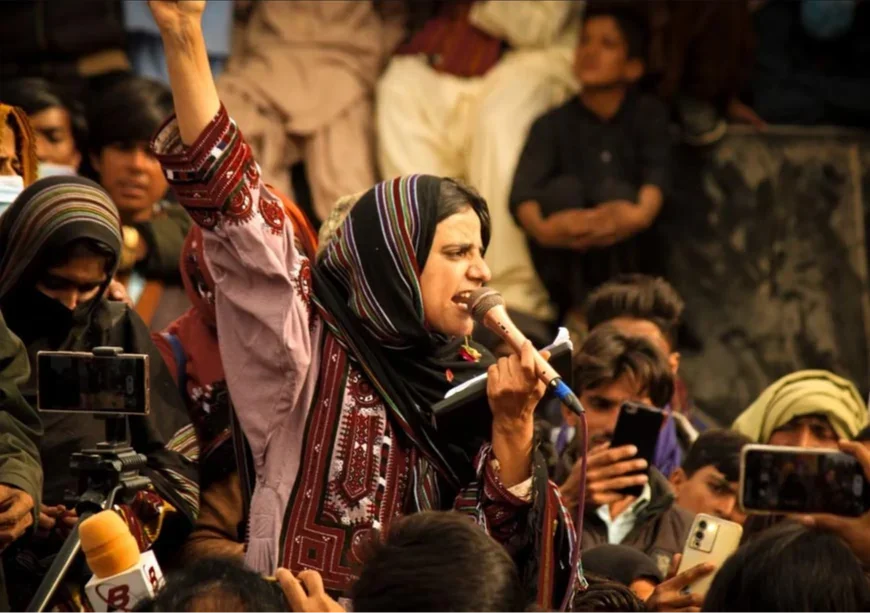
Mahrang Baloch speaks at a BYC rally. Source: Baloch Yakjehti Committee.
Because the trial is being conducted inside the jail, journalists and members of civil society in Balochistan have also been denied access to our hearings, which constitutes another violation of fair trial standards.
The cases against me and other BYC leaders are political in nature. The jail trial is being used as a tool to increase pressure on us, weaken our movement, and further strengthen the atmosphere of fear and repression in Balochistan.
Can solitary confinement break your spirit?
For the past year, I have been held in solitary confinement in Hudda Jail. We are being kept in isolation in an attempt to separate us from our organization and movement and to subject us to psychological pressure. The barrack where we are imprisoned was originally built to punish dangerous and high-profile prisoners. Our meetings and communication have been severely restricted, yet solitary confinement cannot weaken me, because for me, prison and torture have become symbols of resistance. Unlike ordinary prisoners, these experiences carry a very different meaning in my life.
My childhood was shaped under the shadow of state torture cells while witnessing my father’s struggle for freedom. My father, Ghaffar Baloch, was once imprisoned in the same jail where I would come carrying Eid cards to meet him. The towering prison walls and its multiple iron gates felt like terrifying nightmares to me. The state torture cells, where thousands of forcibly disappeared Baloch were detained, always remained alive in my imagination. Every night, I would mentally reconstruct those dark spaces in my mind.
When my father was released after his third enforced disappearance, the stories of torture he shared became permanently engraved in my memory. I would often imagine the darkness of those torture cells, the condition of a revolutionary from his purpose, the unbearable reality of state violence, and the point where a person begins to pray for death every single day. The sound of every door opening would make one’s body tremble in fear, wondering if the next round of torture was about to begin.
After my father was extrajudicially killed, I carried a deep desire to one day see the torture cell where he had been held. I constantly wondered how he spent his final moments and what suffering he endured. From that moment onward, I made it the purpose of my life to work for the freedom of every individual trapped in such torture cells.
When I joined the struggle against enforced disappearances, my pain found meaning. I had finally discovered the purpose of my life, to continue on this path and endure every hardship became my source of strength and fulfillment. Whenever we grew exhausted during sit-ins or long marches, we reminded ourselves of the young people from our nation who were enduring torture inside secret detention cells for the future and dignity of our people.
Whenever someone was released from a torture cell, I felt the same joy I once felt upon my father’s release. I always made sure to meet them. The part of my mind once occupied only by the images of my father’s mutilated body and wounded face gradually became filled with the faces of those newly freed Baloch youth, faces that never allowed me to stop.
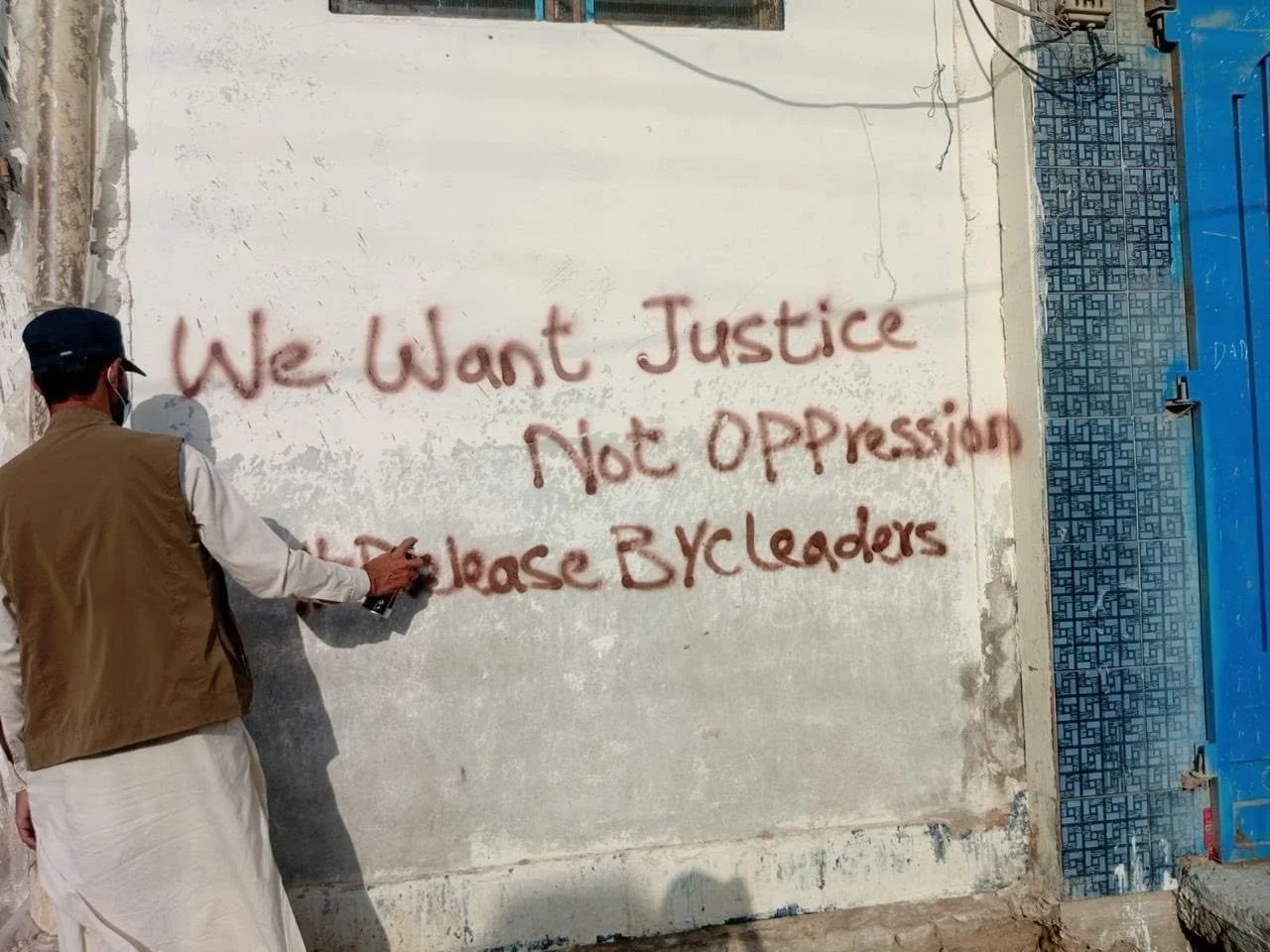
Source: Baloch Yakjehti Committee (BYC)
Whenever I began a difficult campaign, I would tell myself that if even one forcibly disappeared person was freed because of our efforts, then that alone would be our greatest success. All other hardships would become meaningless.
Becoming part of this struggle allowed me to heal, because this movement gave meaning and purpose to our collective pain and national suffering. That is why solitary confinement and prison cannot break me. Since the earliest days of my struggle, torture cells and isolation have represented symbols of resistance for me. For the Baloch people, they have become symbols of defiance against oppression.
This solitary confinement has become a place where we write, study the struggles of people around the world, and strengthen our political consciousness. Our imprisonment will only make our movement stronger and will continue to inspire and mobilize our people in new ways.
Has it affected you physically and emotionally?
Over the past 14 months in solitary confinement, combined with restricted movement and delays in receiving medical care, I have been suffering since October from severe back pain and radiculopathy. Due to the lack of timely diagnosis and proper medical treatment, I was forced to rely on self-medication, which further worsened my condition. In February 2026, I was eventually transferred to a hospital, where I was diagnosed with Lumbar Disc Prolapse. Despite this diagnosis, I am still being denied proper medical treatment, including physiotherapy, which is an essential part of my recovery.
Solitary confinement can leave deep physical and psychological impacts on political prisoners. The state’s objective is not merely to punish us, but also to weaken our revolutionary identity, morale, and political resistance. However, I believe that the truth and legitimacy of our cause give us the strength to endure state repression.
Our struggle is aimed at ending every form of state oppression, and it is for this purpose that we continue to endure inhumane conditions such as solitary confinement. By imprisoning us, the state seeks to spread fear among the people. Yet even within these prison walls, through our resilience and determination, we want to show our people that oppressed nations can continue to resist state violence effectively, even in their weakest moments.
Our philosophy of resistance is the result of decades of struggle by our people for justice, peace, and survival on our own land. No prison or torture cell can weaken that conviction.
“Our struggle is aimed at ending every form of state oppression, and it is for this purpose that we continue to endure inhumane conditions such as solitary confinement. ”
When states choose repression and force over tolerance for dissent, they cease to become institutions of justice and instead turn into instruments of fear. But fear is always temporary. Genuine people’s movements eventually overcome it, and that same fear ultimately transforms into a source of strength for the people.
State repression has made people fearless. The killing of innocent individuals and the constant demand for justice have deepened public political consciousness. This is the purpose shared by me and every Baloch political activist: that our people understand the importance of collective strength, resistance, and political awareness.
If my solitary confinement helps strengthen that purpose, then I will endure this imprisonment with pride and even greater determination.
What role does the BYC play in Balochistan?
The BYC is an indigenous movement of Balochistan. Following the implementation of the “kill and dump” policy in Balochistan since 2009, the state launched a severe crackdown on active political parties and movements. Over the past two decades, thousands of innocent Baloch people have been killed as a result of state repression. In such circumstances, there was an urgent need for a strong public movement against what many Baloch view as an ongoing genocide.
This period represents one of the harshest phases of repression in Balochistan, as even women and children were no longer safe from state violence. It was under these conditions that the BYC emerged. Beginning with resistance protests across Balochistan, the movement gradually evolved into a broad public movement that gained widespread support throughout the region.
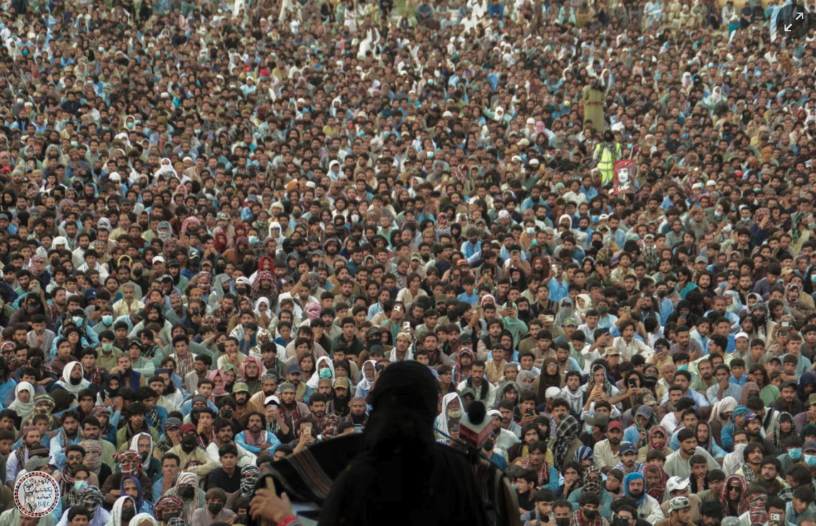
Mahrang Baloch addresses a protest in Gwadar, Balochistan. Source: Baloch Yakjehti Committee (BYC).
The BYC has played a central role in documenting human rights violations and advocating for national and political rights in Balochistan. Under the pretext of security concerns, international human rights organizations have largely been denied access to the region. Representatives of the Working Group on Enforced or Involuntary Disappearances have not been granted permission to visit Balochistan for the past 15 years, preventing independent observation and reporting on ongoing human rights abuses. Similarly, many international institutions have failed to provide effective reporting on the situation in Balochistan.
In this environment, the BYC has simultaneously functioned as both a human rights organization and a civil rights movement. It organized major public gatherings such as the March Against Baloch Genocide, the Raji Muchi, and the Dalbandin gathering. Each of these mass assemblies served as a public referendum against the state’s repressive policies, bringing together people from every segment of Baloch society, including elders, women, students, and youth.
Alongside organizing sit-ins and public demonstrations, the BYC has also become one of the most active bodies documenting and reporting human rights violations in Balochistan. In 2025 alone, the BYC collected data on 1,250 cases of enforced disappearances. This work was carried out while the organization itself was facing an intense state crackdown, with much of its central leadership imprisoned and many activists subjected to harassment and intimidation.
Through political mobilization within a short period of time, the BYC succeeded in raising national political consciousness among the Baloch people and bringing international attention to the suffering of Balochistan. At the same time, the BYC leadership helped fill the vacuum in mass politics that had existed in Balochistan for nearly a decade.
The strong participation of women within the BYC also reflects the movement’s progressive political vision. Women were mobilized, educated about their fundamental rights, and encouraged to become active participants and leaders within the organization.
What challenges did you face while promoting nonviolent resistance in Balochistan?
Promoting nonviolent resistance and democratic political struggle in Balochistan is an extremely difficult task, because students, journalists, and human rights activists are routinely silenced through enforced disappearances, killings, and targeted violence carried out under state repression.
Peaceful political movements are often labeled as “anti-state” or “security threats,” and activists are subjected to profiling, harassment, arrests, and fabricated criminal cases. At present, more than 50 cases have been filed against me and other BYC leaders across Balochistan. Every protest organized by families of missing persons has resulted in cases being registered against us, which reflects the continuation of state policies aimed at suppressing freedom of expression and peaceful political dissent.
“Every protest organized by families of missing persons has resulted in cases being registered against us, which reflects the continuation of state policies aimed at suppressing freedom of expression and peaceful political dissent.”
Even FIRs related to the actions of armed groups have been filed against peaceful political activists. This represents an extreme form of state brutality, where nonviolent political workers are deliberately linked to armed organizations in order to justify state violence and repression against them.
Despite all these pressures and hardships, the people of Balochistan have not abandoned peaceful politics. For the BYC, nonviolent resistance is not merely a political struggle; it is a continuous effort to create space for human rights, justice, and dialogue in an environment dominated by fear, silence, and repression.
Is book reading helping you overcome your isolation in solitary confinement?
In solitary confinement, my greatest source of support has been my books, the memories of the Baloch resistance movement, and the courage of those who have endured repression before us. Books have strengthened my political consciousness, intellectual depth, and belief in resistance during this period of isolation. They have expanded my understanding and helped me remain connected to my inner strength despite physical confinement.
Much of our protest inside prison has centered around gaining access to books. Reading about revolutionary movements and political figures has given me the opportunity to reflect deeply on my own struggle, beliefs, and purpose in life. Through this process, I have been able to understand my mission with greater clarity.
Books have also helped me endure the weakest and most difficult moments of solitary confinement by giving me the capacity to better understand and carry the pain and suffering of my people.
Some of the books I have read during this period include:
1. Interview with History by Oriana Fallaci
2. The Writings of Mao
3. The Power of Habit by Charles Duhigg
4. Living My Life by Emma Goldman
5. Roots by Alex Haley
6. No Friend But the Mountains by Behrouz Boochani
7. The Political Thought of Abdullah Öcalan
8. The Geopolitics of Shaming: When Human Rights Pressure Works and When It Doesn’t
9. The Paradox of Repression and Nonviolent Movements
10. Indira Gandhi and the Year That Transformed India
11. Long walk to freedom Nelson Mandela
12. مہر افلاک (صورت خان مری)
13. The Song of youth by yang mo
14. World Order by Henry Kissinger
15. Prisoners of Geography by Tim Marshal
16. Resistance and Decolonisation by Amircarl Cabral
17. Men in the Sun by Ghassan Kanafani
18. Remotely Colonial by Nina Swidler
19. Back to the Future by Martin Axmann
20. Manufacturing Consent: the political economy of the mass media by (Noam Chomsky and E.S Herman)
21. Battle Ground by Christopher Phillips
22. بلوچ اور ان کا وطن (ڈاکٹر فاروق بلوچ)
Dr. Mahrang Baloch is an activist and the leader of the Baloch Yakjehtee Committee.
Akbar Notezai is a journalist from Quetta.
Related content: