After a Dictator, Bangladesh Turns Right
Hardline Islamists gain ground in historic election following the 2024 July Uprising that ousted Sheikh Hasina.
Illustration by Jamhoor, created using publicly available images
On February 12, 2026, Bangladesh held its first general election since overthrowing the authoritarian rule of Sheikh Hasina and the Awami League (AL)—an election widely believed to be a true democratic election in 17 years. Around 44% of the electorate were young (<37 years old), first-time voters. The centre-right Bangladesh Nationalist Party (BNP) and its leader, Tarique Rahman, returning from his AL-imposed exile, gained a majority of parliamentary seats to form the government. Its main opposition was the far-right Jamaat-e-Islami (JI) who built a 11-party alliance with smaller Islamist parties and the National Citizens’ Party (NCP), a party formed to reflect the aspirations of the youth-led mass uprising that overthrew the previous regime. The disposed AL were banned from participating in the elections, leaving a significant portion of the electorate without representation. The election results mark a clear turn in Bangladesh towards right-wing populism – but this is not shocking. A close reading of the post-uprising moment exposes that this paradigm shift has been brewing for a while, especially in the absence of a strong, progressive alternative.
The Right-ward Turn in Post-uprising Bangladesh
The main contestant against the BNP was the far-right JI, an Islamist party marred by its role as collaborators of the Pakistani state during Bangladesh’s liberation struggle in 1971. JI’s 11-party coalition managed to win 77 out of 300 seats in the election, higher than they have ever achieved in Bangladesh’s history. Of course, one must account for the fact that AL, historically BNP’s primary political opponent, was banned from participating in the elections this time. Yet, winning almost 40% of the popular vote in an election with around 60% voter turnout is a serious feat.
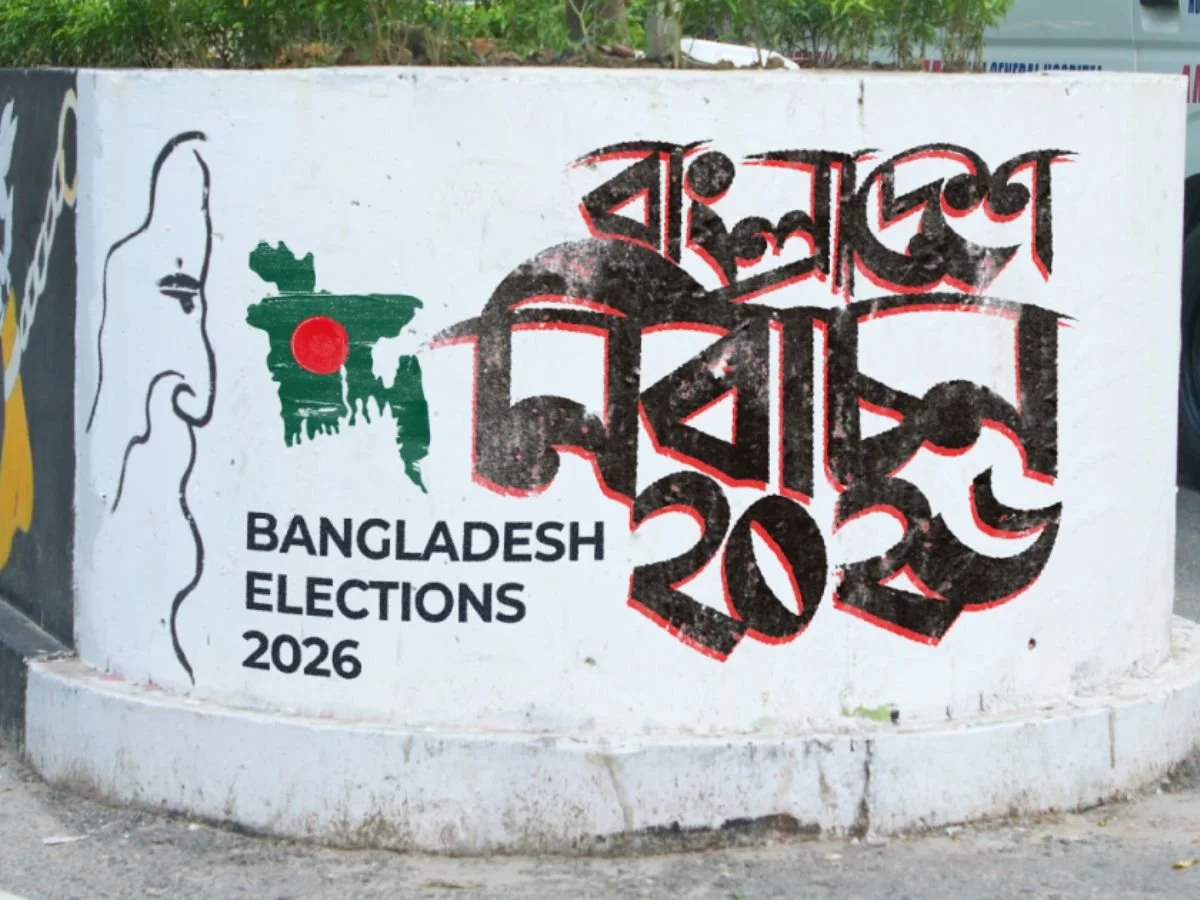
Graffiti announcing Bangladesh’s 2026 elections. Source: The Sunday Guardian/X.
Heading into the election, there was widespread speculation that JI would sweep a landslide victory. JI had been steadily building its organizational strength at the grassroots level, embedding itself in the lives and struggles of working class people. They have developed cadres committed to the party’s ideology who are accountable to a centralized, vertical party structure—much like the traditional Leninist model. Party cadres are rooted in local communities and campuses, and often mobilize to provide mutual aid and support in absence of a welfare state. This has solidified loyalty and support for JI’s vision of a theocratic Bangladesh in previously untapped layers of Bangladeshi society.
JI also bore the ire of Hasina’s regime; its key members were tried under a special war crimes tribunal in 2013 and given either life sentences or the death penalty. Numerous JI activists have been forcibly disappeared by the state security apparatus under Hasina, with few making it out alive once she was ousted. This systematic targeting generated sympathy towards JI, especially amongst groups that opposed state violence and supported human rights.
Earlier in 2025, JI’s student wing, Chhatra Shibir, won student union elections across university campuses including both Dhaka University and Jahangirnagar University, two of the most progressive public university campuses in the country and institutions that were central to the July Uprising. In December 2025, the assassination of a prominent political figure related to the uprising, Osman Hadi, revived the zeal and anger of the July Uprising which was promptly capitalized by the Islamist right-wing. Hadi had come up as a charismatic leader from the madrassa system and was actively shaping a post-uprising majoritarian politics of Bengali Muslim nationalism that was initially separate from JI. But the JI-led coalition was able to exercise pro-July, anti-India sentimentality when Hadi was given a state funeral with thousands of well wishers flocking to Dhaka for the event.
Yet, none of this really translated to electoral gains for JI.
“JI’s significant gain in this election, however, is not merely about votes and seats, but about mainstreaming its politics in a country where the party was considered fringe, and at times even banned.”
JI’s significant gain in this election, however, is not merely about votes and seats, but about mainstreaming its politics in a country where the party was considered fringe, and at times even banned. Critically, JI’s win has shifted the overton window enough to the right to normalize and even popularize hardlines like Mamunul Haq, the leader of Khelafat Majlis, who gave a fierce challenge to BNP’s Bobby Hajjaj, a heavyweight candidate, in one of Dhaka’s prominent ridings. Haq infamously called for the dissolution of the Women’s Affair Reform Commission, formed under the Interim Government, and is well known for his misogynist and exclusionary comments, while positioning his own ideology as anti-imperialist and anti-establishment.
Mamunul Haque, Islamic cleric and leader of Khelafat Majlis, speaks against Indian and US imperialism at a rally. Source: The Daily Sun
JI’s coalition with non-Islamist “centrist” parties such as the NCP, consisting of student leaders from the Uprising, and the Liberal Democratic Party led by former Liberation War veteran Oli Ahmad, provided the cover that was needed to legitimize hardline Islamist ideology in the electoral arena.
The NCP claimed that their party ideology is “militant centrism” but several of their core leadership, including Sarjis Alam and Akhter Hossen, have leaned towards some kind of Islamist politics. The tensions came to a boil on December 28, 2025, when several female leaders of the NCP defected from the party when it announced its coalition with JI, a party that repeatedly refused to nominate women for any of their seats. NCP campaign front runners such as Tasnim Jara and Tajnuba Jabeen publicly condemned the NCP-JI alliance and noted NCP’s own ideological contradictions inside the party. Despite all of this, NCP’s core leadership continued with the alliance and helped position JI as the pro-July, pro-reform, and anti-India choice.
NCP leaders Nahid Islam and Asif Mahmud Bhuiyan share the stage with JI leader Shafiqur Rahman at an election rally in Dhaka. Source: Syed Mahamudur Rahman/Al Jazeera
Many viewed the interim government, led by Dr. Muhammad Yunus and other NGO and civil society figureheads, as sympathetic to the NCP, Islamists, and right-wing mobs. Former student coordinators Nahid Islam and Asif Mahmud Shojib Bhuiyan were both part of the interim government and then later joined the NCP. Hasnat Abdullah and Sarjis Alam regularly mobilized student groups to impose demands on the interim government and were met with minimal resistance. This was most evident when students and touhidi janata (Islamist mob) were given free reign to demolish Sheikh Mujibur Rahman’s house in Dhanmondi Road no. 32 that had been previously preserved as a museum.
“BNP’s win in this election came as a tactical victory, not a decisive one. Swaths of liberals, seculars, women, religious and ethnic minorities, and even Hefazat voters flocked to the polls to vote against the JI-led Islamic bloc”
There was no protection given to religious and ethnic minorities, bauls (folk singers), artists and groups who came under attack numerous times in the aftermath of the uprising. Reports of local NCP activists engaging in extortion and bribery became commonplace. And as frustration grew with the interim government, BNP distanced itself from the reform agenda and skewed ahead as the obvious anti-JI choice in this race.
BNP, on the other hand, has always maintained its commitment to centre-right politics. The party believes in private enterprise and the free market and during prior rule, engaged in massive corruption that helped embed the party with the industrial ruling class. It is not merely a coincidence that a BNP-majority means that there are more business people in parliament than politicians.
As such, BNP’s win in this election came as a tactical victory, not a decisive one. Swaths of liberals, seculars, women, religious and ethnic minorities, and even Hefazat voters flocked to the polls to vote against the JI-led Islamic bloc. Despite that, JI successfully increased its parliamentary representation, marking a significant shift in Bangladesh's political centre to the right and codifying the far-right Islamist bloc as the main opposition to BNP’s economic conservatism, in the absence of any left or liberal opposition.
Caught in the Middle: India, U.S.A., China
India has loomed over Bangladeshi politics often as an interventionist threat and other times as a bogeyman and JI had positioned itself as the only anti-India party. During the Uprising and in its aftermath, the slogan “Delhi na Dhaka? Dhaka Dhaka [Delhi or Dhaka? Dhaka Dhaka]” became popular amongst the youth and Islamists alike. Former coordinators of the student movement and currently members of parliament, Hasnat Abdullah and Nahid Islam, would often lead rallies with this chant.
AL was also seen as closely linked with India, a legacy Hasina inherited from her father, Sheikh Mujibur Rahman. The fact that Delhi gave refuge to Hasina when she fled the country only solidified that association.
JI winning most of their seats across districts lining the West Bengal border only confirms this widespread antagonism against “Indian hegemony.” One can imagine that the local communities in Rangpur and Khulna are most likely to be impacted by India-Bangladesh projects such as Rampal Power Plant and the Teesta water-sharing agreement, as well as bear witness to the regular border killings at the hands of Indian Border Security Forces (BSF). The Modi goverment’s anti-Muslim rehtoric only aggravates majoritarian victimhood in Bangladesh’s majority Muslim proletariat.
Geographical distribution of seats won by the BNP and JI-led coalitions. Source: Election Commission/X.
And for whatever reason, this anti-India sentiment is often articulated in Bangladeshi politics through violence towards religious minorities, the Left, secular/atheists, and liberal institutions. Just two months before the election, the office buildings of two of the largest newspaper dailies in the country, The Daily Star and Prothom Alo, as well as music/cultural institution Chhayanaut, were torched by angry mobs claiming these outlets to be “Indian mouthpieces.” On the same day, a Hindu garment worker, Dipu Chandra Das, was lynched for allegedly disrespecting the Quran—an allegation later proved to be false.
The fact is, while Indian expansionism is a legitimate concern, it is only one of many superpowers trying to exert influence over Bangladesh. Both China and the U.S. have keen interests in Bangladesh. For example, in 2022, direct Indian investment in Bangladesh was only US$15.7 million whereas Chinese investment was US $1.4 billion. China also has invested in the Payra Port and the Banshkhali Coal Power Plant and is the primary weapon supplier for the Bangladesh military. In her final days in power, Sheikh Hasina was struggling to maintain this balancing act between China, India, and the U.S.
None of this is surprising considering the increased global hostility in this multipolar world and the crumbling of international rules-based order. In fact, it may be these geopolitical anxieties that informed the interim government’s insistence on leasing administration of Chittagong Port, one of the most strategic ports in the Indian Ocean, to foreign operators. The initiative was met by an indefinite strike from port workers who were then harassed, intimidated, and arrested. The leasing process was ultimately put to a pause.
It is important to note here that just two days before the election, the Yunus-led interim government rushed to finalize a trade deal with the U.S. that aligns Bangladesh squarely under the American sphere of influence. With this trade deal, Bangladesh committed to purchasing military equipment from the U.S. while limiting its purchase from other countries, removing tariffs on 6,000 American products, purchasing energy directly from the U.S. while allowing them full reign to explore and extract critical minerals and energy resources from Bangladesh. In return, Bangladesh receives a marginal tariff waiver only on ready-made garment products made from American cotton. This deal could not only restructure Bangladesh's economy in the coming days but also weaken the power of industrial labour with threats of job layoffs.
Challenges Ahead
“The power vacuum left by AL was capitalized mostly by the populist-Islamic right-wing on the ideological terrain and the ruling class-backed “deep state” (military, security forces, intelligence and civil bureaucrats) on the political terrain”
The cross-class mobilization during the July Uprising signified a desire to reject the status quo. In the absence of any organized progressive formation prior to the spontaneous uprising, this desire has manifested into a reactionary expression. The power vacuum left by AL was capitalized mostly by the populist-Islamic right-wing on the ideological terrain and the ruling class-backed “deep state” (military, security forces, intelligence and civil bureaucrats) on the political terrain.
With BNP’s win, the managers of the state have changed but the entire state apparatus remains the same. The military, civil bureaucracy, security forces, and the balance of class power remain exactly the same as during the last Awami regime. These actors have been waiting anxiously for the transition to an elected government so that things could return to business as usual.
The reality of the July Uprising and this election is that ordinary people’s lives have been largely unchanged, if not gotten worse. The Uprising started with a movement for stable government jobs in an increasingly unstable economy—a demand that has been overlooked in the aftermath. Unemployment remains high and affordability is still a major issue in the urban centres. The post-uprising period also saw minimal labour reforms. Mass mobilization for decent wages by tea workers and garment workers remain unaddressed and the appetite for structural reform unmet.
The July Uprising had brought with it an opening to build a broad working class movement for social change. Left-leaning student groups, teachers, culture workers, and activists were at the forefront of the July movement but in the last 18 months, they have gotten roiled up in the culture wars which pit progressive, humanist values against Islamic, traditional ones, signifying an ideological polarization between the left-secular and the populist-Islamic right wing. This dichotomy is mainly concerned with identity politics and narrows the terrain to engage in class struggle that builds solidarities across these identities. Bangladesh, already functioning under neoliberalism, will now have to navigate the U.S.-imposed economic agenda in a rapidly sharpening imperial order. It is urgent, then, for the left to address these contradictions of the moment we are in. If there is one thing people have now learned from the Uprising, it is that power lies beyond the parliament—on the streets, in workplaces, and in communities.
Sarah Nafisa Shahid is a Bangladeshi writer and community organizer based in Toronto, Ontario. Her work has been published in The Daily Star, Hyperallergic, Now Magazine and other publications. She is a regular contributor to Spring Magazine and is the co-host of Spring Radio.