Three Murders and a Truth
After the carnage on December 18, what remains of the July Revolution’s promises for Bangladesh?
What do a seven-year-old girl, a 25-year old Hindu garment worker and a 32-year old rising politician have in common? Theoretically, perhaps many things. But the one that stands out in light of recent events in Bangladesh is that they are all collateral – sacrificial lambs even – in Bangladesh’s return to violence as the primary conduit of political expression, a tradition the July Revolution last year was supposed to have abolished.
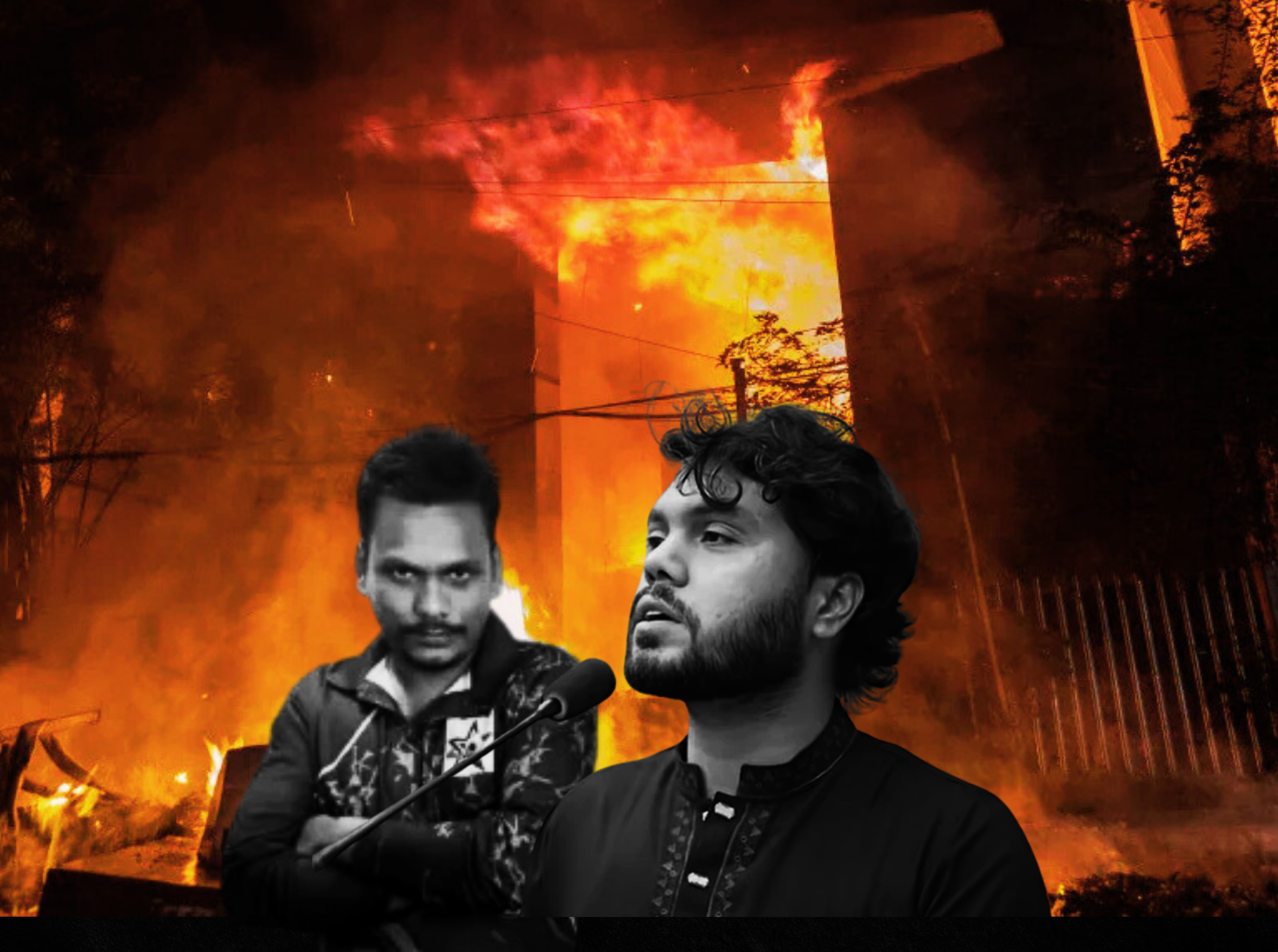
Osman Hadi was a firebrand orator who came to prominence as a coordinator of the July uprising against Sheikh Hasina. He was running as an independent candidate for the Dhaka-8 constituency in the upcoming national elections. On December 12, 2025, assailants (later suspected to be Awami League activists and student leaders) shot him as he was riding a rickshaw in Purana Paltan. Hadi succumbed to his head wounds on December 18, 2025, while being treated in Singapore.
Hadi was known for his staunch anti-India stance; he often railed against Indian hegemony – cultural, economic, political – in Bangladesh’s politics, but he couched it in the language of anti-aggression, demanding that India respect Bangladesh’s sovereignty and claims over resources. Hadi’s ideology, however, has its roots further back than the contemporary Indian state. Given his self-proclaimed identity as a cultural activist, Hadi levied Kazi Nazrul Islam, a Muslim Bengali poet against Rabindranath Tagore, a Hindu Bengali poet, reigniting a long-standing debate in Bangladesh society – the dichotomy of a Muslim vs Bengali identity.
Thus, it is not a surprise that Hadi’s death, and subsequent (unconfirmed) reports that his murderers were AL activists who escaped to India, resulted in carnage. Ostensibly directed against India, it set its focus on secular and liberal Bangladeshi institutions, primarily cultural ones. Mobs, often linked to “Touhidi Janata”, burned down the Dhaka offices of prominent news outlets, Prothom Alo and The Daily Star. The Janata is an amorphous political agent that has risen up since the July Revolution as a violent pressure group.
What were the faults of the news outlets? That they are allies of AL, and thus coded as Indian agents. The subtext – they are liberal, they are secular, and therefore must be Indian allies who are directly responsible for Hadi’s death. The ire against these outlets is not novel, but the allegations do not stand up to criticism. Both outlets have repeatedly reported on the abuses of power and corruption during Hasina’s regime. Old cultural institutions like Chhayanaut (founded in 1961 to preserve and advance Bengali culture and heritage) and Udichi (founded in 1968 and operated a cultural campaign during the 1971 Liberation War) were also not spared – they were vandalized, ransacked and burned with a glee that reached religious fervor.
Notably, this mob was stirred up by Elias Hossain (a discredited journalist-turned-influencer) and Pinaki Bhattacharya (a political commentator in exile) who have amassed millions of followers through often misinformed, ragebait (and clickbait) commentary. The fire that these Pied Pipers stoked in the mobs spread into the buildings and was cleverly manipulated by political factions within the Islamist right wing, who have long targeted secular and liberal cultural institutions in the country. Both Chhayanaut and Udichi’s events have been bombed by Islamist terrorists in the past decades; Prothom Alo and The Daily Star have regularly borne the ire of Islamist rallies, with their leaders threatening to burn down the news outlets and attacking journalists.
As fire raged in those buildings, a Hindu garment worker in Mymensingh – Dipu Chandra Das – was the target of yet another Touhidi Janata. A worker at Pioneer Knitwear, Das was handed over by the factory manager to the mob on allegations of blasphemy. He was beaten, lynched and his body set on fire in one of the most macabre spectacles to arise in Bangladesh in recent memory, with hundreds of people livestreaming and taking photos of the unfolding horror. The lynching itself wasn’t enough – he had to be burned to ash as his attackers were convinced he would be in Jahannam, and the mob took it upon itself to carry out Allah’s justice. Later investigations found no record of such blasphemy – it turned out that it may have been an outrageous conspiracy concocted by a few of his Muslim co-workers who were upset at Das’s promotion.
The gory spectacle of Das’s death spread as rapidly as the fires consuming the country the night of December 18. Indian news channels and media outlets, right-wing Islamophobic influencers and politicians across the globe, and exiled leaders of Awami League circulated the narrative of a Muslim mob lynching and burning a Hindu man. None of this was surprising; what was surprising, though, was that Bangladesh’s Interim Government, which appears much better at public relations (or faster) than any other aspect of governance or administration, could not even spell Das’s name in their press release. Instead they only mentioned a “Hindu man”.
Despite the anti-India sentiment currently gripping Bangladesh, the Touhidi Janata – a vassal of religious vigilantism and majoritarian rule – is replicating the playbook of the Hindu fascists: fabricate allegations against minorities, stoke communal hatred, beat, murder, lynch and burn them. Burn them all – as now-deleted facebook posts by Islamic political activists demanded; as did Pinaki and Elias in their calls to burn Prothom Alo and The Daily Star.
The December 18 fire also spread to the house of Belal Hossain, a political leader from the Bangladesh Nationalist Party (BNP). It burned Hossain’s seven-year old daughter Ayesha Akhtar to death and left other family members critically injured. The instigators remain at large; but, it is clear that the mob that torched Hossain’s house was an extension of the Touhidi Janata, which has flexed its majoritarian muscle with impunity. If you are not with them – culturally, religiously, politically – or refuse to submit to their demands, you will be punished and the state will look the other way.
This mob is the same as the ones that have burned majaars and akhras, attacked Ahmadiyyas and Bauls, beat up Adibashis on Dhaka’s streets, set fire to cultural institutions, broke down sculptures, desecrated temples and lynched Hindus; it’s all the same mob - nameless, faceless, yet so familiar. The hydra lives in the protection of a government, which has been spineless at best, collaborative at worst. It is the manifestation of a rising Islamofascism that feeds on the very true sentiments of Bangladeshis, only to disgorge a monster. For it is true that Hasina and her regime signed India-friendly treaties whose consequences are borne by the Bangladeshi working class; it is true that Indian media and Bollywood dominate Bangladeshi airwaves; it is true that Bangladeshis are indiscriminately killed by Indian border forces who face no repercussions; it is true that Islamophobia is on the rise globally and especially in India; it is true that Bangladeshi peasants are pushed to the brink of poverty because of unequal water resource sharing between India and Bangladesh.
But it is also true that the July Revolution had promised us that the era of violence as the sole vehicle of political expression was over. It is also true that the July Revolution had promised a new Bangladesh with freedom of expression; a new Bangladesh with unity amongst all; a new Bangladesh with respect and dignity for all religions, genders, ethnicities. It is also true that the July Revolution had promised that not one more life will be used as a pawn for political games; that those days were over.
Yet, political parties are already using Hadi’s death to score points and rile up their bases; on the other hand, liberals hand-wring about the loss of cultural memory. Few tears are shed for Das and Akhtar, who will soon be chalked up as yet more unfortunate deaths in a country that continues to fail to prevent violence against workers, women, children, and minorities. All in all, a return to the pre-Revolution status quo. These three murders, which the state was so slow to act on (and rightfully suspected of some level of collaboration), show us that those promises of the Revolution are now nothing but ashes.
As the smoke clears from the fires of December 18, this is the truth that emerges from the embers.
Nafis Hasan (@cannafis_) is a Bangladeshi writer and organizer based in Philadelphia. He is the author of Metastasis: The Rise of the Cancer-Industrial Complex and the Horizons of Care and also sits on Jamhoor’s editorial committee.