Pakistan Out of Gaza
The connection between the Pakistani state’s internal repression of dissent and the Board of Peace
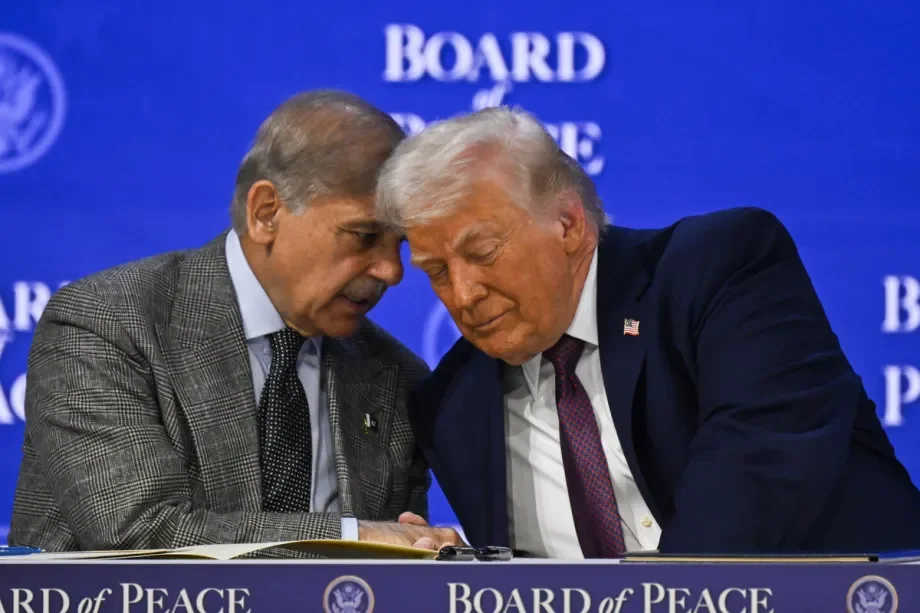
Prime Minister Shabaz Sharif and Donald Trump at the Board of Peace Meeting
Today, a sessions court in Islamabad sentenced lawyers Imaan Mazari and Hadi Ali Chattha to 17 years of imprisonment each under the Pakistan Electronic Crimes Act (PECA). Their crime, according to Justice Afzal Majoka’s order, was issuing “anti-state tweets” that ostensibly advanced the agenda of the Baloch Liberation Army and the Tehreek-i-Taliban Pakistan by alleging that Pakistan is a “terrorist state.” This was a characterization rooted in the state’s increasingly militaristic and oppressive overtures, particularly in the putative peripheral regions of the country.
Three days prior, Prime Minister Shehbaz Sharif was seen seated beside a conspicuously cheerful Donald Trump on the sidelines of the World Economic Forum in Davos, committing his support for the newly established Board of Peace –an organization borne from the ashes of a liberal world order that proved too inadequate to support the whims of rogue and honest American imperialism. Tasked with managing and rehabilitating Gaza under the auspices of a coalition of war criminals, technocrats, and business elites, the Board envisions the besieged and embattled Palestinian territory as fertile ground for corporate and colonial “reconstruction.” Pakistan’s decision was made without civilian or parliamentary consultation, and in direct contravention of popular consent.
As disparate as these two events may seem, the narrowing of space for political dissent and accountability in Pakistan remains tied to, and actively reinforced by, a foreign policy posture that once more brandishes imperialist colors. Reading these events in the same conceptual frame reveals the inherent link between Pakistan’s long-standing and renewed service to American whims–including the forays this enables towards normalization, even if covert, with Israel–and the consolidation of domestic oppression. Underlying this posture is the concerted commitment of the military-elite nexus to a logic of extractive capitalism.
Pakistan’s willful capitulation to the Board of Peace paradigm is unsurprising, if not inevitable. For months, state officials remained publicly ambivalent about the role Pakistan would assume within the “peace process”–one predicated on the planned disarmament of Hamas and the Palestinian resistance. Public discourse around this process was shaped by sustained popular criticism of such a prospect, widely understood as a betrayal of the Palestinian people and their struggle for self determination. Statements from US Secretary of State, Marco Rubio, made digital waves when he revealed that Pakistan had offered to ‘consider’ participation in the Gaza Stabilization Force–implying that the country’s increasingly unpopular military would serve as collaborators in the disarmament effort.
The decision to join the Board of Peace, however, must be viewed in context of Pakistan’s foreign policy maneuvers over the past year. The Trump-led ceasefire deal–one marked by recurrent Israeli violations, including an airstrike three days ago that murdered three Palestinian journalists–was enthusiastically cheered on by the Pakistani state. This was in spite of it being clear that the fragile ceasefire would remain conditional on the neo-colonial architecture of the “peace” arrangement itself.
Urgent attempts to halt the genocide cleared the path for states to reconcile with a narrative of “peace” and half-hearted two-stateism without contending with the enduring projects of settler-colonialism, ethnic cleansing, apartheid and genocide in Palestine. Unlike the overt cooperationism of the Abraham Accords, the course championed by this wave of US-led normalization is more subtle, yet all the more insidious. It deploys the pretext of ending a genocide that should never have occurred to compel states to reassert their commitment to a neo-colonial arrangement–one in which Israel retains the imperialist-backed, genocidal upper hand. At the same time, it foreshadows these states’ cooperation–including Pakistan’s–with Israel in the management of the Gaza Strip.
Such a “peace” process conveniently allowed for states like Pakistan–otherwise positioned as docile proponents of the Palestinian cause–to join hands with the United States and other Arab and Muslim states in participating in and enthusiastically endorsing the new normal for Gaza, while securing rents for themselves. Doing so requires no meaningful advocacy for Palestinian anti-colonialism or self-determination, while simultaneously allowing state leaderships to congratulate themselves for having helped bring an end to the Israeli assault.
On the other hand, the last few years have witnessed an explicit avowal of Pakistan’s hybrid-regime–one largely controlled by the military–that has relentlessly crushed all political dissent. The “hard state,” as Trump’s “favorite Field Marshal” Asim Munir describes it, emerged further emboldened after its performance in the three-day confrontation with India earlier last year. With the ensuing ceasefire between the two warring nuclear-armed countries allegedly negotiated at the behest of the American government, the Pakistani state seized the moment to pursue a grand reconciliation with its once-benefactor and principal strategic ally.
This was a partnership that had waned since the American withdrawal from Afghanistan, and the now-deposed and detained Prime Minister Imran Khan’s assertion of a semi-independent foreign policy. Pakistani state officials have since enjoyed two private audiences with Trump, including an unprecedented lunch between White House officials and the Field Marshal. The meeting marked a departure from previous public engagements traditionally reserved for civilian leadership. Shortly after, Pakistan nominated Donald Trump for the Nobel Peace Prize merely days before he launched attacks on Fordow, Natanz and Esphahan in Iran.
In this context, “peace” is a precondition for extraction. The reconciliation has already borne fruit for Pakistan's ruling military-elite. The United States has expressed a familiar eagerness to invest in Pakistan’s rare mineral resources, most of which are concentrated in Balochistan, Gilgit-Baltistan, and Khyber Pakhtunkhwa. These regions are longstanding hotbeds of discontent. Here, indigenous mass movements have mobilized against land dispossession, ecological degradation and the militarism that accompanies extractive developmentalism, alongside enduring violations of political rights and sustained displacement, often at the behest of imperialist wars.
Imaan Mazari and Hadi Ali Chattha have been accused of sedition precisely because they named these grievances by campaigning for the release of political prisoners affiliated with the Baloch Yakjehti Committee and the Pashtun Tahaffuz Movement, and demanding an end to the collective punishment meted out in these regions. December 2025 saw an escalation of state violence to include the enforced disappearances of women in Balochistan. Such acts of repression will only intensify as imperialist interests, buttressed by their Pakistani collaborators, consolidate their hold over the country’s already war-ravaged and militarized regions’ resources in return for Pakistani state collusion in Palestine and elsewhere. If one requires precedent, one must only examine the surge in militarization across Balochistan during the construction of the China-Pakistan Economic Corridor and investment poured into the project, deepening local alienation and disenfranchisement from an already exclusionary national project.
Yet, one does not have to look at long-standing political violence against peripheral communities to gauge the state’s proclivity for chilling repression in this conjuncture. On October 3rd, mere days before the purported ceasefire came into effect, Jameel Behram, a Jamaat-i-Islami affiliated pro-Palestine organizer from Karachi was abducted from the confines of his home. He has not yet been returned and remains forcibly disappeared. The incident marks a strong departure from the presumption that pro-Palestine organizing constitutes a relatively safe and non-partisan, politically neutral form of activism in the Pakistani context–condeming expressions of solidarity with Palestinians, especially when they entail an abnegation of Pakistani state practice, as threats to be neutralized. Any deployment of Pakistani forces in Gaza will invariably generate expressions of dissent, even within this climate of heightened repression. The perimeter of repression will widen in response.
The Mazari-Chattha case is a pivotal representation of how the state operationalizes its instruments to silence dissent, especially when it threatens the entrenched interests of the military-elite. As we enter yet another abhorrent phase of Pakistan’s complicity in upholding militarism, violence and occupation, sympathetic organizers, thinkers and intellectuals must view the architecture of repression at home as deeply entwined with the foundations of enduring occupation in Palestine, and elsewhere. In a political moment marked by strife on both fronts, expressions of solidarity must be rooted in locally grounded assessments of transnational problems, so as to cultivate multiple and concurrent axes of resistance.
Asmer Asrar Safi is a Rhodes Scholar at the University of Oxford from Lahore, Pakistan. His research focuses on the intellectual history of Muslim revolutionary traditions in 20th-century South Asia. He was a former member of the Harvard Out of Occupied Palestine (HOOP) Coalition and is a member of the Jamhoor team.