The Politics of Indigeneity in Post-Hasina Bangladesh
Adibashi struggles in the Chittagong Hill Tracts continue to expose the limits of Bangladeshi nationalism.
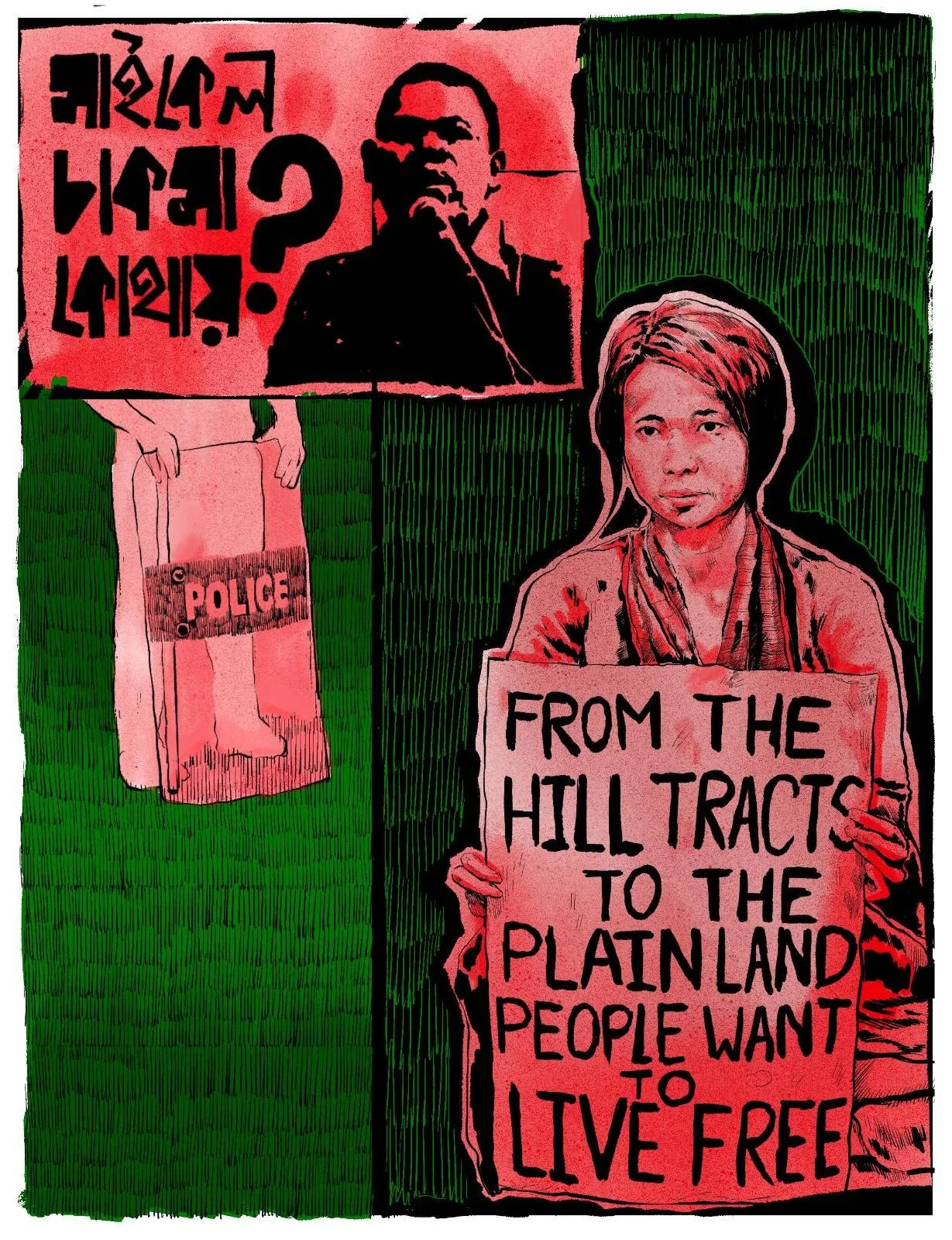
Illustration by Jamhoor, created using publicly available images
‘Everything implemented on the Hills will be implemented on the plain lands,’ warned Kalpana Chakma, an Indigenous activist allegedly abducted by plainclothes Bangladeshi military officers in 1996 and still missing nearly 30 years later. Her slogan, a reminder that political transformation in Bangladesh cannot be separated from the struggle of the Adibashis in the Chittagong Hill Tracts (CHT), reappeared across Dhaka’s walls in the weeks surrounding Sheikh Hasina’s overthrow in August 2024.
The CHT, comprising three hilly districts in southeastern Bangladesh, has been a long-standing victim of the politics of state-making and state-building in South Asia. Largely inhabited by a collection of 12 minority ethnic groups, the region and its populations have been left outside a national imagination centred around building an exclusively Bengali national identity.
Collectively known as Adibashi (Indigenous) or Jumma people, these groups made up 90% of the population of the Hill Tracts in the 1950s. However, post-partition development drives, alongside decades of militarisation and settler colonisation under successive Bangladeshi governments, led to the forced displacement of Adibashis, resulting in drastic shifts in ethnic and religious composition, and heightened land disputes. In 1956, the Pakistani government constructed the Kaptai Dam on the Karnaphuli River to generate hydroelectric power. The dam permanently displaced nearly 25% of the region’s population, creating what is referred to amongst Adibashis as the Bara Parang or “The Great Exodus”. Demographic change intensified under Ziaur Rahman’s Bangladesh National Party (BNP) regime—between 1979-1983, government sponsored programs resettled hundreds of thousands of landless Bengalis into the region. By 1991, Adibashis only made up 51% of the population of the Hill Tracts.
“Nationalism, as it often does, made blind the majority to the violence required to collapse a nation-state into a single ethnicity.”
Meanwhile, official rhetoric, believing homogeneity to be the key to nation-building, has denied Adibashi identity outright. Bangladesh’s founding President, Sheikh Mujibur Rahman, famously declared that “Everyone in Bangladesh is Bengali.” Having led the struggle for the recognition of Bengali identity and culture, Mujib now refused Adibashi groups a cut of that dream. The struggle for self-determination in Bangladesh became tied specifically to a unified Bengali nation, and schoolbooks made no mention of Adibashi demands for autonomy or self-determination. Nationalism, as it often does, made blind the majority to the violence required to collapse a nation-state into a single ethnicity.
Resistance and Occupation
Adibashi groups mobilised, and in 1977 Manabendra Narayan Larma, a Chakma politician and Adibashi rights advocate, formed the Parbatya Chattagram Jana Samhati Samiti (PCJSS), a left-wing political party representing various indigenous groups and advocating for regional autonomy for the CHT. Its armed wing, the Shanti Bahini, launched an insurgency against the Bangladeshi government, fighting for regional autonomy and land rights. The state responded with overwhelming force, in a military crackdown marked by widespread human rights violations including extrajudicial killings, torture, sexual violence and forced displacement. What emerged was a protracted armed conflict that lasted nearly three decades, throughout which the Bangladeshi military set up six military garrisons and more than 500 military camps in the CHT. As the landscape of the Hill Tracts became saturated with checkpoints, patrols and surveillance, civilian life unfolded under conditions of constant military control. At the same time, the military settled 400,000 poor, landless Bengalis in the Hill Tracts, granting them land titles and food rations, and positioning them as buffers between the army and Adibashi communities, thereby drawing them into the systematic displacement and dispossession of Adibashi populations.
Following the restoration of parliamentary democracy to Bangladesh in 1991, formal peace negotiations began with the newly elected prime minister Sheikh Hasina of the Awami League. On 2 December 1997, the Shanti Bahini laid down arms and signed the CHT Peace Accord, which promised a route towards self-rule through a system of regional and district councils, and importantly, land redistribution and reparations.
However, decades on, the 1997 Accord remains largely unimplemented, having done little to restore land to Adibashi communities or dismantle the military’s grip over the region. Critical provisions enabling the genuine devolution of authority have been stalled, and land restitution, the withdrawal of army camps, and control over law enforcement have yet to be fully transferred to the councils. Beyond a handful of publicised actions to dismantle a few temporary military camps, the military’s everyday presence endured, and as Dina Siddiqui argues, in many ways the Accord in fact invisibilised the militarisation of everyday life.
Indeed, in the post-accord landscape, state power was not withdrawn so much as reconfigured, resurfacing in the form of military-controlled tourism, embedding settler-colonialism into routines of leisure and consumption. The hills and forests of the CHT, marketed for their ‘unique cultural diversity,’ filled up with hotels and luxury resorts for Bengali tourists, largely operated by the business arm of the Bangladesh Army. Adibashi cultures became reduced to tokenised symbols and romanticised representations, while the steady influx of Bengali tourists helped to naturalise both military presence and demographic domination. Further, the persistent failure of the 1997 Accord to deliver tangible benefits, such as land restitution and genuine demilitarisation, critically delegitimised the moderate indigenous political leadership, causing the PCJSS to splinter and leading to several violent clashes between rival political factions within the regional autonomy movement in the Hill Tracts.
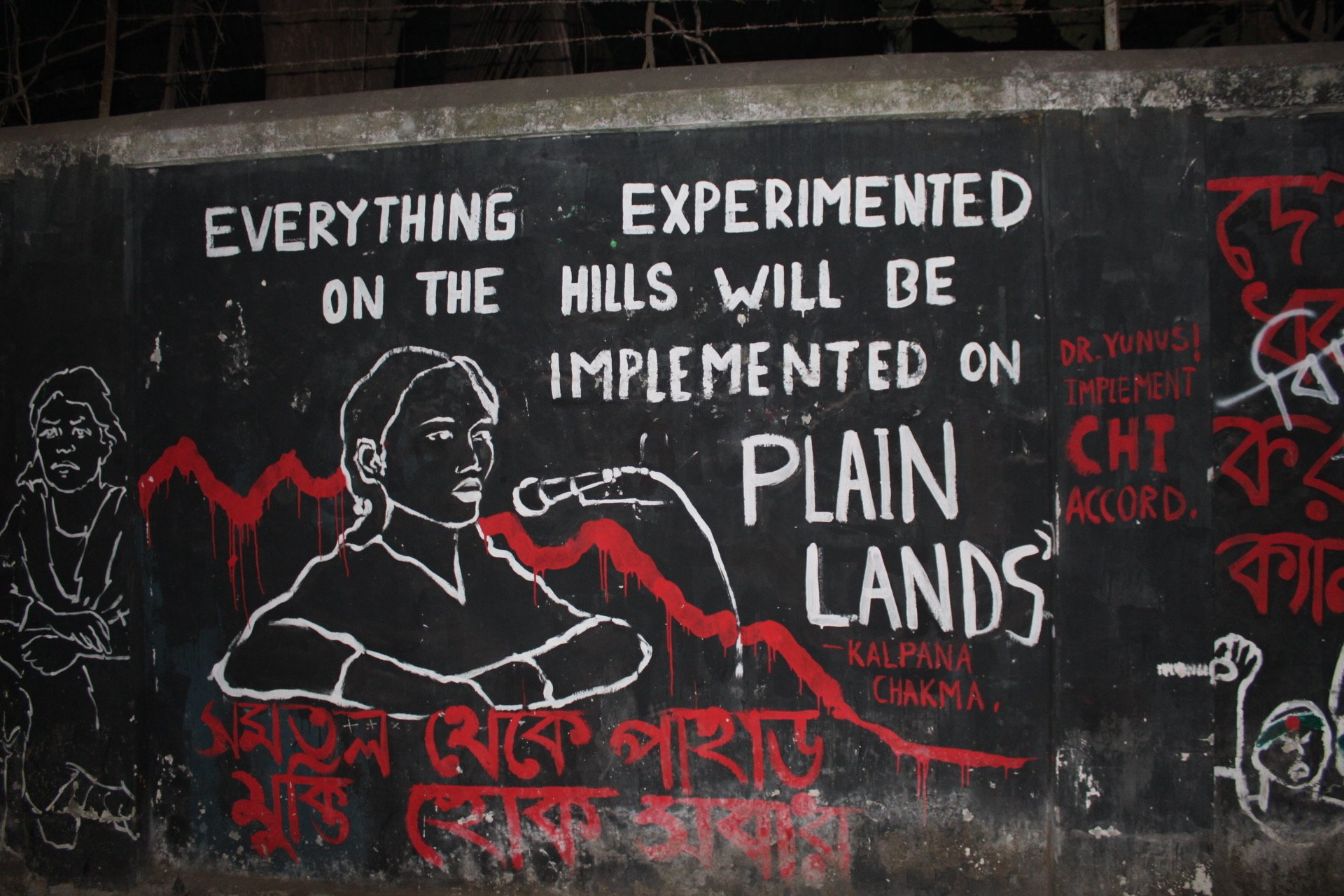
Graffiti depicting Kalpana Chakma near Dhaka University, January 2025. Image: author
From “Post-Conflict” Bangladesh to the Fall of Hasina
Within this context of ongoing settler-colonialism, political disillusionment and institutional paralysis, a second phase of insurgency began to coalesce, culminating in renewed armed activity in October 2022 led by the Kuki-Chin National Front (KNF). The KNF, which emerged in 2017, is a separatist group that seeks an autonomous region spanning parts of Bandarban and Rangamati for Kuki-Chin peoples, an umbrella term encompassing several smaller Adibashi communities, including the Bawms, an indigenous Christian community in the CHT. Rejecting the authority of the CHT Regional Council and District Councils, the KNF has instead called for the creation of an independent Kuki-Chin Territorial Council (KTC), with control over land administration, tourism, and a separate police force.
The state’s response to the KNF followed a familiar pattern, and between October 2022 and October 2024, more than 4,000 Bawms were displaced from their ancestral lands amid sweeping security operations carried out in the name of counterinsurgency. Framed as raids against the KNF, these operations disproportionately targeted civilian Bawm populations who were turned from civilians to suspected militants. The Hill Tracts continued to be governed through the logic of occupation, treated not as part of the nation, but as a frontier to be militarised and settled.
As Kalpana Chakma had warned decades earlier, this mode of governance did not remain confined to the Hills, and the techniques honed in the CHT—of surveillance, arbitrary detention, and extrajudicial violence—increasingly travelled to the plainlands. Under Sheikh Hasina’s government, enforced disappearances became a routine instrument of political control, with human rights groups estimating that at least 1,500 people were disappeared during her rule. Journalists were harassed, surveilled, detained, and physically assaulted. Dissent was criminalized through sweeping digital security laws, critics were jailed without charge or coerced into silence, and the increasing militarization and politicization of the police entrenched a pervasive culture of impunity.
By the summer of 2024, these accumulated abuses reached a breaking point. Public university students in Dhaka took to the streets to protest the regime’s manipulation of a government job quota system to reward political loyalists. What began as a student movement quickly spiralled into a mass uprising, culminating in the collapse of the Awami League government after fifteen years of increasingly autocratic rule. In the months that followed, Dhaka’s walls began to be filled with murals calling for pluralism and interfaith solidarity as the nation envisioned a new Bangladesh, rooted in ideas of inclusivity and belonging. For Adibashi communities, this graffiti portrayed an apparent crack in the walls of exclusion, hinting at the possibility of belonging to a country that had long denied them space in its imagination.
“Michael’s reappearance symbolised the immediate arrival of political hope and the sudden eruption of post-revolutionary optimism following the fall of a regime that many thought would never end.”
The experience of this sudden political transformation is epitomised by the story of Michael Chakma, a prominent Adibashi activist forcibly disappeared by the state in April 2019. After years of campaigning against military settlement and land seizures in the CHT, Michael had vanished into Bangladesh’s notorious military intelligence prison, Aynaghar, or the “House of Mirrors.” Presumed dead, Michael reappeared on 5 August 2024, just hours after Sheikh Hasina fled the country. “I returned to a Bangladesh full of hope,” Michael told me over the phone. “A new Bangladesh, a new independence, an environment full of hopes and dreams.” Michael’s reappearance symbolised the immediate arrival of political hope and the sudden eruption of post-revolutionary optimism following the fall of a regime that many thought would never end.
This optimism initially seemed to indicate a shift towards pluralism. An image incorporated into a national textbook pictured a new “Bangladesh 2.0,” made up of Muslims, Hindus, Christians, Buddhists, and Adibashis, and for the first time, Adibashi communities were formally invited to participate in Bengali New Year’s celebrations. Conversations about settler-colonialism began to enter mainstream conversations and indigenous communities, including the Bawm people, were brought into public rallies and national platforms.
Many of the Adibashi activists who played important roles in Hasina’s ouster decided to enter into the fold of representational politics. Alik Mree, a young leader from the Garo community, joined the National Citizen’s Party (NCP), a student-led political party formed in the aftermath of the uprising, becoming its only indigenous representative. Others participated in counterintuitive ways, with Sarba Mitra Chakma winning a seat in the Dhaka University Student Union elections as a candidate from the alliance led by Chaatra Shibir-led student alliance, the student wing of the Jamaat-e-Islami. Amidst criticisms that Shibir’s Islamist ideology was at odds with his identity, Sarba Mitra maintained that participation offered an important institutional platform from which indigenous concerns could still be articulated.
Yet this move towards inclusion unravelled almost as soon as it appeared. Rather than broadening notions of belonging, mob pressure narrowed it down further. Bengali nationalism reasserted itself with renewed ferocity, now fused with the demand for a singular Muslim Bengali identity. At the same time, resentment toward India, shaped by the Awami League’s perceived proximity to New Delhi, as well as long-standing grievances over border killings, trade imbalances, and water-sharing disputes, fed a widening rhetoric of wounded sovereignty that cast Adibashi political claims as security concerns, and Adibashi activists as potential proxies for Indian influence. Following protests by a student group, who argued the word “Adibashi” threatened national unity, it was removed from the aforementioned textbook. When Adibashi groups in Dhaka protested this removal, they were brutally attacked by right-wing nationalist groups, and several young activists were left injured.“The dream of a new Bangladesh is still a dream,” Michael Chakma reflected.
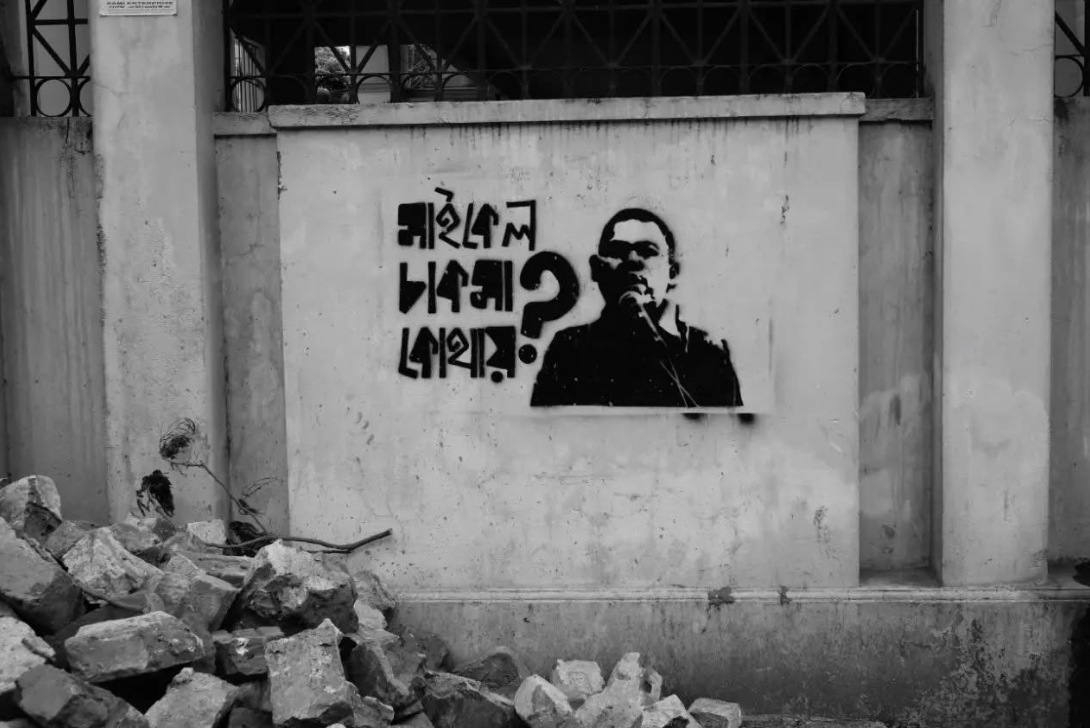
“Where is Michael Chakma.” Graffiti from 2022, two years before Michael’s re-appearance following Hasina’s overthrow. Source: Radical Graffiti Bangladesh
A Fading Optimism
For many Adibashi activists who had participated in the July Uprising, this backlash crystallised a growing sense of disillusionment. I spoke with Paddmini Chakma, an activist and photographer advocating for demilitarisation in the Hill Tracts, who recalls initially feeling hopeful that “long-suppressed voices were finally beginning to emerge.” However, that hope faded quickly as she came to assess the interim government’s approach to Adibashi rights as largely unchanged and exclusionary. “More broadly, the interim government has continued a pattern of symbolic inclusion without substantive representation,” she continued. One of the earliest indications of this was the appointment of an advisor for the CHT without any meaningful consultation with indigenous peoples or representatives from the region. Paddmini argued the selective visibility of indigenous groups reflected continuity with past governments, as indigenous presence is acknowledged symbolically while structural injustices persist.
Indeed, while state-sponsored celebrations of Bengali New Year showcased Adibashi communities as emblems of cultural diversity, the state’s old reflexes of repression, far from fading, remain deeply entrenched. In post-Hasina Bangladesh, military operations against the Bawm community, carried out in the name of raids against the Kuki-Chin National Front, continued unabated. A Netra News investigation found that since April 7th 2024, at least 22 civilians have been killed by the military, and nearly 200 Bawm civilians have been caught up in the campaign of state repression as cases filed under Hasina’s government continued seamlessly under the Interim Government. As Paddmini notes, Adibashi peoples were reduced to “cultural showcases rather than political subjects with rights and agency,” even as arbitrary detention, sexual violence, and prolonged imprisonment without trial persisted in the Hill Tracts.
I also spoke with Adit Dewan, a filmmaker and curator who has worked against the censorship of Adibashi communities. Reflecting on the outbreak of mob violence and vigilante justice in the post-uprising period, Adit describes the moment as one of rapid political reversal. “For a moment, I thought Bangladesh would move toward law and justice,” he said, “but this hope disappeared as bad governance and mob violence took lead.”
Adit highlights how mob violence quickly took a communal turn, as Adibashi groups were branded as “anti-state” by nationalist and pro-settler groups. In September 2024, only a month after Hasina’s ouster, 19 year old Anik Chakma was beaten to death in Rangamati, ironically while attending a protest against communal violence. A year later, in September 2025, Khagrachari, one of the three districts of the Hill Tracts, exploded in protests, strikes and roadblocks following the alleged gangrape of an Adibashi schoolgirl by a Bengali settler. Reactions to the outbreak of protests once again revealed the disproportionate and brutal nature of both state and settler responses. The state deployed several platoons of the Border Guard Bangladesh, and imposed Section 144, restricting public gatherings.
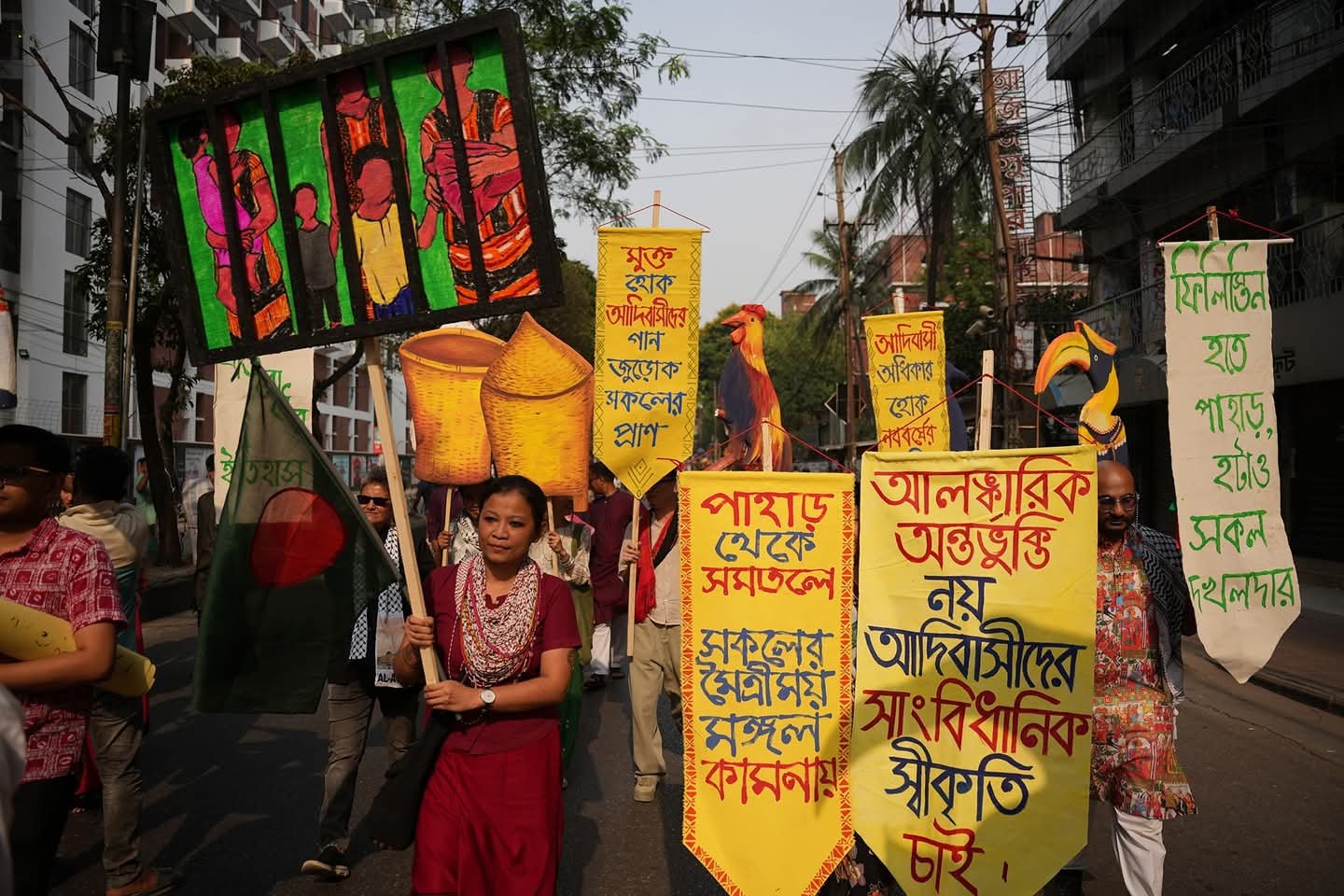
Adibashi activists call for constitutional recognition and an end to exploitation at Bengali New Year’s celebrations, January 2025. Image: Sayrat Salekin.
Meanwhile, Bengali settlers launched retaliatory attacks and killed two Adibashi men guarding a temple. Soldiers opened fire on protesters in Guimara, killing at least three people and injuring more than forty. Several homes and shops were also torched. The Home Advisor, Lt Gen Jahangir Alam Chowdhury, alleged that the violence in Khagrachari was being fuelled by a “vested quarter,” provoked by India or “fascist” groups. Such deflections only underline the government’s refusal to confront the anger born of militarisation, dispossession, and impunity in the Hill Tracts. Alik Mree resigned from the NCP in protest against the party’s silence over Khagrachari.
Ballot Box Politics
Nearly a year and a half after Sheikh Hasina’s fall, on February 12 2026, Bangladesh headed to the polls in its first genuinely competitive elections in seventeen years. Yet this long-awaited return to electoral politics unfolded amid a right-wing resurgence, as the centre-right BNP, in the absence of the Awami League, dominated the elections, competing against a coalition led by the Jamaat-e-Islami, a right-wing Islamist party. In a surprising move, the NCP joined this Islamist-led coalition, at the cost of 13 of its central leaders, including some of its most well-known women members who were unable to reconcile this partnership with their professed progressive commitments. With a rise in conservative, misogynist and anti-minority rhetoric, excitement about elections was accompanied by a growing anxiety that many social freedoms and protections could now be rolled back. The BNP, led by Tarique Rahman, heir to one of Bangladesh’s two main political dynasties, won a two-thirds majority, while Jamaat achieved its best performance in the country’s history, emerging as the main opposition party.
Adibashi activists approached the elections with particular caution. Both Adit Dewan and Paddmini Chakma expressed deep scepticism about what electoral change will mean for the Chittagong Hill Tracts. “I am not very hopeful,” Adit said. “Political parties are not talking about implementing the CHT Peace Accord. Instead, they want to ‘reassess’ it, which risks pushing Adibashi peoples out of the governance structure altogether. The parties also said nothing about constitutional recognition for indigenous communities.”
Protestors block a road in Khagrachari, September 2025. Source: The Daily Star
These concerns were compounded by the constitutional referendum scheduled alongside the parliamentary election. The referendum centred on the implementation of the ‘July Charter,’ drafted after the 2024 uprising, signed by most of the political parties active at the time, and framed as a blueprint for democratic reform and the prevention of future authoritarianism. Critics, however, warned that the referendum collapsed multiple, complex reforms into a single yes-or-no vote, denying citizens the opportunity to assess each of the 47 constitutional reform proposals on their own merit. The interim government further narrowed space for debate by presenting a “yes” vote as the only legitimate option, implying that dissent amounts to a rejection of reform itself, and worse, an endorsement or alignment with the fallen “fascist” forces.
“This feels less like justice and more like a strategic move to preserve existing structures of exclusion. It seems to partially recognise Indigenous demands while stripping away their political and social identity.”
For Paddmini, the referendum encapsulated a deeper problem. “The 2026 constitutional referendum feels confusing and deliberately vague,” she explained. “It talks about linguistic diversity, but it avoids explicitly recognising Indigenous peoples as Indigenous. Indigenous languages may be mentioned, but political subjectivity, land rights, and historical struggles are completely ignored.” The result, she argued, is not meaningful inclusion but a familiar pattern of containment.“This feels less like justice and more like a strategic move to preserve existing structures of exclusion. It seems to partially recognise Indigenous demands while stripping away their political and social identity.” Because of this, I have very little hope that the upcoming elections will bring real change for Indigenous peoples,” Paddmini told me in the week running up to the vote.
Ultimately, the July National Charter was approved by 60.26 percent of voters. Yet its endorsement did not translate into immediate constitutional transformation as the newly elected BNP MPs, joined by several independents, refused to take the second oath stipulated in the President’s Order that would have initiated the charter’s implementation, citing its lack of constitutional legitimacy. With more than two-thirds of MPs declining to take the oath, the implementation process has been paused, and it is unclear what will happen next.
The persistence of violence and exclusion in the CHT reveals the limits of political change in post-July Bangladesh. Regimes may fall, elections may return, and the language of reform may shift, but the deeper architecture of the state remains largely intact. The brief opening created by the July Uprising offered a glimpse of an alternative political imagination, but the rapid contraction of that space, marked by mob violence and right-wing resurgence, shows how fragile that imagination remains. Adibashi visibility has once again been tolerated only insofar as it does not challenge land, power, or sovereignty.
As Bangladesh emerges from a defining electoral moment, the CHT remains a litmus test for the country’s democratic claims. The struggle of Jumma people in the CHT for participation and inclusion is not a peripheral grievance but a mirror held up to the nation itself, reflecting the costs of a nationalism that continues to promote unity through erasure. To stand in solidarity with Adibashi voices is to challenge the homogenising narratives of language, culture, and identity that have defined the Bangladeshi nationalist project for over half a century, and to imagine a different kind of nation: one not built on erasure, but on recognition.
Laleh Bergman Hossain is a Bangladeshi-British writer and researcher interested in identity, politics and visual cultures across South Asia and the Middle East.