The Pakistani Left’s Middle Class Crisis
A history and class critique of the left’s positions on the India-Pakistan war in May 2025.
Composite illustration using web-sourced images. Illustration: Jamhoor
In an article published by Jamhoor, Muhammad Umar Ali and Dr. Syed Azeem exposed “deep ideological contradictions” in the Pakistani Left’s response to the brief India-Pakistan conflict in May 2025. They analyzed various positions of Leftist parties and criticized the stance of “unprincipled peace,” arguing that the primary contradiction should be Indian fascism and expansionism which presents a danger for the entire subcontinent. Therefore, the people of Pakistan should stand with the people of Nepal, Bangladesh and other countries of South Asia against Indian expansionism.
Here we offer a critique of this position. We also provide brief histories of the trajectories of some of the main left parties, paying special attention to how a middle-class political outlook has dominated left politics in Pakistan.
On a theoretical level, Ali and Dr. Azeem make two broad generalizations. The first puts Haqooq-e-Khalq Party and Awami Workers Party (Asim Sajjad Akhtar) under a single category of the ‘New Left’ pursuing Gramscian thought. While it is true that both parties share the rejection of Leninist and Maoist models of the past and emerge mostly from academia, in reality, they take opposing positions. The second generalization brackets the current major parties of the Pakistani Left—the Awami Workers Party (Akhter Hussain), Mazdoor Kisan Party (Taimur Rahman), Communist Party of Pakistan, and Tabqati Jeddojehad—into the “traditional Left.” Each of these parties is a combination of different tendencies. Today, their legacies are indecipherable due to recurring splits and mergers amongst various fractions, which will be discussed later in this article. These generalizations assume a continuous historical journey of different tendencies and parties, but the reality is different.
History and Continuity
In the late 1960s and early 1970s, radical movements across the globe witnessed a resurgence inspired by Mao Tse Tung thought and the 1980s and 1990s marked its decline. China had changed its position towards supporting revolutionary movements around the world. The Soviet Union also declined under Khrushchev’s revisionist political legacy. The Pakistani left, dependent on these two countries for its ideological and practical framework, witnessed a corresponding decline. With no organizational structure to consolidate and provide leadership (unlike the Left in Peru, India and Philippines), parties began losing their political character. Reduced to drawing room clubs, they started to merge for a chance at survival.
“The lack of practice-driven theory limits Dr. Azeem and Ali’s ambitions to find continuity of Maoism to theoretical juggling. In the absence of any rectification campaigns in these parties, Dr. Azeem and Ali’s approach lacks concrete analysis.”
Dr. Azeem and Ali dedicate a section on the evolution of the Maoist tendency fixated on the idea of “continuity and rupture.” There are several approaches to this concept, one used by Foucault and another by Althusser. Foucault's analysis is not dialectical. Althusser uses the concept to develop an “epistemic break” in Marx’s work, differentiating between Marx’s earlier and later works, rejecting the former. Dr. Azeem and Ali draw on J. Moufawad-Paul’s ideas instead. The latter blends different theorists to use continuity and rupture to study the development of Maoism. He understands Maoism as a continuity of Marxism-Leninism but also a rupture from its limitations. That is, when new problems emerge in struggle, the tendency does not completely break from the previous one. Rather, the tendency continues to build on some concepts while diverging from others to develop new concepts necessary for the evolution of struggle and further advancement of analysis.
Dr. Azeem and Ali follow this approach. While Moufawad-Paul draws his analysis from concrete practices of Maoists from China, Peru, India and others around the world, Dr. Azeem and Ali draw from a limited set of concrete practices. In terms of practice, there has been no development of Mao Tse Tung Thought in Pakistan towards Maoism. If anything, the trajectory of Maoist organizations—Mazdoor Kisan Party and National Students Federation—only indicates a shift towards modern revisionism and Dengism, which will be discussed in detail in the next section. The lack of practice-driven theory limits Dr. Azeem and Ali’s ambitions to find continuity of Maoism to theoretical juggling. In the absence of any rectification campaigns in these parties, Dr. Azeem and Ali’s approach lacks concrete analysis.
Pakistan Mazdoor Kisan Party
The authors are currently members of the Pakistan Mazdoor Kisan Party which is a broken faction of the Mazdoor Kisan Party established just before Bangladesh’s independence from Pakistan. The other faction claiming Mazdoor Kisan Party’s legacy is Taimur Rehman’s party. There is also a significant group in the Awami Workers Party (Akhter Hussain) led by Hamza Virk, which is also influenced by Mazdoor Kisan Party (Major Ishaq), as the Communist Mazdoor Kisan Party merged with National Workers Party in 2009 to form Workers Party Pakistan and then Awami Workers Party.
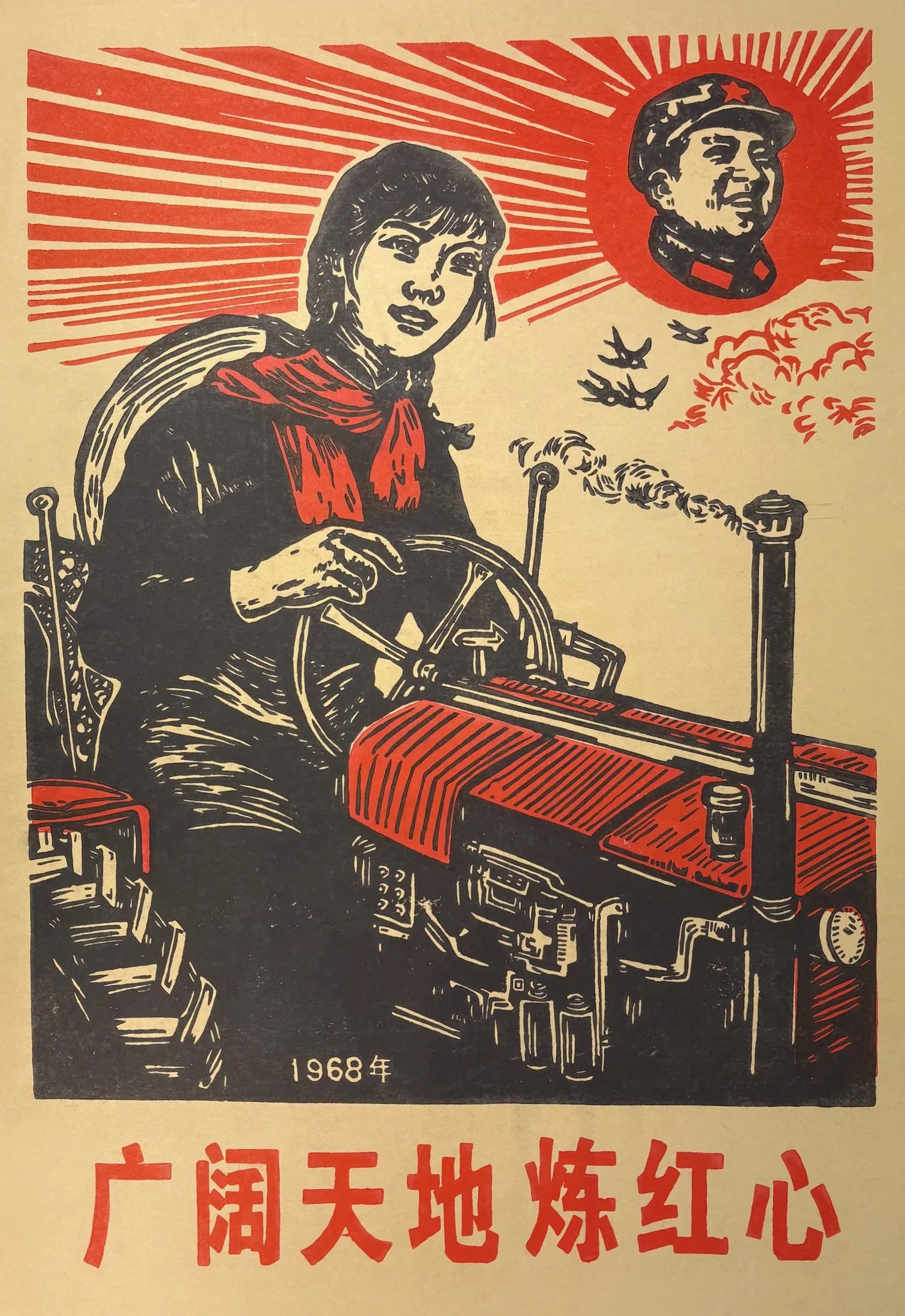
A Chinese Cultural Revolution poster which says, "In the vast world, forge a red heart.” from 1968.
“The authors correctly analyze the Hashtnagar Movement led by Mazdoor Kisan Party as one of the most important peasant movements in Pakistan. Yet, they do not closely analyze why the movement failed to become a powerful force like the Naxal movement which challenged the whole system.”
The authors argue that the Mazdoor Kisan Party, under the leadership of its founder and central ideologue Major Ishaq, was on the path to reach Maoism. But this is not what the party’s history suggests. Its steady decline and fractures experienced since 1979 are reflective of its revisionist trend and Punjab-centric politics. Despite initiating a merger with another Mao Tse Tung Thought group, the People’s Democratic Front, which was a mass front of National Students Federation, the merger failed to materialize, according to Hasan Alia, former President of National Students Federation (Rasheed Group). Mazdoor Kisan Party insisted that Nawaz Sharif was a national-capitalist, implying that the Pakistan Muslim League-Nawaz was an ally against imperialism. Mazdoor Kisan Party then merged with the Communist Party of Pakistan, the main pro-Soviet party, to form Communist Mazdoor Kisan Party, compromising their position on the USSR. As a result, Mazdoor Kisan Party submitted to the Communist Party of Pakistan’s political position that the Maoist tendency was incorrect in terming USSR a social imperialist power. Lastly, the Mazdoor Kisan Party has not produced a single document that criticizes Deng Xiaoping's policies.
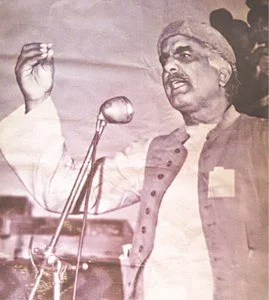
A rare photograph of Major Ishaq, founder of the Mazdoor Kisan Party. Image: Communist Mazdoor Kissan Party Pakistan, X
The authors correctly analyze the Hashtnagar Movement led by Mazdoor Kisan Party as one of the most important peasant movements in Pakistan. Yet, they do not closely analyze why the movement failed to become a powerful force like the Naxal movement which posed a challenge to the whole system. Furthermore, despite the huge success in Hashtnagar, Mazdoor Kisan Party failed to grow in Khyber Pakhtunkhwa as it did in Punjab to the point that it is now considered a Punjab-centric party within the Left, with no significant units and leaders outside Punjab, except the legacy of Hashtnagar. A more pertinent question is why the founding members of the party who led the Hashtnagar struggle ended up separating from Major Ishaq, eventually pursuing the politics of oppressed nationalities. Afzal Bangash formed Awami National Party with Wali Khan and Sher Ali Bacha formed Pakhtunkhwa Milli Awami Party with Mahmood Khan Achakzai. The lack of self-criticism of their party leads the authors to adopt two premises of Mazdoor Kisan Party (Ishaq) that result in incorrect conclusions.
Haqooq e Khalq Party
Haqooq e Khalq party’s leadership was initially primarily associated with the Trotskyist tendency within the Labour Party with the exception of some members who came from other tendencies. The leadership formed Awami Workers Party by merging with various leftist groups of different ideological orientations. Within 6 years, some of the leadership split from Awami Workers Party and abandoned party politics, under the influence of prefigurative thought, to concentrate on non-hierarchical movements while also being actively involved with national movements, particularly the Pashtun Tahaffuz Movement. They formed the Haqooq e Khalq Movement.
A large group of women at a Haqooq e Khalq meeting in Chungi, Lahore. Image: Geo.tv
Their turn to non-hierarchical movements and national movements was short-lived. They shifted towards constituency politics, particularly in the working class neighbourhood of Chungi in Lahore. The Haqooq e Khalq Movement was converted to a structured party, the Haqooq e Khalq Party. After experiencing an electoral defeat in 2024, their leader, Ammar Ali Jan reflected that they failed because the election became a referendum on Imran Khan such that the electorate voted on a national debate (which their party was not a part of) instead of local issues. They turned towards building a mainstream narrative of left within the masses through the media. They also moved towards traditional pro-Soviet politics inspired by Domenico Losurdo. At the 2025 Marxism Political School at the Irtiqa Institute in Karachi, Jan’s lecture defended Stalin and the current Chinese model with a hint of criticism of identity politics and the New Left school.
“The party’s prioritisation of social media can be seen to appeal to this class. In recent times, the same class, especially Gen Z, has reinvigorated anti-colonial and anti-imperial ideas because of the Palestine solidarity movement. ”
In the span of ten years, the incredible shifts in their political framework reflect an opportunism which emerges from an incoherent understanding of class and national composition. Today, their non-linear journey, from the Labour Party to the effort to create mainstream parties in alliance with Zulfiqar Ali Bhutto Junior or with Moshin Dawar fits within this pattern. Although Farooq Tariq and certain members of their group have remained consistently involved with the power-loom workers’ movement, bonded labour and the Okara peasant movement (using NGO funding), the party’s class composition and following are primarily based in the urban, upper middle class of central Punjab and to a much smaller extent from other urban centers.
Historically, the middle class is known for looking for short-cuts and quick successes, changing its ideology and politics and lending itself to political opportunism and careerism. If an organization fails to achieve celebrated wins in five years, they join another emerging movement. Social media activists also usually belong to this class. Another important facet of this class is that many of them are either settled or visiting western countries for economic or educational opportunities. This distance can create a patriotic imagination of the homeland whose national, racial and religious identity is under attack in the imperialist world. The party’s prioritisation of social media can be seen to appeal to this class. In recent times, the same class, especially Gen Z, has reinvigorated anti-colonial and anti-imperial ideas because of the Palestine solidarity movement. The brutality employed by Israel, on the one hand, helped them realize why imperialism is the principal contradiction in today’s world, but on the other hand, it resulted in feelings of powerlessness watching the genocide of the people of Gaza on a daily basis on their cell phones.
Amidst this, academics like Vijay Prashad, revisionist left parties like the Communist Party of India (Marxist) and social media platforms like Breakthrough News portray China as an anti-colonial socialist country, catering to the upper middle class’ new interest in China. Haqooq e Khalq Party’s political analysis of the India-Pakistan conflict through the lens of geopolitical competition between the US and China appeals to this section of the middle class, which is the party’s class base. Haqooq e Khalq Party provides a perfect thesis for them: US imperialism is supporting India to become an Israel-like state in the region, bullying all the neighbouring countries, including Pakistan, so that it can challenge China in the region.
Zulfiqar Ali Bhutto at a Haqooq e Khalq’s Khalq Youth Front’s protest for Palestine, August, 2025 in Karachi. Image: Haqooq e Khalq Party
Awami Workers Party (Aasim Sajjad Akhtar)
“Their predicament is that if the middle-class students of the peripheries force them to take national questions seriously, the urban upper-middle class limits the party from completely negating Pakistani identity. As such, they can neither completely ignore the national question within Pakistan nor take a radical line. ”
Awami Workers Party (Asim Sajjad Akhtar) includes different sections of the middle class from various regions: students and youth who belong to middle and lower sections of the middle class from Pakistan’s peripheries of Sindh, Balochistan, Khyber-Pakhtunkhwa, Gilgit Baltistan and Kashmir. It also includes professors, researchers, and development sector professionals from the urban upper middle class. They are not a homogeneous group as there are important leaders from a pro-Soviet tendency like Zahoor Sahab, Farman Sahab and Bakhshal Thallo, who also influence the party line. The Awami Workers Party and in particular Akhtar’s insight that industrial workers and peasants are not the primary classes for a revolution anymore comes from the conditions of the urban cities where the party has gained strength.
Aside from universities, Aasim has remained active in the katchi abaadis (informal settlements) of Islamabad with primarily urban semi-proletariat and lumpen classes. But even their role in the party was often subservient to the upper middle class, as evident by the 2018 elections contested by party, where Ammar Rashid and Ismat Shahjahan got the party tickets while their supporter base was comprised of residents of katchi abadis. Similarly, their second area of interest is Hyderabad and other smaller cities of Sindh, where they primarily concentrate on students, mostly coming from the middle and upper peasantry who are relatively better off than landless peasants and rural workers. Their contradiction with feudalism is not as sharp as that of the latter classes. They are primarily against corporate projects with some incorporation of nationalist and identity politics.
This party has struggled over the question of how to develop a politics which combines these tendencies: the pro-Soviet left, urban upper middle class, middle and lower sections of the rural middle class, the urban semi-proletariat and lumpen classes. Still, the party leadership has a strong urge to develop a middle class party, as evident from their consideration of a merger with Haqooq e Khalq Party despite disagreements on almost every political question.
Their predicament is that if the middle class students of the peripheries force them to take national questions seriously, the urban upper middle class limits the party from completely negating Pakistani identity. As such, they can neither completely ignore the national question within Pakistan nor take a radical line. Interestingly, the middle section of the middle class of the peripheries is usually also stuck between feelings resonating with the national oppression of their regions and job opportunities available in urban centers. This compels them to take a stance of a loose federation with more power to the national units and the concept of a decentralized party.
This political framework and arrangement is similar to the National Awami Party of the pro-Soviet left which disintegrated in the 1970s. The National Awami Party also acted as an umbrella under which both moderate nationalists, middle classes and socialists worked together under the pro-Soviet line, but was unable to provide anything meaningful to national struggles. Similarly, this political framework allows the domination of middle forces — a small national capitalist class, professionals, academics, and other middle class elements — over the formation of alliances, as was the case with the National Awami Party. Hence the Awami Workers Party’s (Aasim Sajjad Akhtar) over-emphasis on identity politics and climate issues. This Gramscian interpretation and framing includes all identities instead of taking class as the central subject, making the model acceptable for the urban upper middle class, particularly professors and researchers concerned with academic theories and research papers.
Although Ayyaz Malick usually has independent positions from the Awami Workers Party (Aasim Sajjad Akhtar) and class takes a central position in his analysis, Dr. Azeem and Ali accurately consider his recent article on the India-Pakistan conflict as Awami Workers Party’s line. Mallick’s criticism of the Haqooq e Khalq Party’s position and his analysis of the conflict and its relation to the national question in Pakistan was precise and informed more by a Maoist position than a Gramscian one. However, Awami Workers Party’s (Aasim Sajjad Akhtar), including Ayyaz, fall short due to their skepticism about the success of any national liberation movement or radical militant leftist struggle in Pakistan. Similarly, they do criticize the role of China in Balochistan but hesitate in declaring it a social imperialist country or even an exploitative power. Both these middle positions are reflective of the different middle classes they interact with, and the groups their politics depend on.
Gramsci’s concept of the historical bloc on which the Latin American countries built the concept of “pluri-national” becomes important for them. Pluri-nationalism means a political and legal framework to pacify the contradictions of various nations in a single country through autonomy and self-determination. Awami Workers Party’s Aasim Sajjad Akhtar and Dr. Ayyaz Mallick use the concept to justify their balance between two positions–– nationalism vs. liberation of oppressed nationalities. Pluri-national is an academic name for the politics of the National Awami Party. Similarly, their emphasis on democratic politics instead of a more radical one and their lack of recognition of the semi-feudal nature of the state reflects the approach of various urban and rural middle-class career-oriented sections within their party. In result, certain interpretations of Gramsci provide convenience to build political unity across differences.
Alia Amirali, leader of the Awami Workers Party (AWP), speaking to katchi abaadi residents protesting evictions in Islamabad in 2026. Image: Hum English.
Awami Workers Party (Akhter Hussain)
Awami Workers Party (Akhter Hussain) can neither be framed as Gramscian nor as the Traditional Left. Although it can be argued that many of its members emerged from pro-Soviet parties such as the Pakistan Socialist Party and the Communist League, a deeper analysis shows that those coming from the Socialist Party had long dissociated from their Marxist-Leninist past. Instead, they became more involved in democratic struggles and constitutional rights for peasants and workers. At the same time, they emphasized that the party was not only one of the mehnatkash (working class) but also of the mehnatkaar (professional classes), a position reflected in its leadership remaining in the hands of the upper-middle class.
The dominance of the upper-middle class and upper peasantry has historically remained strong within this group and predates the Awami Workers Party’s formation in 2012 and the formation of the Pakistan Socialist Party, when the group was still part of the pro-Peking Bhashani section of the National Awami Party. During the 1960s, strong Kisan committees existed in both wings of Pakistan and were associated with the National Awami Party. Around the time of the famous Toba Tek Singh conference of Maulana Bhashani, the Punjab Kisan Committee split between the Major Ishaq and Chaudhry Fateh Mohammad groups, a split that eventually led the former to convert their committees into the Mazdoor Kisan Party. The Major Ishaq group raised two key allegations: first, that landed classes were representing the Kisan committees; and second, that this class composition explained the deradicalization of the peasant movement. A close study of this group’s journey toward the Awami Workers Party suggests that both allegations had considerable merit.
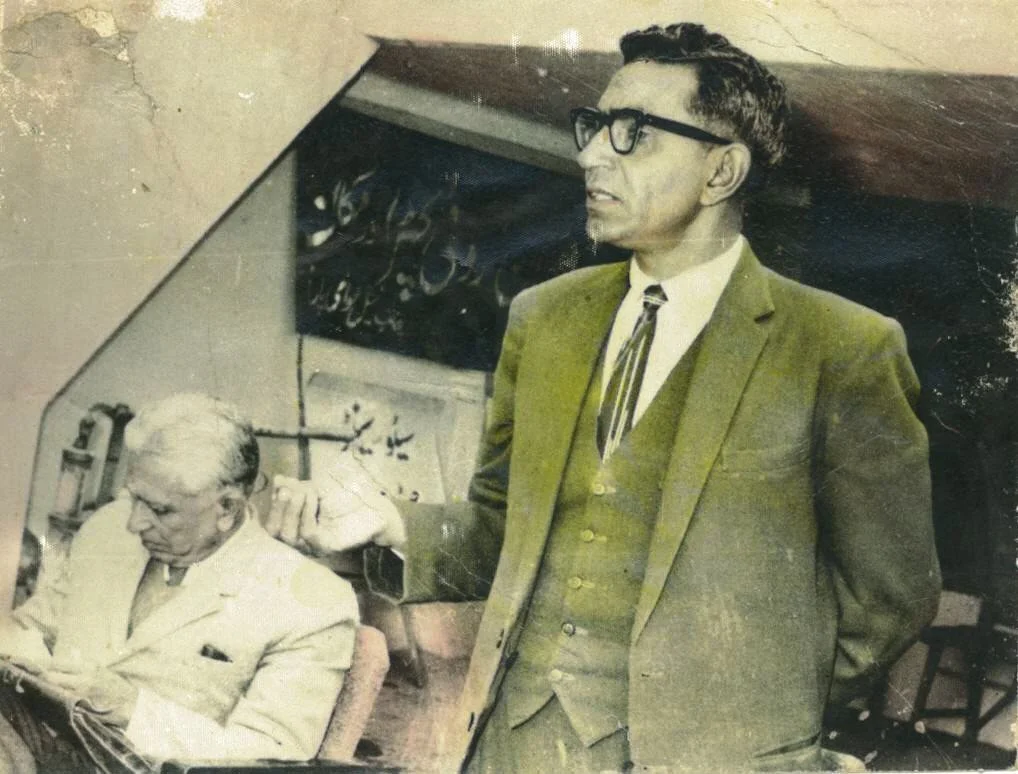
Chaudhry Fateh Mohammad addressing National Awami Party (NAP) meeting in Faisalabad in 1968. Image: Fatehm.com
The politics of this group continued to be deradicalized over time, shifting from affiliation with Bhashani’s pro-Peking “jalao ghirao” (siege and burn) politics to Khrushchev’s line of revolution through democratic means, and after 1989, toward parliamentary democracy, human rights, and social justice, replacing any notion of revolution. Subsequently, the group actively pursued a social-democratic approach by aligning with broad democratic and liberal forces. Even today, while the party’s practice remains social-democratic, it has begun identifying itself as Marxist-Leninist due to strong reactions from the lower strata of the party and the growing importance of remnants of the Mazdoor Kisan Party and National Students Federation within the Awami Workers Party (Akhter Hussain).
This section, consisting largely of former Mazdoor Kisan Party and National Students Federation members, follows a Dengist line and holds significant expectations from Xi Jinping. The majority of this group comes from middle-class backgrounds in Punjab and Karachi and harbors strong patriotic sentiments along with hostility toward national movements. There is also a populist section within the party comprising the Gujar community from Buner, who joined under Fanoos Gujar after he left mainstream parties due to caste-based discrimination against lower-caste Gujars. While this group had the potential to be radicalized, the party made no such effort. Instead, they were reduced to passive followers, with representation limited to the inclusion of Fanoos Gujar’s nephew, Usman Gujar, in the central committee. Overall, the party’s class and national base primarily consists of retired sections of the middle class from Punjab and Karachi.
Awami Workers Party (Akhter Hussain) is limited in its efforts to understand Pakistani society or develop a concrete political strategy. Following sour experiences with the New Left and nationalist factions within (the larger, pre-split) Awami Workers Party as well as the Women’s Democratic Front, it has turned Marxism-Leninism into a dogma, interpreted through its own revisionist framework. While the dominant section had long degenerated toward social democracy, the rise of China as a global power has prompted a renewed ideological shift in that direction.
A rally organized by AWP in Islamabad’s katchi abaadi. Image: All Pakistan Alliance for Kachi Abadis
The recent split between the Awami Workers Party’s Dr. Asim Sajjad Akhtar group and Akhter Hussain group was closely linked to questions of identity politics, particularly the national question. While the Dr. Asim Sajjar Akhtar group argues that environmental and other identity-based issues are equally significant as class contradictions in the party line, the Akhter Hussain group maintains that these questions are not even worthy of analysis, including from a class perspective. The similarity between Akhter Hussain group’s position on the current Pakistan–India conflict and that of Mazdoor Kisan Party (Taimur Rahman) reflects their shared class base. This is evident in the Awami Workers Party and Mazdoor Kisan Party (Taimur Rahman)’s statements on how both states should refrain from acting as proxies for imperialist powers and should cease terrorist activities against each other—blaming Baloch and Kashmiri militant groups—without any acknowledgment of the national oppression faced by the people of Kashmir and Balochistan.
Pakistan Mazdoor Kisan Party
“This thesis further reflects the class and national composition of the Mazdoor Kisan Party: a party attempting to organize lower-caste bonded laborers and landless peasants in Punjab while being led by the rural middle peasantry and urban middle class of the same region. ”
Dr. Azeem and Ali also attempted to create a rupture from their own tendency and party but as discussed earlier, no concrete analysis was provided regarding why the Hashtnagar movement stalled. Similarly, there was no critique of why the Mazdoor Kisan Party transformed into a left-wing party largely confined to Punjab. Above all, the discussion remained limited to the glorification of Major Ishaq, without offering a critical evaluation of his politics. Even when they acknowledge that the pro-Peking parties of West Pakistan failed to take correct positions on national questions, they do not identify the underlying causes and instead attribute this failure to the closeness between the Chinese and Pakistani states. If this explanation were sufficient, then Siraj Sikdar—the most radical Bengali Maoist leader—would logically have adopted a similar position. All this stems from Dr. Azeem’s idealist pursuit of continuity, evident in their subjective error in using two theses of Major Ishaq and the old Mazdoor Kisan Party, without critically analyzing their merit.
First, they rely on the thesis presented by Major Ishaq in his well-known book, Mashriqi Pakistan aur Punjab ka Almia (East Pakistan and the Dilemma of Punjab), which emphasizes the “differences between the civilizations that developed around the Indus River and those around the Ganges River,” suggesting the existence of two distinct cultural and economic histories. It is therefore unsurprising that many consider Major Ishaq a chauvinist, as this thesis not only justifies the division of the subcontinent into two dominions rather than multiple nation states but also reinforces the state narrative that East Pakistan separated for geographical and cultural reasons, rather than due to uneven development and severe national exploitation and discrimination imposed by the state. This also explains why figures such as Dr. Hamza Virk and Dr. Arfan Choudhry lectured activists of the Baloch liberation movement by arguing that Balochistan and Punjab share historic cultural and economic ties, and therefore there exists no basis for separation.
The second thesis of the earlier Maoist groups, with which Dr. Azeem and Ali attempt to establish continuity, is that the “material roots of the partition of India and Pakistan” lie in the “class and caste contradictions faced by the majority of Muslim masses in Punjab, East Bengal, and Sindh.” They further clarify what they mean by “masses” and their “contradictions” by stressing that these groups primarily consisted of small peasants, tenants, landless individuals, and scheduled caste members who were exploited by both British colonialism and landowning and money-lending Hindu upper castes, who were minorities in these regions. This represents an opportunist position and helps explain why the leadership of the pro-Peking left groups—particularly the Mazdoor Kisan Party—became increasingly confined to the middle class and middle peasantry of Punjab and Karachi. It also reinforces the narrative of Pakistan’s ruling classes and state on the national question by creating the impression that the subcontinent was marked by genuine communal contradictions at the lowest levels of society, and that Pakistan emerged not as a product of British colonial interests and allied Hindu and Muslim elites, but as a savior of Muslim masses. This thesis further reflects the class and national composition of the Mazdoor Kisan Party: a party attempting to organize lower-caste bonded laborers and landless peasants in Punjab while being led by the rural middle peasantry and urban middle class of the same region. This is not only an ideologically and politically incorrect line, but also factually inconsistent.
One can take the case of Sindh to test whether this thesis truly explains the material roots of partition or merely reflects the Punjabi subjectivism of a middle-class and middle-peasant leadership. There is no doubt that religion and caste were closely linked to class composition in Sindh; however, while the urban merchant and money-lending classes were largely Hindu, the landowning and feudal classes were predominantly Muslim. In fact, it was precisely the contradiction between these two classes that created the conditions which enabled British colonial forces to invade Sindh and annex it to the Bombay Presidency.
Similarly, for centuries the Sayeds or Shahs have occupied the highest caste status in Sindh, a reality reflected in the poetry and texts produced during the Talpur era. Although the Talpurs ruled Sindh politically, real prestige and social authority remained with the Sayeds. Moreover, the early development of Sindhi nationality is often attributed to Hindus, due to the emergence of merchant and small industrial capitalist classes among them and their role in urban development. It was these forces that first demanded the separation of Sindh from the Bombay Presidency. The Muslim League, at that time, had no real standing against the Sindh United Party, just as it lacked influence in Punjab against the Unionist Party. At the mass level, the situation was even weaker: despite persuading the Muslim feudal leadership of the Sindh United Party to join the Muslim League, the latter failed to secure popular support. As G. M. Syed acknowledged in Sindh Jo Muqaddamo (The Case for Sindh), the orchestration of the Manzilgah Masjid riots was essential for the Muslim League to generate even minimal mass backing.
These historical facts, combined with the religious harmony still exhibited by the masses in Sindh today—despite the continued exploitation and oppression of Hindus and lower castes by feudal and other Muslim ruling classes—and the strong current of Sindhi nationalism accompanied by deep resentment toward Punjab’s ruling classes, suggest that both theses advanced by the old Mazdoor Kisan Party and related Maoist groups reflect a tendency to find empirical evidence in support of the patriotic line instead of thorough and deep analysis. They reflect how even progressive sections of the Punjabi middle class and middle peasantry tail the Punjabi ruling classes and the Pakistani state. This tendency is further illustrated by the recent shift of a former NSF president, Akhter Rohella, toward Mohajir chauvinist politics, where he employs the same thesis to mock Sindhi nationalists by claiming that without Mohajir advocacy for Pakistan, Sindhi Muslims would have remained under Hindu moneylenders
These theses inevitably lead Dr. Azeem and Ali toward Dr. Ammar’s position. While they do not openly endorse Pakistan’s ruling classes, their dismissal of left-wing calls opposing the war—calls urging the people of India and Pakistan to struggle against their own fascist and authoritarian states—as “unprincipled peace” effectively masks the same political stance. The primary difference lies in their theoretical affiliation with Maoism, which prevents them from framing the conflict within the context of a new Cold War between an imperialist United States and a “socialist” or “anti-colonial” China.
Their position ultimately rests on the assertion that India and Pakistan are not comparable, and that the left must “stand in genuine solidarity with the militant struggles of Adivasis, Dalits, and Kashmiris within India, as well as the regional victims of its expansionism, including the Nepalese, Bengali, and Sri Lankan peoples, against the Brahmanical Hindutva fascist state, its imperialist backers, and the ruling classes throughout the region.” We fully agree with the call to stand with all oppressed sections fighting the fascist and expansionist Indian state. However, the unresolved question is how the authors differentiate these struggles from those of Baloch, Pashtuns, Sindhis, Hazaras, Shias, Ahmadis, Kashmiris, and other oppressed groups within Pakistan, as well as the victims of Pakistan’s regional expansionism in Afghanistan, under an authoritarian Sunni Islamic state backed by imperialist forces.
Conclusion
“[A]lthough we have discussed middle-class errors of certain parties in Pakistan, almost all the leftwing parties and groups, including Karachi Bachao Tehreek, are grappling with the issue of such errors. ”
While Dr. Azeem and Ali’s article is helpful in tracing historical debates, their conclusion was reduced to a simplified analysis. They failed to correctly identify the historical contradictions leading to the partition; central for understanding the current conflict. They used selective empiricism to justify the creation of Pakistan. The problem lies in the ultra-academic approach taken by Dr. Azeem and Ali. They emphasize the historical evolution of the trends, portraying their fixation with the under-explored concept of “continuity and rupture” which they followed rather dogmatically instead of analyzing the concrete practices, actions and class forces within the parties and groups. This led the focus of the article towards finding continuities while ignoring the ruptures on a practical level.
They also ignored the failure of Mazdoor Kisan Party to conduct any thorough rectification campaign within the party to concretely change its direction. Their broad theoretical generalizations, reflective of their dogmatic and over-theoretical approach, led to an incorrect critique, insufficient for understanding the historical failure of their own party, let alone the Left’s various positions.
Here it is worthwhile mentioning that although we have discussed middle-class errors of certain parties in Pakistan, almost all the leftwing parties and groups, including Karachi Bachao Tehreek, are grappling with the issue of such errors. Either they tilt towards the empiricist practice, with a focus only on contemporary and immediate issues, creating a centric politic, deradicalizing themselves–shifting from class politics towards identity politics–– or moving towards dogmatism; which results in rejecting national and other identity questions, generalizing very different trends, avoiding concrete analysis and framing everything in the realm of theory. One more evidence of this middle-class subjectivism is the fact that almost all the leadership of the leftwing parties, whether emphasizing the importance of the rural or not, remains and grounds their politics in urban centers, particularly amongst university students.
Within every organization, there is an ongoing struggle between middle-class and working-class lines and currently the former is dominating the parties. This struggle will persist, and the principles of the mass line and two-line struggle will remain essential tools for all left-wing organizations seeking to combat bourgeois and middle-class influences within their ranks. It is only through criticism and self-criticism, and concrete rectification campaigns the Left can analyze strategic and theoretical frameworks and evolve in our approach to truly organize the masses.
Aisha Tahir is a documentary filmmaker based in New York City.
Khurram Ali is the convener of Karachi Bachao Tehreek and previously served as the Central Organizer of the National Students Federation.