Babri After Babri: The ‘Disputed Sites’ Playbook
How a seemingly banal ‘legal’ tool enables the destruction of Muslim spaces across India.
Everyone – except for its perpetrators and benefactors, of course – acted shocked and surprised to have witnessed the destruction of Babri Masjid on December 6th, 1992. It was as if the violent, bloodthirsty mob, had come from nowhere, acted without directions, and demolished a monumental mosque without a plan or infrastructure. We were told there was no lead-up to the murder of Babri. It only had an aftermath – one we must reconcile with and be ready for more, at Kashi and Mathura. With the courts acquitting all 32 accused of the destruction, the mob has also now vanished. To borrow a Bollywood title, no one demolished Babri.
“The mob-led destruction of the 16th century mosque was obviously not without a plan”
However, the destruction of the 16th century mosque was, obviously, not without a plan. Courageous truth tellers like AG Noorani have provided enough investigative and educational material detailing the preparations undertaken. We have evidence of rehearsals before the event, and confessions in its aftermath. Some were immediate, in the many pictures taken by photographers Praveen Jain and Raghu Rai, and some retrospective. The latest comes from former Chief Justice of India, DY Chandrachud (who wrote the land off to the Hindus in 2019) that he considers the construction of the mosque itself, under the Mughal ruler Babar in 1527, as “the fundamental act of desecration.” For the much-admired judge, the modern-era myth of a Ram temple preceding the mosque stands as legal truth, while the material presence of the medieval mosque symbolises invasive sacrilege.
But I want to draw the reader’s attention to something institutional, something seemingly banal, something that in the noise of Hindu nationalism has escaped our cognition. The former prime minister, Rajiv Gandhi is credited (or blamed, depending on your political inclinations) for opening the doors of Babri Masjid in 1986 and rekindling the desires of its destruction. In her book ‘How Prime Ministers Decide,’ Neerja Choudhury writes that this was his bid for a few last gasps before the setting of his own political sun. Hindus were angry at Rajiv Gandhi’s handling of the Shah Bano case and he responded by opening the locks of Babri Masjid. But lurking in the legalese surrounding Babri and its aftermath, is a term, a juridical category called ‘disputed sites’, which in fact sowed the seeds of Babri’s destruction nearly four decades before Rajiv Gandhi’s desperate act.
The 16th century Babri Mosque was destroyed by a Hindu mob in 1992, a major flashpoint of Hindutva attacks on India’s Muslim minority. Source: BBC News
The Babri Playbook
In 2024, Vishnu Shanker – a lawyer infamous for replaying the Babri playbook at Gyanvapi Mosque in Varanasi and Shahi Eidgah in Mathura – filed yet another plea in a court in Sambhal, Uttar Pradesh. His target was the Shahi Jama Masjid in the north Indian town, a mosque hitherto known only to locals or Mughal history enthusiasts. He claimed, following the cliché, that this 16th century mosque was also built over an ancient temple, one dedicated to Lord Kalki.
The courts responded as if following a well-known script, and ordered the Archaeological Survey of India (ASI) to survey the mosque, in flagrant violation of the Places of Worship Act 1991. The Act prohibits the conversion of any place of worship and mandates that the religious character of each place must be maintained as it was on August 15, 1947. It aims to preserve communal harmony by freezing the status of religious sites, including temples, mosques, churches, and gurdwaras, and by ending all pending legal disputes over their conversion. The local Muslim community opposed the survey. Their protests were met with violence and five people were killed. Several others, all Muslims, were later arrested under draconian terrorism-related laws.
The case went on and was challenged in the Allahabad High Court – the state’s highest court. In March 2025, the court classified the mosque as ‘disputed site,’ and ordered a sign marking it as such to be pasted on the mosque compound’s wall. Four months later, on July 3rd, a plea filed in Chandausi Court in Uttar Pradesh asked for a ban on namaaz being offered in the Sambhal mosque. It argued that a disputed structure cannot be considered a mosque and hence cannot be used to offer namaz or any other Islamic practice.
The category of disputed site or structure is a hauntingly familiar one in India’s history of violence on Muslims. It demands a critical examination of this seemingly banal jurisprudence. The rhetoric surrounding Babri Masjid, too, claimed that Muslims should not pray there because Islam does not allow namaz at a disputed site. What was missed was the question: Who declared it a disputed site, and why should we accept it as such?
Gyanvapi Mosque in Varanasi, now also declared disputed by the courts and cordoned off. Source: Reuters
Arbitrary Law, Hindutva Power
What makes a site disputed is unclear and the process by which a mosque is declared ‘disputed’ is legally baseless. It has arbitrariness built into it and arbitrary law, as Edmund Burke reminds us, is no law at all.
In a rather easy exposé of the Babri playbook and as something of an admission of guilt, those demanding that the Sambhal mosque be declared disputed used Babri to legitimise their claims. They argued that this change of status is “…a legal process”. There is, however, no provision in Indian law that allows a property to be declared disputed merely on a claim without documentary evidence like land deeds or proofs of inheritance or purchase.
“There was no documentary evidence, and therefore, no legal process, doctrine or precedence that justified declaring Babri as disputed in 1949”
In the case of Babri too, there was no documentary evidence, and therefore, no legal process, doctrine or precedence that justified its declaration as disputed in 1949. The Babri Masjid case was a title suit; the Muslim plaintiffs had documentary evidence dating back to the mosque’s construction, while the Hindu plaintiffs had no such documents, only myths. Myths of a temple at the site of Ram’s birth, with ASI’s BB Lal, a long time Sangh affiliate, standing in as expert archaeologist, and a supposed miracle. On December 23rd, 1949, Babri was declared disputed after some Hindu priests allegedly placed idols in the mosque and claimed their appearance as miraculous. It was this mischief, and not a law, documentary claim, or established jurisprudential tradition that led to the mosque being declared disputed. An act that would otherwise count as public threat, desecration and crime under India’s penal code, became the grounds for recasting Babri Masjid as disputed property.
The legal sanction of disputed-ness that follows the precedence of Babri is not only deeply flawed but also dangerous. It admits that the power of Hindutva means it needs nothing to validate its claims – it is its own claimant, judge, and jury. When the courts saw that the ‘miraculous appearance’ of idols can threaten peace and instigate violence, they quickly declared the mosque disputed, possibly to pacify the raging emotions that those who placed the idols in the mosque had themselves created. This rationale legitimizes manipulation of the legal system using threat of public violence – something no scholar of law anywhere in the world would condone. Babri was declared disputed not because there was some legally maintainable property dispute, but because not doing so would have invited large scale violence. There was a threat of the skies falling, and therefore, justice was denied.
Criminal Mosques
The term ‘disputed site’ enables violence. It is therefore nefarious to present this term as banal legal procedure (as Vishnu Shanker recently did), or an artefact of legalese, harmless nomenclature or judicial tradition. It is crucial to recognise how the term enables religious dispossession and the criminalization of Muslim spaces.
For a mosque to become disputed, it is first stripped of its religious status as a mosque, at least in part, and then constructed as a site of securitization, as a threat to peace and order. The mosque becomes a site of suspicion, where conspiracies, not prayer, are performed, and where theft and violence, and not heavenly redemption and peace, are sought. All sections of modern society – the police, courts, citizenry and media – look at mosques as security threats in general. The term disputed sites offers legal validation to this gaze.
Similar to Babri and Sambhal, Gyanvapi Masjid has been cordoned off, though namaaz is still being held in a highly securitised and tense environment. Any photography around the mosque is prohibited unless ordered by the court. The Sambhal mosque’s management has lost autonomy over its functioning and was forced to seek the court’s permission to decorate it for Eid. The mere act of decorating – an expression of joy and celebration – came to be seen as suspicious, and potentially malicious. They were also denied permission to whitewash the mosque for Eid, with the courts asking the ASI to do it instead. The ASI obliged, lest Muslims do something to invalidate the department’s eventual legitimization of a Hindu past buried under the mosque.
Crucially, however in both Babri and Sambhal, Hindu claimants appealed that under their constitutional right to the freedom of religious practice, they must be allowed to perform puja on the mosque site. Some kept idols inside Babri Masjid to do so and finally achieved a large temple there. In other cases, such as at Gyanvapi, the courts have designated spaces within the mosque property for Hindu rituals. The appeal of Hindus to the freedom of religious practice became the pathway to stop Muslims from practicing theirs. While Hindus invoked their constitutional rights, those of Muslims were undermined.
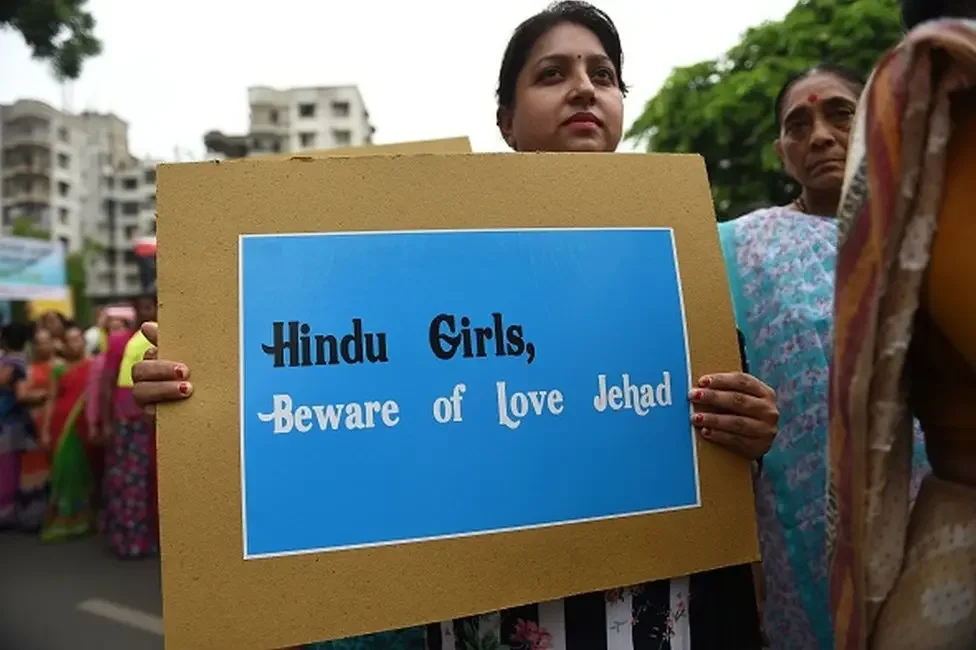
A poster against ‘Love Jihad’ at a protest in Ahmedabad in 2018. Source: BBC News
Muslim Life as Crime
“It is the desire of Hindutva to dig under Islamic architecture until a shard can be found to construct a history and project a violent future”
The apparent neutrality of the term ‘disputed sites’ obfuscates reality and projects a lie. It gives the false impression that conflict over religious sites is commonplace and equally prevalent in India’s various religious communities. That every religious community is fighting every other community over religious sites. In reality, these attacks are launched exclusively by the coalition of Hindutva and only on Muslims. Attacks on architectural heritage are unilaterally committed by Hindutva and the dispossession and criminalization that follows is exclusively that of Muslims.
It is the desire of Hindutva to dig under Islamic architecture until a shard can be found to construct a history and project a violent future. No temple has been dug under by the ASI to “ascertain” – as our former Chief Justice suggested – its “true religious character.” Even though many Hindu temples were built atop Buddhist and Jain shrines, as documented by historian DN Jha in ‘Against the Grain: Notes on Identity, Intolerance and History,’ and admitted by Swami Vivekananda himself. Following other fascist regimes in the history of the modern world, Hindutva uses archaeology as a vehicle of destruction, dispossession, and criminalization of the nation-state’s other – the Muslims. Just like the terms ‘communal violence’ or ‘riots,’ hide the reality of unilateral violence on Muslims and assign equal damage and power to ‘both sides,’ the term ‘disputed site’ presents a dangerously false picture.
“It is the animating fantasy of the Sangh Parivar that the country can be made whole only when a fifth of its population is rendered perpetually provisional, a suspect community on probation in a homeland...”
The destruction of Islamic heritage (both architectural and cultural) in India is located within the wider criminalization of Muslims. This year’s Eid was the most explicitly criminalized in our times. The state warned Muslims that praying on the road would result in their passports and driving licenses being revoked, even though religious and wedding processions are routinely assigned space on roads in India, and large gatherings such as Eid prayers often spill into the streets given space constraints in mosques. While such orders criminalize Muslim prayer, other rife conspiracy theories such as “Love Jihad” criminalize love between Muslims and Hindus, “Land Jihad” criminalizes Muslim housing, “Vote Jihad” criminalizes Muslim franchise, and Spit Jihad criminalizes Muslim business.
The criminalization of Muslims is not a by‑product of Hindu nationalism but its organizing principle. It is the animating fantasy of the Sangh Parivar that the country can be made whole only when a fifth of its population is rendered perpetually provisional, a suspect community on probation in a homeland that claims to pre‑date their very existence. The RSS ideal, dressed up as “cultural nationalism,” is in fact a textbook case of ethno-supremacy by instalments. It insists that India is not merely a state but a civilizational organism whose true self is Hindu, into which Muslims may be tolerated only as penitent guests. Their historical presence – as merchants and monarchs – is recast as occupation; their monuments – mosques, mausoleums, and markets – as scars; their political claims – equal franchise, right to the city, and natural justice – as insolence; and their social life – to love, to eat, and to pray – as conspiracy. Once this metaphysics is granted, every Muslim demand for equality appears as a kind of lèse‑majesté against the majority faith, a standing insult that must be policed.
India’s Muslims face widespread and deadly violence from Hindutva mobs and vigilantes. Source: scroll.in
The genius of the RSS‑BJP project is to fuse private vandalism and intimidation with public law. Vigilante mobs, piously devoted to bovine welfare, perform the rough work of killing, while the state murmurs about “law and order” and then remembers, conveniently, to charge the victims. The grammar of Muslim criminalization is routinised to such a degree that in a self-proclaimed secular democracy, discrimination in citizenship can be justified as an act of historical correction or, more ironically, of amnesty. Architecture suffers a similar fate. Courts, for their part, learn to speak a new dialect in which the demolition of a mosque can be solemnly rewarded with a temple, vandalism is celebrated as redemption, and segregation of neighbourhoods by law articulated as maintaining peace. A secular constitution is thus hollowed out from within, not torn up but quietly re‑annotated in saffron ink.
Hindu supremacist politics in contemporary India has not merely vilified Muslims; it has reconfigured them as a problem to be managed, spatially and legally, within the imagined Hindu nation. This is not only a matter of speech acts and laws, but of how neighbourhoods are (re)mapped, how streets are patrolled, how ruins and new monuments are made to speak. The criminalization of Muslims unfolds, in other words, as a project of remaking the city and the polity at the same time.
Islamic architecture shares a dialectic relationship with the Muslim citizen. The space and its inhabitants, are both made into a threat. The use of spurious legal tools like ‘disputed sites’ constitutes the mechanics of this dialectic of criminalisation. To term a mosque disputed and brand it on its walls is a blatant act of criminalization that opens the path towards destruction and dispossession. In the process, it builds the image of the Muslim in India – an image rendered suspect through, and in, space and form. The arrest of the mosque committee in Sambhal is thus the expected outcome of the grammar of criminalisation.
Scrutinising the Banal
It is tragic that our appeals against Hindutva aggression on mosques are still stuck in the trap of evidence. There is enough archaeological literature to show that firstly, the Indo-Gangetic plains have created layers upon layers of multi-cultural archaeological evidence over time that cannot be classified as Hindu or Muslim. Secondly, that fragments found underground can be interpreted by organizations such as the ASI to meet statist ends. We have, as collective opposition, failed to understand the attack on Islamic architecture within the larger paradigm of Muslim criminalization in India.
A new direction of thinking would demand a closer scrutiny of the banal – of legal processes that displace and attack architecture years before its actual vandalism. The dialectic between the Muslim body and Muslim space, and their relationship with law and its banalities, needs closer scrutiny. We need rigorous critique of architectural historiography as well as the contemporary meanings of monuments and ruins. An investigation into legal categories like ‘disputed sites’ is a beginning in this direction.
The legal scholar Robert Cover famously wrote, “Legal interpretation takes place in a field of pain and death.” Learning from Babri and Sambhal, where malicious agendas are disguised as procedure, where nefarious acts are validated as miracles, and where violence holds the course of justice hostage, we might add to Cover’s warning and say that jurisprudence, terminology, and legal semantics also play out in the field of pain and death. Unlike a poem or a novel that can be variously interpreted, there are greater stakes when laws are read, written or used arbitrarily – or worse, through an overtly supremacist lens. Instead of legitimising the term ‘disputed site,’ and enabling its use to displace and demolish mosques, there is only one action that courts in India must follow – reject such claims with heavy penalties.
To remind ourselves of Hannah Arendt, it is here, in the banality of the state’s actions and legal semantics, in actions and things that become everyday legal procedures and language, that we find the most horrifying technologies of violence.
Fahad Zuberi is a doctoral scholar in Architectural History, Theory and Criticism at MIT. His research is located at the intersection of architecture and violence.